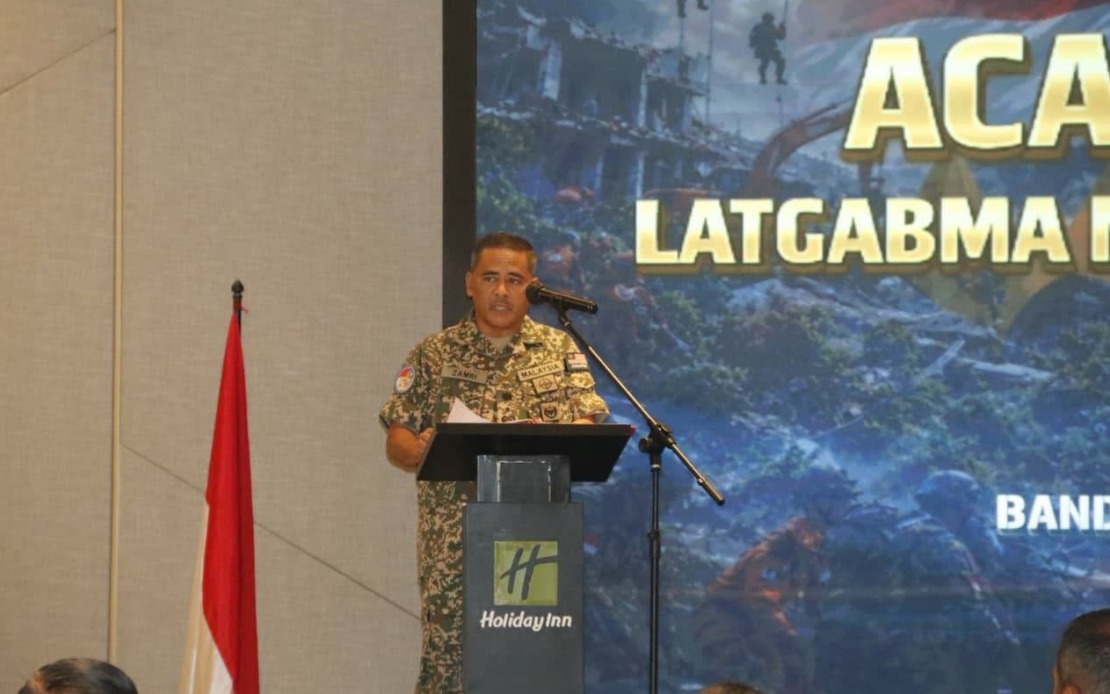
Malaysia and Indonesia have reinforced their strategic military partnership through a comprehensive 13-day joint exercise spanning land, sea and air operations in Lampung, Sumatra. The exercise, designated LATGABMA MALINDO DARSASA 12AB/2026, represents a significant demonstration of the defence cooperation between the two Southeast Asian neighbours, drawing together 719 personnel from multiple agencies across both nations. Conducted under the auspices of Malaysia's Joint Forces Headquarters at Al-Sultan Abdullah Camp, the operation reflects the deepening institutional bonds between the Malaysian Armed Forces (MAF) and Indonesia's National Armed Forces (TNI).
According to Brigadier General Datuk Zamri Othman, Commander of the 1st Infantry Brigade and chief of the MAF Exercise Planning Group, this undertaking transcends routine military training protocols. Instead, it serves as a tangible expression of the longstanding fraternal relationship and strategic confidence that characterises Malaysia-Indonesia defence relations. The exercise framework encompasses far more than conventional combat simulations; it functions as a practical mechanism for military personnel from both countries to deepen their familiarity with shared operational procedures, standardise tactical responses, and foster the interpersonal trust essential for effective multinational coordination during genuine crises.
The regional security landscape has evolved considerably in recent years, creating compulsions for enhanced bilateral cooperation. Contemporary threats extending beyond traditional military confrontation now encompass maritime piracy, transnational smuggling networks, organised terrorism, state-sponsored cyber operations, and unpredictable natural disasters. Both Malaysia and Indonesia, as major regional maritime powers with extensive economic zones and vulnerable coastlines, face identical vulnerabilities across these domains. By coordinating training initiatives and sharing operational expertise, the two nations amplify their respective capacities to address these multifaceted challenges while simultaneously reducing the friction and miscommunication that could otherwise undermine regional stability.
The LATGABMA MALINDO DARSASA programme boasts a substantial institutional pedigree, having operated continuously since 1984 through the General Border Committee and the Malaysia-Indonesia Joint Training Committee. The exercise rotates between host nations on a triennial cycle, with the previous iteration conducted in Pekan, Pahang in 2023 under an anti-terrorism operational framework. This institutional continuity demonstrates the commitment both governments maintain toward systematic military relationship-building, transcending the fluctuations of political leadership or temporary diplomatic tensions.
The decision to position the current exercise in Bandar Lampung was deliberately strategic rather than arbitrary. Lampung Province's geographical location at the confluence of three active tectonic plate boundaries renders it extraordinarily vulnerable to seismic events and resulting tsunamis, making it an authentically challenging training environment for humanitarian response scenarios. The exercise design deliberately incorporates realistic disaster simulation elements derived from Indonesia's harrowing experiences with major earthquakes and tsunami events throughout southern Sumatra, thereby grounding the training in genuine operational conditions rather than theoretical scenarios disconnected from actual regional hazards.
The exercise curriculum divides into two complementary learning phases: an academic staff exercise addressing conceptual and procedural dimensions, followed by practical field training. The staff exercise confronts participants with ten distinct operational scenarios spanning the complete disaster response lifecycle. These scenarios encompass immediate post-disaster emergency protocols, handling mass casualty situations, responding to structural infrastructure collapse, managing medical emergencies, coordinating international assistance mechanisms, defending against cyber attacks targeting critical systems, managing information environment warfare, executing population evacuations, stabilising affected areas, and facilitating transition to recovery phases. This comprehensive scenario architecture compels participants to consider disaster response not as isolated tactical episodes but as interconnected phases requiring evolving strategic adjustments.
The field training component emphasises integrated force operations involving MAF personnel, TNI counterparts, and specialist Indonesian agencies including the National Search and Rescue Agency (BASARNAS), the Disaster Preparedness Cadets (TAGANA), the Indonesian Red Cross (PMI), and regional disaster management authorities. Personnel engage in practical skill development spanning technical rescue operations such as rope techniques and rappelling, emergency medical response procedures, and field hospital establishment and management. This integrated approach ensures that Malaysian forces gain exposure to Indonesian disaster management systems and protocols, while Indonesian personnel benefit from Malaysian operational methodologies and equipment practices.
Beyond traditional humanitarian disaster response training, the exercise encompasses an Engineering Civil Action Programme involving actual community development projects within participating Indonesian villages. MAF and TNI personnel are conducting rehabilitation of two uninhabitable residential structures in Kampung Sukamaju and constructing concrete road infrastructure in Kampung Keteguhan. These initiatives generate tangible benefits for local communities while simultaneously reinforcing the humanitarian dimensions of military capability. A parallel Medical Civic Action Programme operating through community health centres provides general health screening, optical services, and blood donation collection, integrating military training with direct public health benefits.
The cyber security dimension of the exercise assumes particular importance as both nations confront escalating digital threats targeting critical infrastructure and government systems. The CyberEx component trains military personnel across technical penetration testing methodologies, encompassing reconnaissance protocols, system enumeration techniques, credential compromise attacks, man-in-the-middle interception tactics, spoofing approaches, and data manipulation strategies. This training ensures that participating officers understand contemporary cyber attack methodologies and can develop defensive countermeasures appropriate for protecting essential military and civilian infrastructure during crisis situations.
The exercise composition reflects careful inter-agency coordination across both nations. Indonesian participation includes 463 TNI personnel, 25 members of the Indonesian National Police (POLRI), and 79 representatives from various government agencies including the National Disaster Management Agency. Malaysian participation incorporates 150 MAF personnel and two representatives from the National Disaster Management Agency (NADMA). This multi-agency composition ensures that military training occurs within a genuine whole-of-government framework reflecting actual crisis response architectures. Disaster response rarely occurs within military-only domains; successful operations require seamless coordination between military, police, health, and civilian administration authorities operating under unified command structures.
For Malaysian stakeholders and regional observers, the exercise carries substantial strategic significance. It demonstrates Malaysia's commitment to deepening institutional ties with its largest neighbour at precisely the moment when regional stability requires robust security partnerships. The exercise also provides Malaysian officers with operational exposure to Indonesian disaster management capabilities and protocols, knowledge transferable to improving domestic response systems. Furthermore, the publicly prominent nature of the exercise signals to other Southeast Asian nations Malaysia's capacity for sophisticated military coordination and its positioning as a serious contributor to regional stability mechanisms beyond traditional bilateral arrangements.