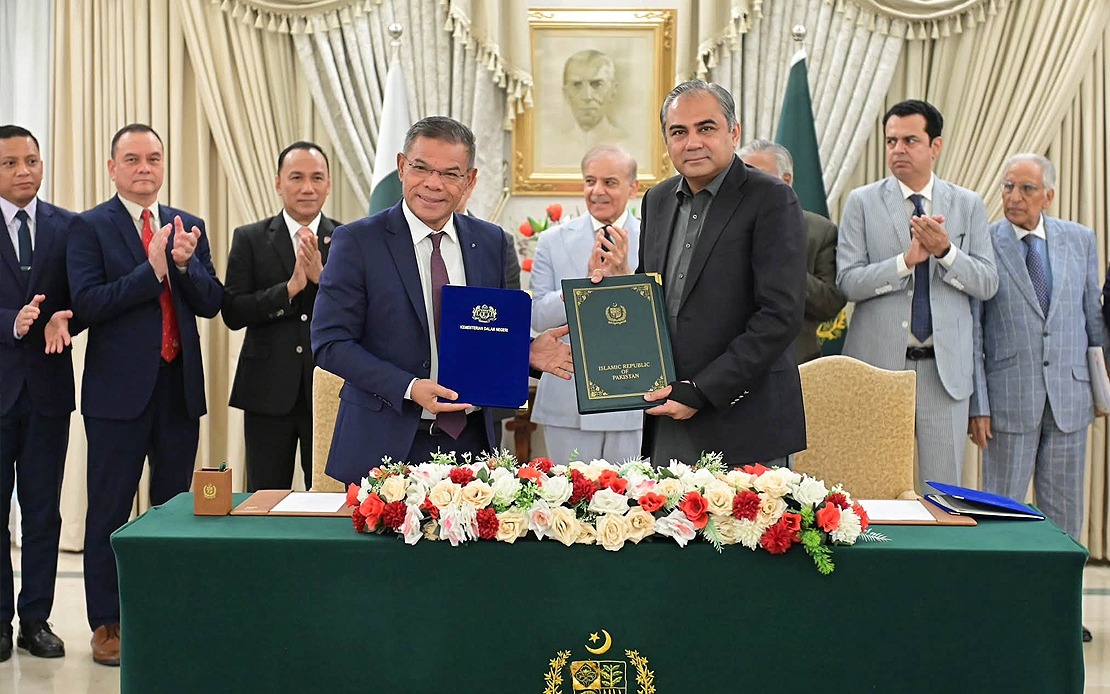
Malaysia and Pakistan have taken a significant step in strengthening their bilateral security architecture by formalising the International Transfer of Prisoners (ITOP) Treaty, a landmark agreement that reflects both nations' commitment to improving criminal justice cooperation and humanitarian considerations for incarcerated nationals. The treaty was signed during a visit to Islamabad by Malaysian Home Minister Datuk Seri Saifuddin Nasution Ismail, who met with Pakistan's Interior and Narcotics Control Minister Syed Mohsin Raza Naqvi and Prime Minister Muhammad Shehbaz Sharif at the Prime Minister's Office.
The agreement represents the culmination of five intensive negotiating rounds that began in September 2025, demonstrating the sustained diplomatic effort required to bridge the legal and administrative frameworks of two countries separated by geography and legal traditions. Malaysia's side involved extensive coordination among multiple agencies including the Home Ministry, Foreign Ministry, Attorney General's Chambers, the Malaysian Prisons Department, and the Royal Malaysia Police, underscoring the complexity of creating compatible systems for prisoner transfers. This multi-stakeholder approach ensured that the final instrument addressed security concerns, legal requirements, and operational realities across both jurisdictions.
Central to the ITOP framework is the principle that Malaysian prisoners currently incarcerated in Pakistan will have the opportunity to be repatriated and complete the remainder of their sentences within Malaysia's correctional system, while Pakistani nationals serving time in Malaysian prisons may similarly return home to serve out their sentences. This bidirectional mechanism ensures equitable treatment and recognises the legitimate interests of both nations in managing their respective prison populations efficiently. The framework addresses not merely the mechanical transfer of prisoners but also the broader humanitarian and rehabilitative dimensions of custodial justice.
A key justification articulated by Malaysian authorities centres on the rehabilitative potential that prisoners gain when reintegrated into their home country environments. According to Saifuddin Nasution, the treaty enables inmates "to undergo rehabilitation programmes in a more conducive environment that is suited to the mould and culture of their respective countries." This reflects evolving international best practices in penology, which recognise that successful rehabilitation depends partly on cultural continuity, family proximity, and alignment with the social and institutional frameworks within which the prisoner will eventually reintegrate into society. For Malaysian prisoners in Pakistan, access to programmes designed around Malaysian values and social contexts may improve prospects for successful reintegration upon release.
The Cabinet approval granted on May 13 provides the formal governmental endorsement necessary for the agreement's implementation, signalling that both Malaysia's executive and legislative processes have validated this expanded security cooperation. This procedural compliance underlines Malaysia's commitment to operating within constitutional frameworks while advancing international cooperation, a consideration of particular importance given the sensitive nature of cross-border prisoner movements and their implications for national sovereignty.
For regional observers, the ITOP Treaty exemplifies the deepening security cooperation among Southeast Asian and South Asian nations in an era of transnational challenges. Malaysia and Pakistan have maintained historically warm diplomatic ties, and this agreement extends those relationships into the crucial domain of criminal justice administration. The treaty's signing reflects acknowledgment by both parties that their citizens occasionally find themselves on the wrong side of each other's laws, and that having rational, humane, and legally robust mechanisms to address such situations serves mutual interests.
The agreement also carries implications for Malaysia's broader prison management strategy. The Malaysian Prisons Department operates under considerable capacity pressures, and mechanisms enabling the repatriation of foreign nationals serve to alleviate systemic overcrowding while simultaneously improving the rehabilitative prospects of those prisoners. Similarly, Pakistan stands to benefit from the reciprocal arrangement, gaining ability to manage its own custodial systems more flexibly.
From a legal perspective, the treaty joins Malaysia's expanding network of bilateral and multilateral security instruments, adding another operational framework to the country's international criminal justice architecture. This accumulating web of agreements with various countries enhances Malaysia's ability to pursue transnational law enforcement objectives and to manage the complex scenarios that arise when Malaysian citizens commit crimes abroad or when foreign nationals transgress Malaysian law.
The timing of the treaty's formalisation comes as both countries navigate evolving security landscapes in their respective regions. Pakistan confronts persistent terrorist financing and narcotics trafficking challenges, whilst Malaysia continues managing transnational organised crime and maritime security threats in the Strait of Malacca. Strengthened legal cooperation through instruments like the ITOP contributes to the broader architecture of regional stability and mutual capacity-building in criminal justice matters.
Saifuddin Nasution's characterisation of the treaty as "another important milestone" in Malaysia-Pakistan relations positions the agreement within the context of incremental deepening of bilateral ties spanning security, trade, and cultural domains. The emphasis on expanding "cooperation that benefits their people" suggests a people-centric framing, whereby the ability to repatriate citizens and provide them with culturally appropriate rehabilitative support is presented as a tangible benefit emanating from strong diplomatic relations.
Looking forward, the ITOP Treaty establishes mechanisms that will likely handle dozens of cases over time, as Malaysian and Pakistani nationals move between correctional systems according to its provisions. The treaty's success will depend substantially on effective coordination between the two countries' prisons authorities, consistent application of agreed-upon procedures, and ongoing communication regarding individual case circumstances. Implementation challenges will inevitably arise, but the agreement's existence provides a formal framework within which such issues can be addressed diplomatically rather than becoming sources of bilateral friction.

