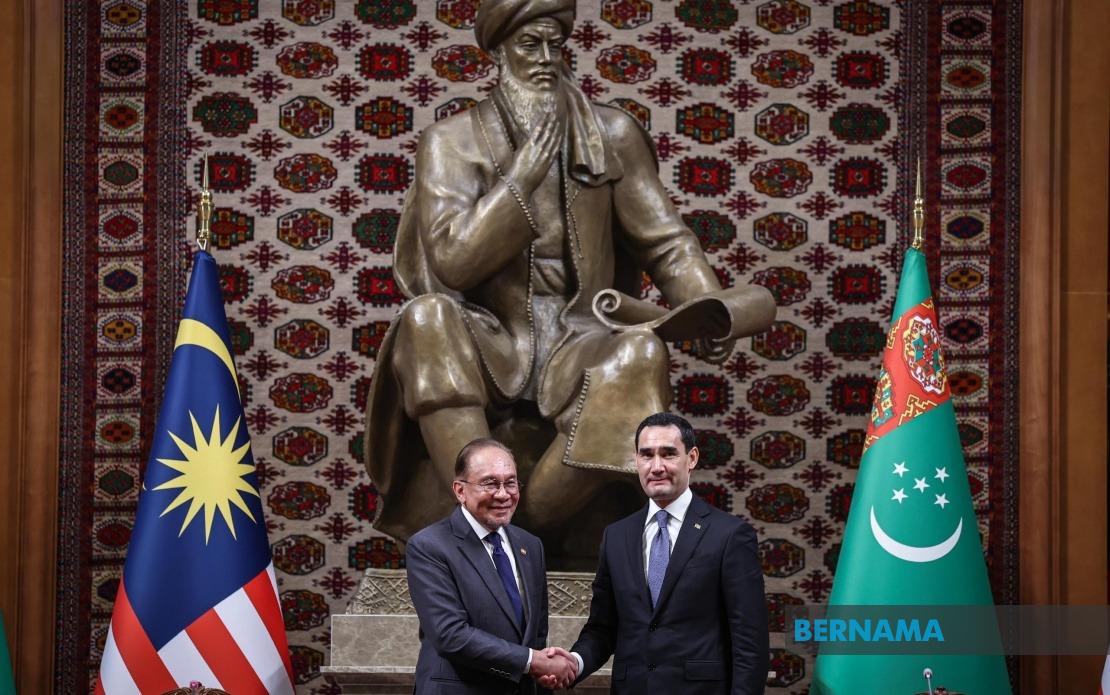
Malaysia and Turkmenistan have signalled their intent to forge a substantially deeper relationship, moving beyond diplomatic courtesies toward concrete, measurable cooperation across multiple economic and strategic fronts. Prime Minister Datuk Seri Anwar Ibrahim conveyed this commitment during a bilateral meeting with Turkmenistan President Serdar Berdimuhamedov at the Presidential Palace in Ashgabat on Friday, emphasising that the partnership would be anchored in transparent implementation, long-term thinking, and mutual benefit for both nations' citizens.
The substance of this upgraded relationship was formalised through the signing of four key documents. Malaysia and Turkmenistan executed an Air Services Agreement designed to improve direct connectivity between the two countries—a critical step for boosting tourism, business travel, and people-to-people exchanges. Additionally, three memoranda of understanding were inked, covering diplomatic cooperation between the two nations' foreign relations institutes, transport sector collaboration, and scientific research partnerships. For Malaysia, these arrangements open pathways into Central Asian markets while offering Turkmenistan enhanced engagement with Southeast Asia's largest Muslim-majority economy.
Energy emerged as a central plank of the discussions, reflecting Turkmenistan's position as a major hydrocarbon producer and Malaysia's strategic interest in diversifying energy sourcing and partnerships. The two leaders explored opportunities across conventional and emerging energy sectors, though specifics were not detailed at the press conference. This engagement is particularly significant given Malaysia's own energy transition goals and the potential for knowledge-sharing on liquefied natural gas infrastructure and renewable energy technologies. Turkmenistan's vast natural gas reserves position it as a potential supplier for regional energy security, an increasingly important consideration as Southeast Asian nations navigate geopolitical complexities.
Trade and investment cooperation formed another pillar of the discussions, with both delegations examining mechanisms to facilitate greater commercial exchange. The presence of Malaysia's Minister of Investment, Trade and Industry Datuk Seri Johari Abdul Ghani at the talks underscored Kuala Lumpur's seriousness about creating tangible economic opportunities. Turkmenistan, while smaller than many regional economies, occupies a strategic crossroads between Asian and European markets, potentially offering Malaysian businesses new corridors for expansion and access to Central Asian consumers.
The halal industry and Islamic banking emerged as distinctive areas of cooperation, reflecting shared values and Malaysia's leadership in these sectors. As the global halal market expands and Islamic finance gains traction beyond Muslim-majority nations, Turkmenistan's engagement with Malaysian expertise in certification, product development, and financial services could accelerate its integration into these high-growth industries. Malaysia's position as a halal hub and Islamic financial centre provides tangible competitive advantages that can be leveraged to deepen bilateral economic ties while strengthening the broader Islamic economy.
Educational and scientific collaboration represents an investment in human capital and intellectual exchange. The Academy of Sciences Malaysia and the Academy of Sciences of Turkmenistan have committed to working jointly on research initiatives, while educational partnerships may facilitate student mobility and institutional knowledge transfer. These connections typically yield long-term dividends, nurturing networks of professionals, researchers, and policymakers who become advocates for stronger bilateral relations throughout their careers.
Anwar's characterisation of the partnership as guided by strategic interests reflects Malaysia's broader diplomatic strategy of engaging diverse partners across multiple regions. Rather than viewing bilateral relationships through narrow bilateral lenses, Malaysia positions itself as a bridge between East and West, and between different regions of Asia. Turkmenistan, while geographically distant, fits this pattern by offering Malaysia a foothold in Central Asia and a diversified portfolio of diplomatic and economic relationships.
This visit marks Anwar's first official trip to Turkmenistan since assuming office as Malaysia's 10th Prime Minister in November 2022, occurring more than a year and a half into his tenure. The timing and composition of the delegation—including senior economic and trade officials—signals that this is not a courtesy call but a deliberate effort to advance concrete interests. The invitation from President Berdimuhamedov suggests comparable enthusiasm from Turkmenistan's side to deepen engagement with Malaysia.
For Malaysian stakeholders, the implications extend across multiple sectors. Airlines and tourism operators may benefit from improved air connectivity and the potential for expanded bilateral tourism flows. Malaysian companies in the halal, Islamic finance, and technology sectors have new market entry opportunities. Energy companies and trading firms gain exposure to Turkmenistan's resource-rich economy. The agreements also position Malaysia as a preferred Southeast Asian partner for Central Asian nations seeking engagement with the region, potentially enhancing Malaysia's soft power and diplomatic influence.
The emphasis on disciplined, transparent, and effective implementation of agreed cooperation is particularly noteworthy. Past bilateral agreements between nations often languish due to bureaucratic delays, unclear responsibility assignments, or shifting political priorities. By explicitly committing to rigorous execution, both leaders acknowledge that signed documents are merely starting points—success depends on sustained institutional commitment from both sides. This reflects lessons learned from other regional partnerships where formal frameworks failed to generate tangible results.
For Southeast Asia more broadly, deeper Malaysia-Turkmenistan cooperation contributes to the region's outward-looking engagement strategy. As ASEAN nations increasingly pursue partnerships beyond their immediate neighbourhood, relationships with Central Asian countries provide economic diversification, reduce dependence on any single major power, and create alternative pathways for trade and investment. Malaysia's initiative here sets a template for other Southeast Asian nations considering Central Asian engagement.
The joint statement signed by Anwar and President Berdimuhamedov provides a high-level framework, but success will ultimately be measured by the tangible outcomes flowing from these agreements. Implementation timelines, dedicated resources, and designated focal points in both governments will determine whether this partnership translates from political rhetoric into observable economic and diplomatic benefits. The coming months will be critical in demonstrating whether the two nations can move from commitments to concrete action.