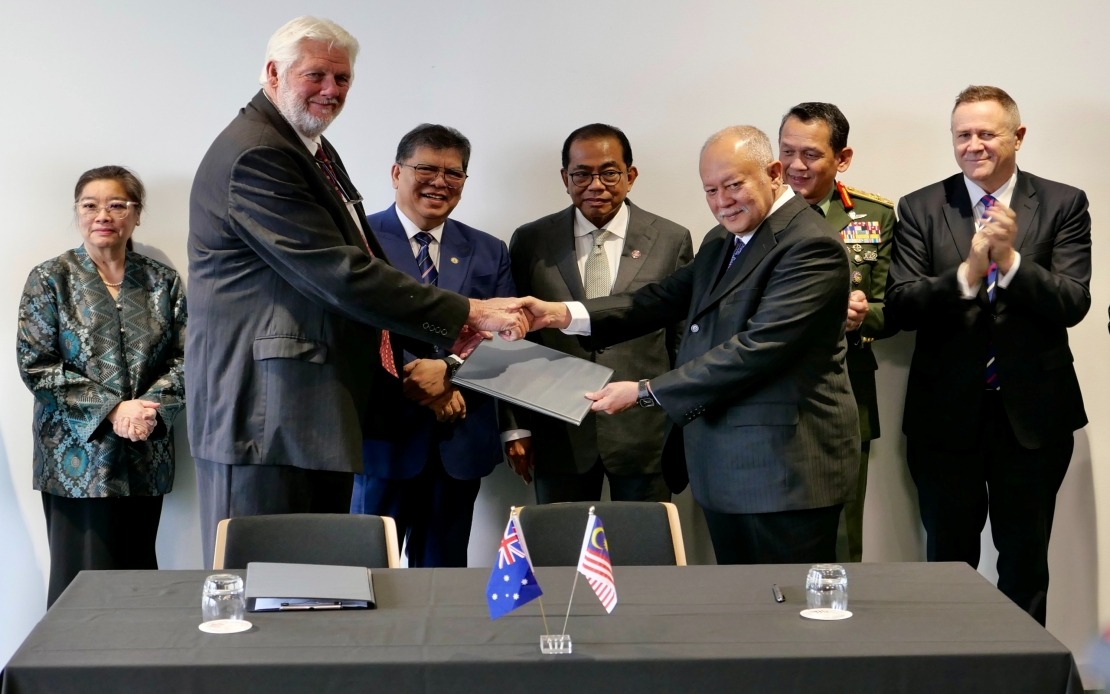
Malaysia has moved to strengthen its sovereign defence capabilities through a landmark collaboration between local defence manufacturer Weststar Defence Industries and Australian aerospace firm Rocket Technologies International. The partnership was formalised during Defence Minister Datuk Seri Mohamed Khaled Nordin's working visit to Australia, with the agreement signed at the National Convention Centre in Canberra by Weststar Group founder Tan Sri Dr Syed Azman Syed Ibrahim and RTI founder Allan James Payne.
The arrangement represents a calculated investment in Malaysia's domestic defence-industrial base at a time when regional geopolitical tensions underscore the strategic importance of self-reliant military capabilities. Rather than remaining dependent on foreign suppliers for advanced defence systems, the partnership enables Malaysia to develop critical expertise in rocket and missile technology—areas where only a handful of nations maintain indigenous production capacity. This shift toward local manufacturing aligns with the government's broader National Defence Industry Policy (DIPN), which prioritises building domestic competency in defence technology development and production.
Under the terms of the collaboration, Weststar will construct a production facility within Malaysia, with manufacturing of rockets anticipated to commence within two years. This timeline suggests a pragmatic, phased approach rather than an ambitious overreach. The facility will serve as a foundation for eventual expansion into missile production, positioning Malaysia to graduate from a consumer of defence products to a manufacturer capable of serving both domestic military needs and potential regional export markets. Mohamed Khaled emphasised that this capability development extends beyond Malaysia's immediate security requirements, noting that the investment will enable domestic companies to integrate into RTI's global supply chain, thereby exposing Malaysian contractors to international defence standards and business practices.
The strategic calculus behind the partnership reflects Australia's broader regional engagement strategy. By supporting Malaysian defence industry development, Canberra reinforces ties with a key Southeast Asian partner while facilitating technology transfer within a trusted alliance framework. The Australian government's explicit approval and support for the collaboration signals confidence in Weststar's stewardship and the compatibility of the technology transfer with bilateral security arrangements. Defence Minister Richard Marles, whom Mohamed Khaled met during the visit, has consistently advocated for deepened defence cooperation with regional allies, and this partnership exemplifies that commitment.
Malaysia's decision to pursue indigenous rocket and missile development carries significant implications for the broader Indo-Pacific security architecture. The capability to design, manufacture, and maintain advanced defence systems reduces strategic vulnerability to supply disruptions and arms embargoes, both real risks in an era of great power competition. Additionally, self-sufficiency in critical defence technology strengthens Malaysia's negotiating position with potential adversaries and enhances deterrence credibility. For a nation navigating complex security challenges from maritime disputes to transnational threats, the symbolic value of sovereign defence capability extends beyond mere military calculations to encompass national dignity and strategic autonomy.
The institutional machinery supporting this partnership reveals a sophisticated understanding of how defence innovation thrives at the intersection of industry, academia, and government. During his visit, Mohamed Khaled toured the Institute for Space, Defence and Advanced Technologies at the University of Southern Queensland, observing how Australian defence companies leverage university research capabilities to accelerate technology development. His delegation, which included the Royal Malaysian Air Force chief General Tan Sri Muhamad Norazlan Aris and UPNM vice-chancellor Lt Gen Datuk Wira Arman Rumaizi Ahmad, inspected advanced composite manufacturing and hypersonics laboratories developed through industry-academia partnerships. This educational dimension of the visit suggests that Malaysia intends not merely to import finished technologies but to build enduring institutional relationships that facilitate knowledge transfer and long-term capability development.
The involvement of Malaysia's National Aerospace Industry Corporation (NAICO Malaysia), represented by chief executive Prof Shamsul Kamar Abu Samah, indicates that the Weststar-RTI partnership sits within a broader ecosystem of government-backed aerospace and defence initiatives. NAICO's participation suggests coordinated national strategy rather than isolated commercial transaction. This institutional architecture enhances prospects for sustained commitment and resource allocation even as political leaderships change, a critical factor for defence programmes requiring multi-year investment and development cycles.
The parliamentary dimensions of the visit—including meetings with Dewan Rakyat Speaker Tan Sri Johari Abdul and engagements with Australian parliamentarians—underline that the partnership commands bipartisan political support. Defence technology partnerships succeed when they transcend transient political cycles and enjoy durable consensus across government institutions. The ceremonial weight attached to the Canberra visit, including official reception at Parliament House, reflects the strategic significance both nations accord to deepening defence ties. For Malaysia, such gestures affirm that the partnership represents not merely commercial transaction but geopolitical commitment.
Looking forward, the Weststar-RTI collaboration will face practical challenges familiar to defence industrial partnerships: managing technology transfer security, maintaining industrial competitiveness, developing a skilled workforce, and sustaining investment through cycles of budget constraint. The two-year timeline to rocket production, while achievable, leaves limited margin for technical difficulties or bureaucratic delays. Malaysian companies must also develop supply chain resilience and quality assurance frameworks meeting international defence standards. However, the partnership structure—with RTI providing proven technology and manufacturing expertise while Weststar brings local knowledge and regulatory access—distributes risk reasonably between parties.
For Malaysian defence planners and military leadership, the partnership offers tangible progress toward a long-standing objective: reducing vulnerability to external supply constraints while developing organic technical expertise. Rocket and missile capabilities represent force multipliers for smaller air forces and navies, enhancing defensive deterrence and offensive reach without requiring unsustainable defence budgets. As regional military competition intensifies and great power rivalry shapes security dynamics, Malaysia's investment in indigenous defence manufacturing capability positions the nation to better protect its interests while contributing more substantially to regional stability.

