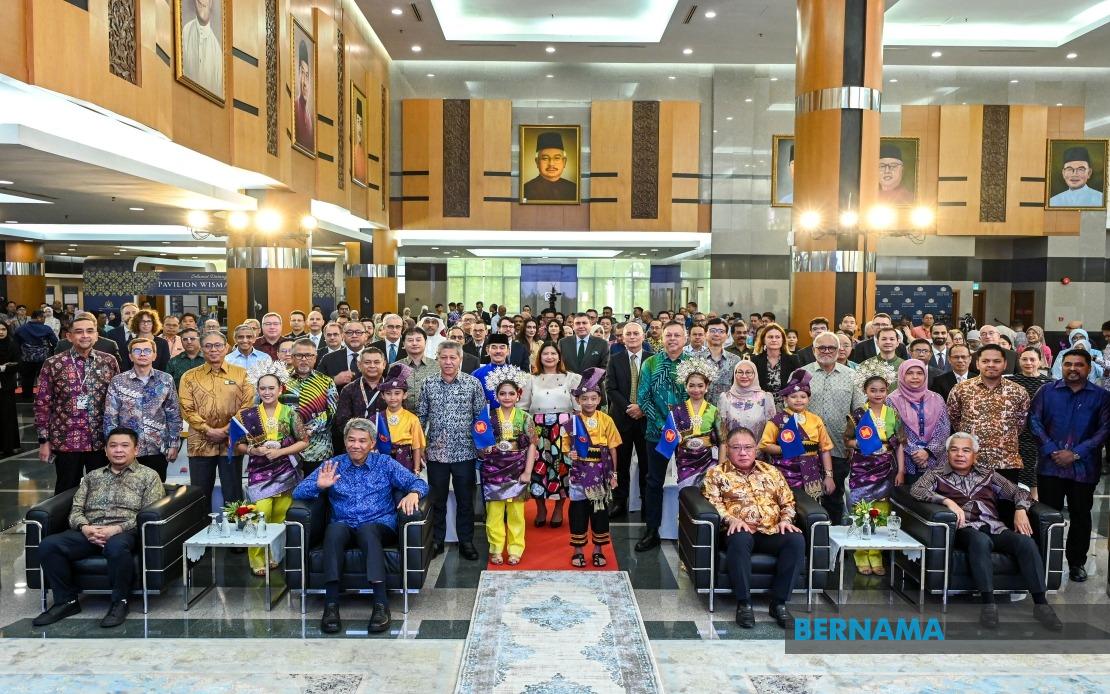
Malaysia recently honoured its place within the Association of Southeast Asian Nations by commemorating nearly six decades of partnership and regional collaboration. The occasion, held at the Foreign Ministry headquarters in Putrajaya on Monday, drew approximately 300 guests including government officials, diplomats and representatives from international organisations to reflect on the nation's journey within ASEAN since the bloc's inception in 1967.
The observance carried the theme "59 Years of Navigating Together", a phrase that encapsulates ASEAN's fundamental operating principle of collective problem-solving and shared advancement. The Foreign Ministry's official statement underscored how this year represents a meaningful milestone in the regional grouping's evolution, one that transcends simple anniversary marking to highlight the enduring bonds connecting the ten Southeast Asian members across multiple dimensions of engagement. The ministry emphasised how ASEAN's institutional framework rests upon three complementary pillars—political-security cooperation, economic integration and socio-cultural exchange—each reinforcing the others to create a resilient regional community.
Foreign Minister Datuk Seri Mohamad Hasan presided over the event, symbolising Malaysia's continued diplomatic leadership and investment in regional mechanisms. His presence alongside Tourism, Arts and Culture Minister Datuk Seri Tiong King Sing and Deputy Foreign Minister Datuk Lukanisman Awang Sauni demonstrated the multi-ministry commitment to ASEAN at the highest governmental levels. Such attendance patterns reflect how ASEAN engagement in Malaysia extends beyond purely diplomatic channels to encompass tourism promotion, cultural preservation and broader development agendas.
The celebration incorporated a specially produced video montage titled "ASEAN Journey: Navigating Our Future, Together—59 Years of Malaysia in ASEAN", which traced the nation's evolution from founding member to mature regional stakeholder. This visual documentation served not merely as nostalgic recollection but as pedagogical tool for younger government officials and attendees unfamiliar with ASEAN's formative decades. The subsequent cake-cutting ceremony, led by Foreign Minister Mohamad, provided the gathering's ceremonial centrepiece, transforming abstract concepts of regional solidarity into tangible, shared experience.
ASEAN itself emerged from the Bangkok Declaration signed on August 8, 1967, by Indonesia, Malaysia, the Philippines, Singapore and Thailand—nations that recognised in regional cooperation a pathway toward stability and mutual prosperity following decades of territorial disputes and ideological tensions. That original quintet has since expanded dramatically, reflecting both ASEAN's attractive institutional design and the region's evolving geopolitical calculations. Brunei's accession in 1984 brought a wealthy oil-producing state into the fold, while Vietnam's admission in 1995 marked a watershed moment, integrating a communist nation into what had been a staunchly anti-communist alliance.
The subsequent expansion westward occurred methodically. Laos and Myanmar joined simultaneously in 1997, expanding ASEAN's continental footprint and establishing the bloc as Southeast Asia's undisputed regional framework. Cambodia's entry in 1999, following its recovery from authoritarian collapse, demonstrated ASEAN's capacity to accommodate nations in political transition. Most recently, Timor-Leste secured membership during the 47th ASEAN Summit in October of the preceding year, becoming the eleventh member and the first to join following ASEAN's maturation into a fully operational regional organisation with established norms and decision-making procedures.
For Malaysian policymakers and public, this commemorative occasion carries particular significance given the nation's role as ASEAN's intellectual architect and institutional anchor. Malaysia provided key intellectual contributions during ASEAN's foundational period, notably through Foreign Minister Tun Adam Malik's advocacy for the Zone of Peace, Freedom and Neutrality concept, which became central to ASEAN's non-alignment philosophy. The nation has consistently hosted ASEAN secretariat functions and served as host nation for numerous regional forums and summits, positioning itself as indispensable to the bloc's operational continuity.
The timing of ASEAN's anniversary celebration arrives amid intensifying great-power competition in Southeast Asia, with United States, China and India all recalibrating their regional strategies. For Malaysia, ASEAN membership offers a diplomatic framework through which to manage these competing pressures while advancing national interests in maritime security, trade diversification and cultural influence. The regional grouping provides smaller members with amplified collective voice in international negotiations, a consideration that became especially relevant as ASEAN navigated post-pandemic economic recovery and shifted supply chains.
The emphasis on navigating together resonates with contemporary Southeast Asian realities where transnational challenges—from pandemic response to climate change to maritime piracy—demand coordinated action transcending individual national capacity. Malaysia's sustained commitment to ASEAN frameworks reflects recognition that regional stability directly correlates with national prosperity, making the bloc's institutional strengthening a Malaysian strategic imperative rather than merely ceremonial obligation.
Moving forward, ASEAN faces mounting pressure to evolve its decision-making mechanisms beyond the consensus principle that has historically constrained decisive action on contentious issues. Myanmar's political trajectory and ongoing South China Sea tensions test the grouping's cohesion and Malaysia, as a moderate, economically developed member, will likely prove instrumental in forging compromise positions that preserve ASEAN unity while acknowledging legitimate national interests. The coming years will determine whether ASEAN can adapt its institutional framework to address challenges unforeseen in 1967 while maintaining the principles of sovereignty and non-interference that remain foundational to regional acceptance.

