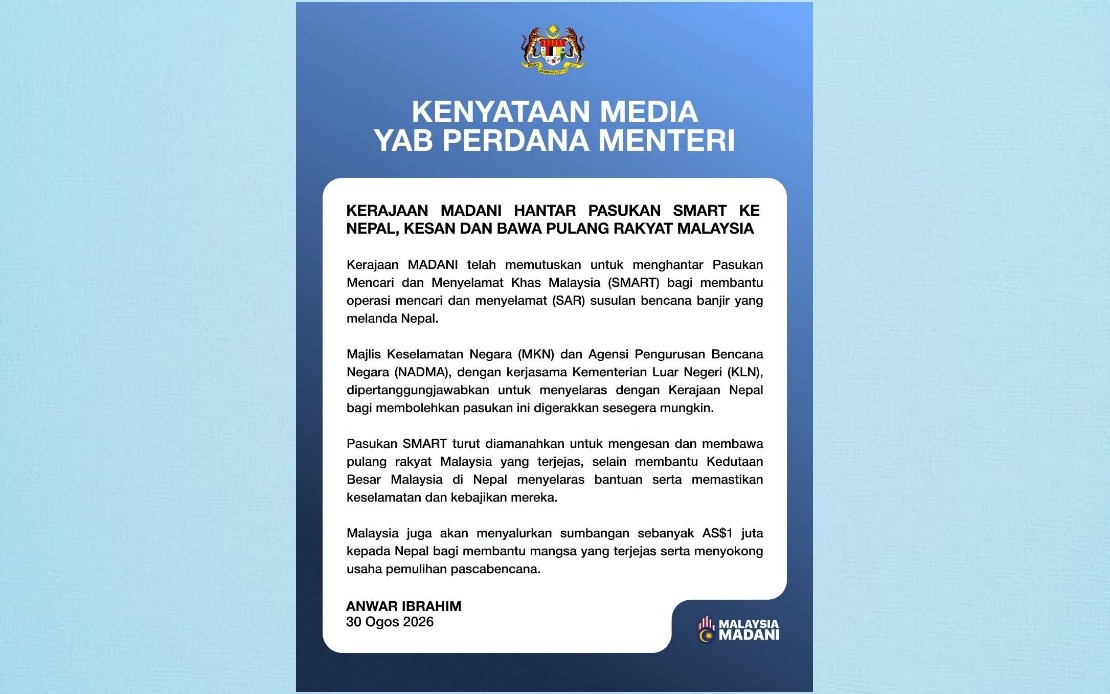
Malaysia has activated its disaster response machinery in response to the catastrophic flooding that has devastated parts of Nepal, with Prime Minister Datuk Seri Anwar Ibrahim announcing the deployment of the country's elite rescue unit to assist in search and recovery operations. The decision represents a swift humanitarian intervention following the severe flash floods and landslides that struck Rasuwa district on August 26, claiming multiple lives and displacing thousands of residents across the region.
The Special Malaysian Disaster Assistance and Rescue Team, commonly known as SMART, will be coordinated through a collaborative effort involving the National Security Council, the National Disaster Management Agency, and the Foreign Ministry, which will liaise directly with Nepalese authorities to expedite the team's arrival and integration into ongoing rescue efforts. This multi-agency coordination underscores Malaysia's institutional capacity to respond rapidly to transnational disasters, reflecting established protocols that have been refined through previous humanitarian deployments across the region.
Beyond immediate rescue operations, the SMART team has been assigned the critical responsibility of locating and repatriating Malaysian citizens affected by the disaster, a concern that has grown more pressing as the Foreign Ministry confirmed that 55 Malaysians remain uncontactable in the aftermath of the calamity. This figure represents a substantial number of Malaysian nationals caught in the disaster zone, many of whom were likely engaged in tourism, business, or other activities in the affected Rasuwa district at the time of the flooding.
The deployed team will also serve as a crucial liaison between the Malaysian Embassy in Nepal and affected communities, coordinating the distribution of aid materials and ensuring that stranded Malaysians receive appropriate consular support and welfare assistance during the emergency period. This diplomatic-humanitarian hybrid role is essential in the early stages of a major disaster, when communication channels are disrupted and vulnerable nationals require immediate assistance to reach safety.
Complementing the deployment of trained personnel, Malaysia has committed US$1 million in financial assistance to support Nepal's immediate humanitarian response and longer-term reconstruction efforts. This contribution reflects Malaysia's recognition that natural disasters in neighbouring countries carry regional implications and that cooperative disaster management strengthens the broader Southeast Asian community's resilience against climate-induced hazards.
The flooding in Rasuwa district represents the kind of transboundary natural disaster that has become increasingly frequent across South Asia, driven by intensifying monsoon patterns and changing precipitation dynamics in the Himalayan region. For Malaysian stakeholders, the incident serves as a stark reminder of the vulnerability faced by citizens travelling to high-risk geographic zones and underscores the importance of maintaining robust consular capacity in neighbouring countries.
Nepal's mountainous terrain, while spectacular for tourism, renders certain districts particularly vulnerable to rapid-onset flooding and landslides during the monsoon season. Rasuwa district, located north of Kathmandu Valley, sits in precisely such a geography, where steep slopes and concentrated rainfall can generate destructive flash floods within hours, leaving little time for evacuation or shelter-in-place measures.
Malaysia's response also reflects broader regional trends in disaster management cooperation, where countries increasingly recognise that mutual aid arrangements yield benefits beyond immediate humanitarian considerations. By deploying SMART and contributing funds, Malaysia positions itself as a reliable partner in crisis response, a reputation that carries diplomatic weight and goodwill dividends across regional forums.
The timing of Malaysia's intervention is significant, as early deployment of search and rescue teams substantially improves survival rates in the critical hours and days immediately following a major flood event. The coordination through established government channels ensures that Malaysian efforts integrate seamlessly with Nepalese national response mechanisms rather than operating in parallel, a lesson learned from previous international disaster responses.
For Malaysian families with relatives in Nepal, the government's swift action provides some reassurance, though the unconfirmed status of 55 nationals underscores the communication challenges inherent in rapid-onset disasters. The SMART team's mandate to locate and assist these individuals represents a direct extension of Malaysia's duty of care toward its citizens abroad, particularly in emergency circumstances where normal consular services may be overwhelmed.
The broader context of this deployment includes Malaysia's growing sophistication in disaster management and humanitarian response capabilities, developed through experience with domestic flooding events, regional earthquakes, and previous international rescue missions. The SMART team represents the crystallisation of this expertise into an operational capacity that can be mobilised within hours to address emergencies thousands of kilometres away.
As Nepal grapples with the immediate crisis of rescue and recovery, Malaysia's contribution—both in personnel and resources—demonstrates that disaster response transcends bilateral relationships and reflects shared human vulnerabilities. The flooding in Rasuwa district has affected not only Nepali citizens but also visitors and workers from multiple countries, creating a moment of regional solidarity that Malaysia has responded to with concrete action and meaningful commitment.

