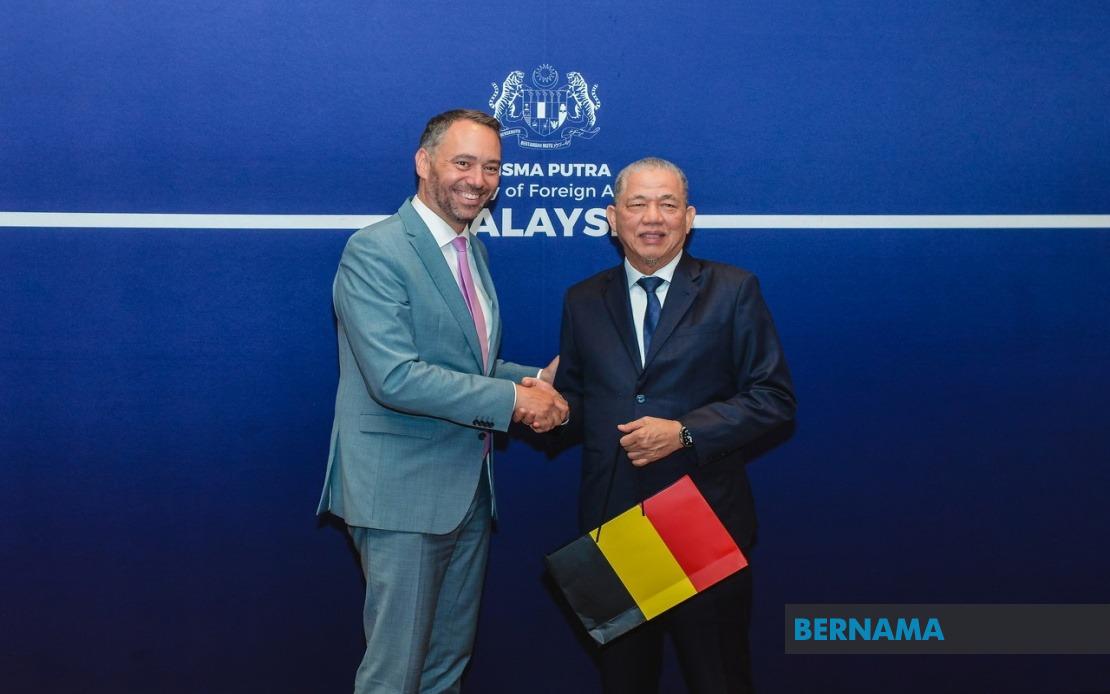
Malaysia has given Belgium formal assurance that maritime passage through the South China Sea will remain unobstructed, underscoring ASEAN's dedication to maintaining peace and open access in one of the world's most strategically vital waterways. The pledge came during a high-level diplomatic engagement between Deputy Prime Minister Datuk Seri Fadillah Yusof and Belgium's Deputy Prime Minister and Minister of Foreign Affairs, European Affairs, and Development Cooperation, Maxime Prévot, held in Kuala Lumpur on Thursday.
The timing of the reassurance reflects growing international anxiety over potential disruptions to global shipping corridors. Belgium, as a European Union member with significant maritime commerce interests, sought clarity on regional security prospects following concerns that the South China Sea could face disruptions similar to those experienced in the Strait of Hormuz, where geopolitical tensions have periodically threatened to block critical international trade routes. Prévot specifically asked for Malaysia's assessment of the security environment in the region, indicating that European governments are closely monitoring developments that could affect their economic interests in Asia.
Fadillah, who also holds the portfolio of Minister of Energy Transition and Water Transformation, provided categorical assurances that no blockades would be imposed on maritime traffic. He emphasized that ASEAN member states, collectively, remain committed to the foundational principles of guaranteeing security, maintaining neutrality, and ensuring uninhibited access through these strategic waters. This position reflects ASEAN's long-standing diplomatic stance of upholding freedom of navigation and non-interference in regional affairs, principles that have underpinned the bloc's engagement with major powers in the Indo-Pacific.
The broader context reveals Malaysia's careful navigation of complex geopolitical pressures. The South China Sea remains one of the world's busiest shipping lanes, handling trillions of dollars in annual trade. Multiple claimants to maritime territories in the region, coupled with major power competition, have created an environment where assurances from Southeast Asian nations carry significant weight for international commerce and stability. Malaysia's explicit commitment addresses European concerns that regional tensions could escalate into barriers to trade, a scenario that would have far-reaching consequences for global supply chains.
Beyond the security discussion, the two leaders explored multiple avenues for deepening bilateral cooperation between Malaysia and Belgium. Prévot signaled Belgium's commitment to expanding commercial ties, with particular emphasis on increasing bilateral trade volumes. The Belgian delegation also undertook a significant diplomatic gesture by agreeing to reassess its travel advisory for Sabah, suggesting that Belgium may be considering an upgrade to the current advisory status. Such moves are consequential for Malaysian tourism, particularly in East Malaysia, where foreign visitor arrivals are crucial economic drivers for local communities and businesses.
A particularly noteworthy aspect of the discussions centered on Malaysia's halal ecosystem. Belgium proposed that Malaysia's halal standards and certification frameworks could serve as a model for broader adoption across the European Union. This development carries significant commercial and soft-power implications. As Malaysia has invested substantially in developing comprehensive halal infrastructure and certification processes, the potential for this expertise to influence European standards represents both an economic opportunity and a validation of Malaysian leadership in Islamic commerce. It also signals growing European recognition of the global importance of halal markets, which represent a multi-billion-dollar industry.
Energy transition emerged as another collaborative priority. Belgium, recognized internationally for its technological innovations and advanced materials development, offered to share expertise in renewable energy and emerging technologies. Simultaneously, both nations discussed prospects for increased Belgian investment in Malaysia's energy transition initiatives. Given Malaysia's stated commitment to carbon reduction and renewable energy expansion, Belgian capital and technical knowledge could accelerate the pace of transformation in Southeast Asia's energy landscape, potentially creating cascading benefits across the region.
The visit by Prévot, marking his first official trip to Malaysia since assuming office in February 2025, underscores the importance both nations place on strengthening people-to-people, business-to-business, and government-to-government ties. Such high-level engagements establish frameworks for sustained cooperation and demonstrate commitment to deepening relationships beyond traditional diplomatic channels. The presence of Foreign Ministry Secretary-General Tan Sri Amran Mohamed Zin and Belgium's Ambassador to Malaysia Peter Van Acker at the luncheon highlighted the institutional significance accorded to the discussions.
For Malaysia and the broader ASEAN region, these exchanges reinforce a critical narrative: Southeast Asian nations remain committed to maintaining the South China Sea as a domain of cooperation and open commerce rather than confrontation. This positioning allows Malaysia to maintain relationships with both Western powers and regional major powers while advocating for stability. For Belgium and the European Union, the assurances obtained during this visit provide some reassurance that critical trade routes will remain accessible, though the underlying tensions in the region ensure that such diplomatic commitments will continue to require reinforcement and careful management.
The discussion on halal standards also demonstrates an emerging trend of Malaysia leveraging its unique position at the intersection of Islamic and global commerce. By positioning Malaysian halal frameworks as potential EU-wide models, Malaysia enhances its influence on international regulatory standards while creating commercial opportunities for its halal certification bodies and businesses. This represents soft power deployed through economic mechanisms rather than traditional diplomacy.

