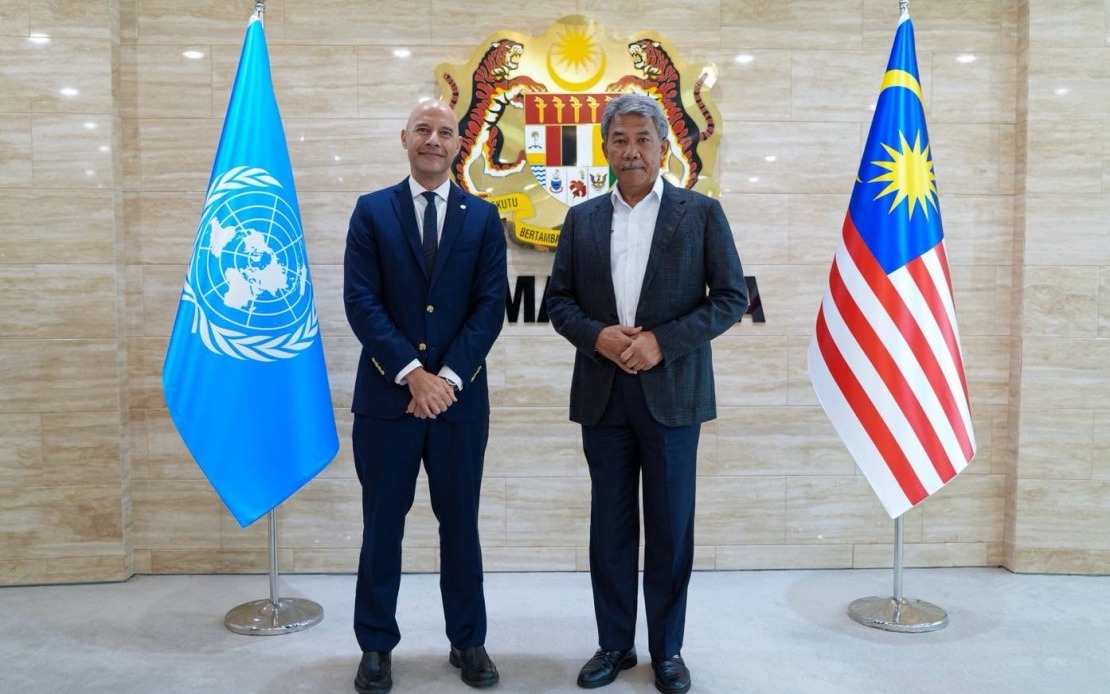
Malaysia's Foreign Minister Datuk Seri Mohamad Hasan welcomed United Nations Resident Coordinator Nikolas Myint at the Ministry of Foreign Affairs headquarters in Kuala Lumpur on Wednesday, underscoring the country's commitment to strengthening its partnership with the global organisation. The courtesy call, held at Wisma Putra, marked an opportunity for Malaysia's diplomatic leadership to engage directly with UN representation across the broader Asean region, signalling continuity in the bilateral relationship at a critical juncture in global affairs.
Myint's appointment to lead UN operations across Malaysia, Singapore and Brunei took effect on May 31, 2026, placing him in charge of coordinating the United Nations' extensive development, humanitarian and advocacy work across three economically significant Southeast Asian economies. His mandate extends to overseeing multiple UN agencies operating across the region, from the World Health Organization to the United Nations Development Programme, making his role pivotal in shaping how global initiatives are implemented at the national level. The new coordinator inherits a portfolio that touches on climate action, sustainable development, public health resilience and socioeconomic advancement—all areas where Malaysia seeks to play an increasingly assertive role within both regional and international frameworks.
During their meeting, Mohamad emphasised Malaysia's deep appreciation for the United Nations' efforts in tackling an expanding array of transnational challenges that extend beyond traditional security concerns. The minister's remarks, shared via public channels, highlighted the nation's recognition that global cooperation mechanisms remain essential for addressing interconnected crises ranging from climate disruption to pandemic preparedness. This positioning reflects Malaysia's diplomatic strategy of anchoring itself firmly within multilateral institutions whilst maintaining pragmatic bilateral relationships with major powers.
The foreign minister articulated Malaysia's intention to deepen operational collaboration with both Myint's office and the constellation of UN agencies active within Malaysian territory. Such engagement carries particular weight given Malaysia's demographic, geographic and economic positioning as a middle-income nation seeking to translate development gains into broader regional influence. Closer coordination with UN bodies can amplify Malaysia's voice on issues from biodiversity conservation to digital governance, areas where the country possesses comparative expertise and stakes in global standard-setting.
Myint's presence in the region also signals the UN's continued investment in Southeast Asian engagement, a region increasingly recognised as central to global geopolitical and economic calculations. The appointment of a resident coordinator overseeing three countries reflects the UN's efficiency-focused reorganisation whilst acknowledging the interconnected nature of development challenges across the subregion. Malaysia, as the largest economy among the three, effectively anchors this trilateral coordination structure, positioning it as a natural hub for UN operations and policy dialogue across maritime Southeast Asia.
Malaysia's stated commitment to working closely with the UNRC framework aligns with broader government aspirations to position the nation as a responsible global actor engaged with international development norms. The country has consistently participated in UN peacekeeping missions, signed major environmental accords and contributed to humanitarian operations, yet seeks greater recognition for these contributions and expanded influence over agenda-setting within UN bodies. Strengthened relationships with resident coordinators provide informal channels for advocating Malaysian interests in technical discussions that precede formal policy announcements.
The emphasis on mutual benefit in the foreign minister's statement reveals Malaysia's transactional approach to multilateralism—the country supports UN frameworks when aligned with national interests but maintains sufficient autonomy to pursue independent foreign policy objectives. This balancing act characterises Malaysian diplomacy across the Indo-Pacific, where the nation navigates between major power competition and genuine commitment to rules-based international order. The UN resident coordinator's regional presence offers Malaysia a credible interlocutor for advancing this nuanced diplomatic posture.
For Malaysian development priorities, closer engagement with UN agencies through their new regional coordinator opens pathways for accessing technical expertise, financing mechanisms and policy guidance on challenges from poverty reduction to technology transfer. Malaysia's aspiration to achieve high-income status by 2030 increasingly depends on addressing issues with global dimensions—climate transition, digital transformation, health security—where UN agencies provide essential coordination and knowledge-sharing platforms. The resident coordinator's office serves as Malaysia's gateway to this broader ecosystem of development partners and policy networks.
The timing of this courtesy call reflects Malaysia's proactive diplomatic engagement following transitions in global governance. As international institutions adapt to shifting geopolitical currents, maintaining strong relationships with UN leadership positions ensures Malaysia retains voice and influence in discussions shaping regional and global agendas. Myint's appointment represents continuity in UN engagement with Southeast Asia whilst potentially signalling shifts in how the organisation prioritises regional cooperation and coordination in the post-pandemic era.

