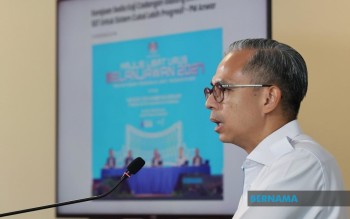
The Malaysian government is taking a methodical approach to exploring a potential overhaul of its taxation system, with Finance Minister II Datuk Seri Amir Hamzah Azizan given extended time to prepare a comprehensive analysis of combining the Goods and Services Tax with the existing Sales and Services Tax framework. According to MADANI Government spokesperson Datuk Seri Fahmi Fadzil, this initiative follows Prime Minister Datuk Seri Anwar Ibrahim's directive to the Finance Ministry to undertake a detailed examination of what would essentially be a hybrid taxation model tailored to Malaysia's economic circumstances.
The deliberate pace reflects the government's recognition that tax reform requires careful deliberation rather than rushed implementation. Speaking at the weekly post-Cabinet press conference in Putrajaya, Fahmi emphasised that officials cannot hastily combine two complex taxation systems without thorough analysis. The proposal carries particular significance given Malaysia's recent experience with the GST, which was implemented then subsequently replaced, and the lessons that experience provided about public reception and administrative challenges in overhauling such fundamental economic mechanisms.
Under the current framework, Malaysia operates the SST system, which comprises a service tax and sales tax applied at different stages of the supply chain. The government's interest in incorporating selected GST elements suggests officials believe certain structural features of the goods and services tax could enhance progressivity and efficiency without replicating the broader issues that prompted the previous GST's removal. Fahmi clarified that the administration remains committed to SST as the foundation of Malaysia's taxation architecture, but acknowledges that targeted refinements drawing from GST methodology warrant serious consideration.
The Finance Ministry's assignment encompasses evaluating lessons learned from Malaysia's GST period, spanning several years when the tax operated before transitioning back to SST. Officials must analyse what worked effectively, what generated public opposition, and which mechanisms might be adapted to function better within an SST-based system. Simultaneously, the study will examine persistent challenges within the current SST framework that stakeholders have identified, including administrative complexities, compliance issues, and questions about whether the system adequately achieves progressive taxation objectives.
While Prime Minister Anwar indicated the government's openness to this exploratory process, no specific timeline for completion has been publicly established. When questioned whether an announcement might accompany the upcoming budget presentation, Fahmi noted that such details were not discussed during the Cabinet session, leaving the timeline for this fiscal review entirely open. This flexibility suggests the Finance Ministry will proceed at whatever pace proves necessary to deliver a thorough assessment rather than conforming to artificial deadlines.
The broader context of this initiative reflects global trends toward tax modernisation, particularly within Southeast Asia where governments increasingly recognise the importance of efficient, progressive, and administratively sustainable taxation systems. For Malaysia, which competes regionally for investment and talent, ensuring a competitive and comprehensible tax environment holds strategic significance. A hybrid approach might offer advantages over maintaining two entirely separate systems, potentially reducing administrative burden on businesses while maintaining revenue objectives.
Public reception will likely prove critical to any eventual implementation. The GST's earlier experience demonstrated that taxation changes, regardless of their theoretical merits, must account for political feasibility and public acceptance. The government's current exploratory stance suggests officials are determined to avoid repeating that experience by ensuring comprehensive stakeholder consultation and rigorous analysis before proposing legislative amendments. This measured approach also allows officials to evaluate technological capabilities required for administering a refined system and to identify necessary capacity-building among the Inland Revenue Board and other relevant agencies.
The Finance Minister II's assignment carries significant responsibility, as the resulting report will substantially shape Cabinet deliberations and potentially influence Malaysia's fiscal policy direction for years. The depth of analysis undertaken during this phase will determine whether the eventual proposal, if adopted, proves administratively viable and economically beneficial. Officials must balance multiple competing objectives including revenue generation, progressivity, administrative efficiency, and business compliance costs.
For Malaysian businesses and residents, the implications remain uncertain pending the Finance Ministry's findings. Enterprises currently operating under SST face the possibility of transitional requirements if a hybrid system is eventually adopted, though such changes would presumably be implemented gradually to minimise disruption. Consumers and workers would experience potential adjustments to tax treatment of various goods and services, though the government's emphasis on progressivity suggests efforts to design the system equitably across income groups.

