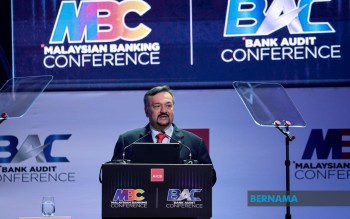
The Asian Institute of Chartered Bankers has called for a fundamental shift in how Malaysia's financial institutions approach artificial intelligence, arguing that the sector has reached a critical juncture where mere technology adoption is no longer sufficient. Speaking at major banking and audit conferences held in Kuala Lumpur this month, AICB and senior industry figures stressed that the next phase must centre on building institutional trust, fortifying governance structures, and developing the workforce capabilities needed to govern AI responsibly as the country's banking sector undergoes digital transformation under the Financial Sector Blueprint.
The challenge facing Malaysia's 1,000-plus banking and audit leaders who gathered for the dual conferences—the 4th Malaysian Banking Conference and 2nd Bank Audit Conference, both held July 7-8 at the Kuala Lumpur Convention Centre—reflects broader pressures bearing down on financial institutions across the region. Beyond the promise of AI productivity gains, banks are grappling with tightening regulation, intensifying cybersecurity threats, climate transition obligations and the unpredictable geopolitical environment. These converging demands have made it imperative for institutions to view AI not as a standalone innovation but as an integral component of a broader risk and resilience strategy.
A landmark report unveiled at the conferences provides the first comprehensive snapshot of how Malaysia's banking sector is actually deploying artificial intelligence at scale. The AICB-Ecosystm AI in Practice report, developed jointly by the Asian Institute of Chartered Bankers, the research firm Ecosystm, and AICB's Chief Risk Officers' Forum, surveyed close to 90 senior leaders from commercial banks, digital banks and development financial institutions across Malaysia. The resulting benchmark reveals significant disparities between the breadth of AI deployment and the depth of institutional confidence in those systems—a gap that could become problematic as banks scale up AI-driven decision-making across the enterprise.
Currently, Malaysian banks are actively deploying artificial intelligence across several critical functions. Know Your Customer onboarding processes increasingly leverage AI to streamline identity verification and reduce manual effort. Fraud detection systems powered by machine learning algorithms scan transaction patterns in real-time to flag suspicious activity. Anti-Money Laundering and Counter Financing of Terrorism compliance relies on AI to process vast datasets and identify potential violations more efficiently than rule-based approaches. Additionally, banks are using AI tools to enhance employee productivity, automating routine administrative and analytical tasks. Yet this operational reality masks a profound trust deficit: only 25 percent of respondents expressed sufficient confidence in AI-generated outputs to rely on them for pivotal business decisions.
This trust gap reflects a deeper institutional concern about the reliability, explainability and accountability of AI systems in contexts where errors carry significant consequences. When a bank's fraud detection system flags a transaction as suspicious, human operators need confidence that the algorithm's reasoning is sound and that false positives won't erode customer experience. When AI assists in lending decisions, regulators and borrowers alike expect transparency about the factors influencing outcomes. The mismatch between deployment scale and confidence levels signals that Malaysian banks have moved faster in implementing AI tools than in establishing the governance frameworks, audit capabilities and risk management protocols needed to ensure those tools operate reliably and fairly.
Minister of Finance II Datuk Seri Amir Hamzah Azizan highlighted this evolution in his keynote address, drawing particular attention to the AI Governance Framework developed by AICB's Chief Risk Officers' Forum with support from Bank Negara Malaysia. Rather than imposing top-down directives on how banks must manage artificial intelligence, the framework represents an industry-led initiative where financial institutions are collectively establishing their own standards and accountability mechanisms. Amir Hamzah characterised this approach as fundamentally different from government-mandated regulation, arguing that trust is most credible when it emerges from within a system rather than being externally imposed. This distinction matters because it reflects Malaysia's regulatory philosophy of fostering industry self-governance while maintaining central bank oversight.
Bank Negara Malaysia governor Datuk Seri Abdul Rasheed Ghaffour, who officially launched the conferences, articulated a complementary perspective that situates AI within a broader institutional context. He argued that genuine innovation extends far beyond the technical implementation of new technologies; it demands the leadership disciplines, governance structures, and strategic clarity necessary to anchor AI deployment in the actual needs and interests of Malaysian society. This framing moves the conversation away from the narrow question of whether banks can successfully deploy AI and towards the more consequential question of whether they can do so in ways that strengthen public confidence in the financial system itself.
Central to addressing this challenge is workforce transformation. AICB Chairman Tan Sri Azman Hashim stressed that as the banking sector embraces artificial intelligence and emerging technologies, sustained investment in developing banking professionals becomes critical. The institute has responded to this imperative through initiatives including the Future Skills Framework and FSF Xcel, both developed in partnership with broader industry stakeholders. These programmes identify the specific technical capabilities, risk management competencies, and leadership skills that banking professionals will need to navigate an AI-enabled financial sector. By explicitly connecting workforce development to institutional resilience, AICB is signalling that the trust problem cannot be solved through technology alone; it requires people with the expertise to oversee, audit and govern AI systems responsibly.
The Future Skills Framework represents an attempt to systematically map the capabilities required across the banking workforce as artificial intelligence reshapes institutional operations. Rather than assuming that technical AI expertise should reside only in specialised data science teams, the framework recognises that audit committees, risk managers, compliance officers, line-of-business leaders and front-line staff all need sufficient literacy to understand AI's implications within their respective domains. This democratisation of AI competency is essential because governance failures often emerge not from technical inadequacy but from organisational blind spots where different functions lack shared understanding of how AI systems interact with institutional risk.
The conferences reinforced Malaysia's positioning as a thought leadership hub within Southeast Asia on responsible AI adoption in financial services. As banks across the region confront essentially identical challenges—how to govern artificial intelligence responsibly, protect against cyber threats in an increasingly digitalised environment, manage climate-related financial risks, and develop workforce capabilities—Malaysia's experience becomes relevant far beyond its borders. AICB's dual conferences served as a catalyst for strategic dialogue among banking sector leaders, audit professionals and regulators, facilitating the exchange of practical insights about how institutions can implement artificial intelligence in ways that advance both competitive advantage and public trust.
The findings mark a consequential inflection point for Malaysia's banking sector. The industry has demonstrably moved past the stage of AI experimentation—artificial intelligence is already embedded in critical operations across multiple institutions. The next phase demands an equally deliberate focus on responsible scaling, where governance maturity, assurance capabilities, and talent development advance in lockstep with technology deployment. The 25 percent trust figure is not a verdict on Malaysia's banking competence; rather, it is an honest acknowledgment of the governance work that remains. Financial institutions that invest now in the governance structures, professional capabilities, and audit systems to build genuine trust in their AI systems will be better positioned to capture the genuine productivity gains and competitive advantages that artificial intelligence offers, while maintaining the public confidence that remains essential to financial system stability.

