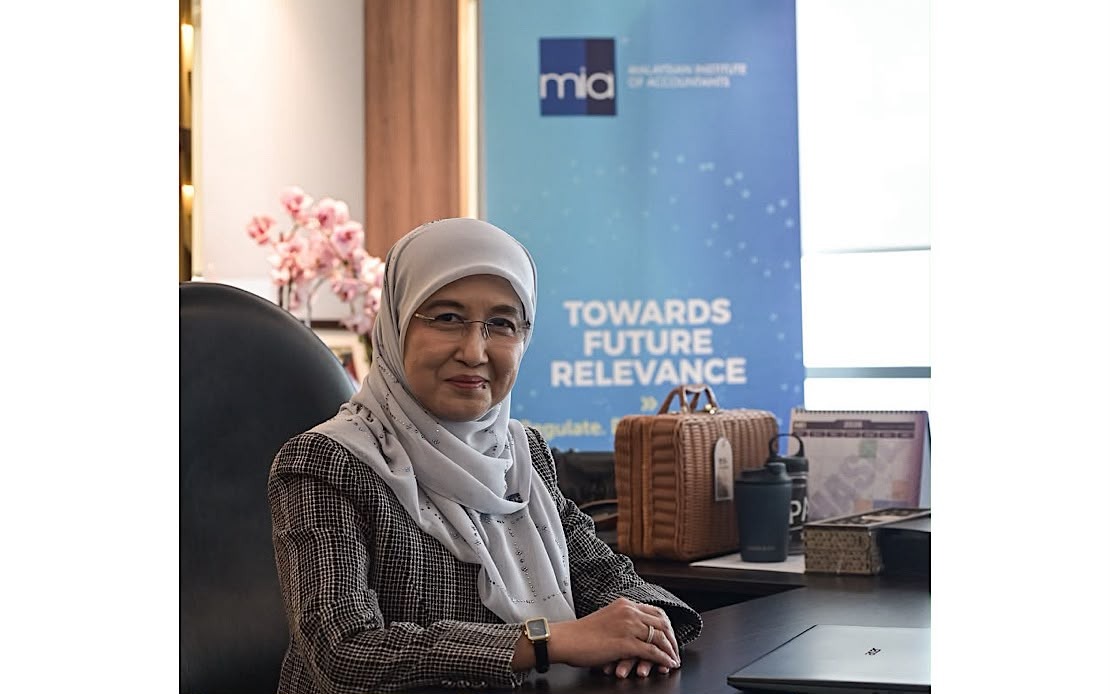
As Malaysia navigates rapid economic transformation and heightened global scrutiny on financial governance, the nation's accountancy profession faces mounting pressure to reinvent itself as a forward-thinking, ethics-driven sector capable of delivering strategic value to businesses and maintaining public trust. The Malaysian Institute of Accountants has staked its vision on positioning accountants as trusted advisers who transcend traditional bookkeeping to become integral players in corporate strategy and risk management, a transition that will determine whether the profession thrives or becomes obsolete in an AI-driven economy.
Datuk Saniza Said, recently elected as MIA's first female president in December 2025, articulated this challenge during recent remarks in Kuala Lumpur, emphasising that accountants today must operate across a vastly expanded remit encompassing business advisory, strategic planning, and stakeholder assurance. This evolution reflects a fundamental shift in how organisations view financial professionals—no longer as gatekeepers of ledgers but as strategic partners capable of exercising sophisticated professional judgement in complex, ambiguous business environments. The accountability framework that once centred on compliance and accuracy has broadened to encompass proactive guidance on future risks, opportunities, and sustainability imperatives that shape long-term competitiveness.
At the heart of this transformation lies a paradox that will define the profession's trajectory. Technological disruption—particularly artificial intelligence, automation, and advanced data analytics—poses both existential threat and transformative opportunity. Saniza acknowledged this tension directly, noting that professionals who resist upskilling face obsolescence, yet simultaneously cautioning that human judgment, responsibility, and ethical reasoning cannot be replicated by algorithms. Her position reflects a pragmatic understanding that AI will inevitably absorb routine transactional work, from data entry to basic reconciliation, but that the higher-order cognitive functions distinguishing professional accountancy from computational processing remain fundamentally human. This distinction carries profound implications for how Malaysian accountants position themselves in the regional job market and how they justify their economic value proposition to employers.
The MIA leadership consensus holds that technological adoption, far from diminishing professional opportunity, should liberate accountants from tedious manual work to pursue more intellectually demanding and commercially rewarding roles. G. Shanmugam, MIA's chief executive officer, articulated this vision with particular emphasis on the emerging concept of foresight capabilities—the ability to anticipate business challenges and market opportunities before they materialise. In an era when competitive advantage accrues to organisations that perceive trends early, accountants equipped with predictive analytics and trend-identification skills become invaluable to boards and management teams seeking guidance on future positioning. This reorientation represents a significant cultural shift for a profession traditionally defined by retrospective financial analysis and historical record-keeping.
Sustainability reporting and environmental, social, and governance (ESG) assurance exemplify this emerging frontier. Shanmugam highlighted MIA's recently launched Sustainability Blueprint and Roadmap as frameworks enabling members to develop competencies in sustainability accounting and potential assurance provision. As global capital flows increasingly favour companies demonstrating credible sustainability commitments, Malaysian accountants who master this domain position themselves as indispensable to the region's businesses seeking to attract international investment and maintain competitive relevance in a sustainability-conscious marketplace. For Malaysian practitioners, this capability development opens pathways to higher-fee advisory work and positions the profession as essential to corporate governance modernisation.
The ethical and integrity foundations underlying this evolution cannot be overstated. Saniza placed considerable emphasis on rebuilding and sustaining stakeholder confidence through unwavering commitment to transparency, accountability, and ethical principles. In a Southeast Asian context where financial misconduct remains a persistent governance challenge, this positioning carries strategic significance. Malaysian accountants who establish themselves as guardians of integrity and independent assurance providers become invaluable commodities in a region where investor confidence in financial disclosure remains variable. The profession's capacity to demonstrate robust ethical standards directly influences Malaysia's broader reputation as a trustworthy financial destination capable of hosting regional headquarters, asset management operations, and sophisticated capital markets activities.
MIA's membership base of approximately 42,000, growing at 1.5 to 2.0 percent annually, provides the institutional foundation for this transformation, but requires deliberate capacity building. The institute's annual slate of roughly 1,000 Continuing Professional Development programmes, supplemented by conferences, online learning platforms, and networking initiatives, reflects recognition that evolution cannot be imposed top-down but must be embedded through accessible, relevant professional development. This scale of investment in lifelong learning reflects both the profession's commitment to member relevance and the genuine complexity of keeping pace with technological advancement, regulatory evolution, and changing business expectations. For Malaysian practitioners at all career stages, this accessibility matters considerably—it enables mid-career professionals to pivot toward advisory work without relocating to international financial centres.
The argument that technological advancement will ultimately render accounting more attractive to younger talent hinges on a credible claim that repetitive work elimination translates into more engaging, higher-status roles. Shanmugam advanced this perspective explicitly, contending that automation reduces mundane tasks while expanding opportunities in analytical, managerial, and advisory functions. If substantiated, this dynamic could reverse a concerning trend in Southeast Asia whereby talented graduates increasingly view accounting as a stepping stone rather than a destination career. Malaysian universities and professional firms have observed this migration toward technology and management consulting, partly because accounting is perceived as rule-following rather than intellectually frontier work. Reframing accountancy as a strategic profession where young professionals rapidly advance to challenging advisory roles could meaningfully shift recruitment and retention dynamics across the profession.
The regional context amplifies stakes for this professional evolution. As ASEAN economies integrate more deeply and competition for professional talent intensifies, Malaysian accountants must develop capabilities that position them competitively against peers in Singapore, Thailand, and Indonesia. Shanmugam's emphasis on foresight and predictive capabilities, combined with Saniza's focus on trust and professional judgment, outlines a differentiation strategy rooted in human expertise and ethical grounding rather than technological prowess alone. This positioning acknowledges that AI and automation are becoming commoditised globally; competitive advantage accrues to practitioners who combine technological literacy with deep business understanding and impeccable professional judgment. For Malaysia, where financial services represent a meaningful economic sector with ambitions for greater regional prominence, accountancy profession excellence becomes a competitive necessity rather than a peripheral concern.
The challenge ahead extends beyond individual professional development to institutional adaptation. MIA must ensure that professional standards, continuing education frameworks, and member support systems evolve in synchronisation with technological change and business expectation shifts. The risk of professional fragmentation exists—where some practitioners successfully navigate toward advisory roles whilst others remain locked in automation-displaced transactional work. Managing this transition equitably, ensuring that smaller firms and regional practitioners access upskilling opportunities equivalent to their Kuala Lumpur counterparts, and maintaining professional cohesion during technological disruption constitute substantial leadership challenges. Saniza's election as MIA's first female president may signal institutional readiness to think unconventionally about professional representation and evolution, though only sustained action will validate whether this symbolic shift translates into substantive organisational transformation.
Ultimately, the Malaysian accountancy profession's future-readiness hinges on executing a difficult dual imperative: embracing technological capability and data-driven advisory whilst maintaining the ethical anchors that justify professional autonomy and stakeholder trust. Neither imperative can succeed in isolation. Technology without ethical grounding produces sophisticated financial manipulation. Ethics without technological literacy becomes irrelevant to modern business decision-making. Malaysian accountants who internalise this integration, positioning themselves as technologically competent trustees of financial truth and strategic advisers grounded in rigorous ethical practice, will thrive. Those who treat technology and ethics as separate concerns risk becoming obsolete or ethically compromised. For Malaysia's competitive positioning in the Asian financial system and for the accountancy profession's capacity to attract and retain excellent talent, getting this balance right matters enormously.

