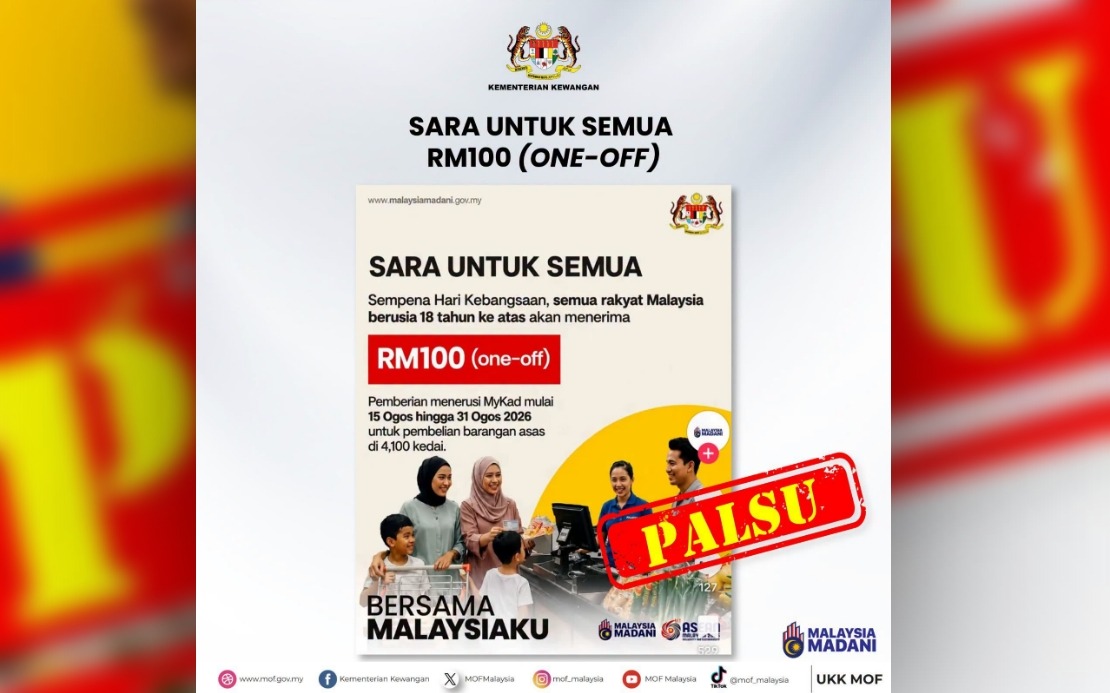
The Ministry of Finance moved swiftly on Tuesday to quash a false claim circulating on social media suggesting that all Malaysians aged 18 years and older would be eligible to receive a one-time RM100 disbursement under the Sumbangan Asas Rahmah scheme as part of National Day celebrations. The ministry issued a direct statement through its official social media channels categorically denying the allegation and labelling the poster promoting this narrative as fictitious.
Viralised misinformation of this nature carries particular potency in Malaysia's densely connected digital ecosystem, where social media platforms serve as primary information sources for millions of citizens. The rapid spread of such claims—particularly those involving promised government payments—can generate genuine public confusion and create unnecessary pressure on government agencies to respond. The ministry's quick intervention reflects an understanding of how swiftly unverified posts can propagate across messaging applications and social networks, potentially reaching audiences who may lack the means or inclination to verify information through official channels.
In its statement, the Ministry of Finance emphasised that no authoritative announcement regarding any SARA payment distribution aligned with National Day had been sanctioned or publicised through legitimate government communication mechanisms. This explicit clarification was designed to address a known gap in public information literacy, where citizens sometimes struggle to distinguish between authentic government communications and fabricated content designed to imitate official announcements. The ministry's reference to unverified posters circulating online underscores how sophisticated misinformation campaigns have become, often employing design elements and language that superficially resemble legitimate government messaging.
The ministry's advisory cautioning citizens to obtain all government information exclusively through verified official channels represents a broader digital hygiene initiative gaining traction across Southeast Asian governments. As digital literacy remains inconsistently developed across Malaysia's diverse population, establishing clear hierarchies of trustworthy information sources has become essential governance infrastructure. Citizens are encouraged to disregard unattributed claims and instead consult the Ministry of Finance's official website, verified social media accounts, and mainstream news outlets that maintain editorial standards and fact-checking protocols.
The broader context for this denial relates to Malaysia's existing welfare and assistance schemes, which have become increasingly prominent following various government programmes designed to provide targeted financial relief. The Sumbangan Asas Rahmah programme itself carries real weight in public consciousness given its actual implementation in recent years, making it a particularly credible vehicle for fabricated claims. This vulnerability suggests that awareness campaigns about genuine government assistance programmes, while necessary and important, can inadvertently create openings for fraudulent variations of these schemes to gain traction.
Misinformation about government payments represents a particularly insidious category of false information because it directly engages people's material interests and economic concerns. During periods when household budgets face genuine pressure from inflation or employment uncertainties, claims promising unexpected cash disbursements possess considerable psychological appeal. The deliberate circulation of such claims, whether motivated by mischief-making, political opportunism, or profit-seeking, exploits real economic anxieties within the population.
The ministry's emphasis on citizens practising verification discipline before sharing content reflects an acknowledgement that social media users themselves function as distribution mechanisms for false information. Every share, repost, or forward of unverified claims amplifies its reach exponentially. By appealing directly to citizens' responsibility as information stewards, the ministry attempted to interrupt this multiplication effect at source. This approach recognises that government debunkings alone cannot counter the ongoing production of new misinformation, requiring instead a shift in collective behaviour around information sharing.
For Malaysian policymakers and administrators, this incident illustrates ongoing challenges in maintaining information environment integrity as digital penetration deepens across the country. The sophistication required to detect advanced misinformation—including deepfakes, manipulated documents, and coordinated disinformation campaigns—continues to escalate. Government agencies must balance rapid response capabilities with measured communication that avoids inadvertently amplifying false claims through excessive attention.
The timing relative to National Day is noteworthy, as major national occasions frequently attract increased misinformation activity, both from opportunistic actors seeking maximum audience exposure and from those attempting to exploit heightened patriotic sentiment and national conversation intensity. Vigilance during such periods requires coordination across government communications departments and cooperation with platform operators to identify and restrict distribution of particularly harmful false content.
Looking forward, the incident reinforces the necessity for government agencies to maintain proactive communication strategies that regularly remind citizens about legitimate assistance programmes and official communication channels, thereby reducing the credibility gap that false claims exploit. When citizens maintain updated awareness of actual government initiatives and the approved methods for accessing information about them, fabricated variants become more readily identifiable as suspicious. Additionally, strengthening partnerships with educational institutions, community organisations, and media entities to improve population-wide digital literacy represents a long-term institutional response to the persistent challenge of misinformation circulation in increasingly networked societies.

