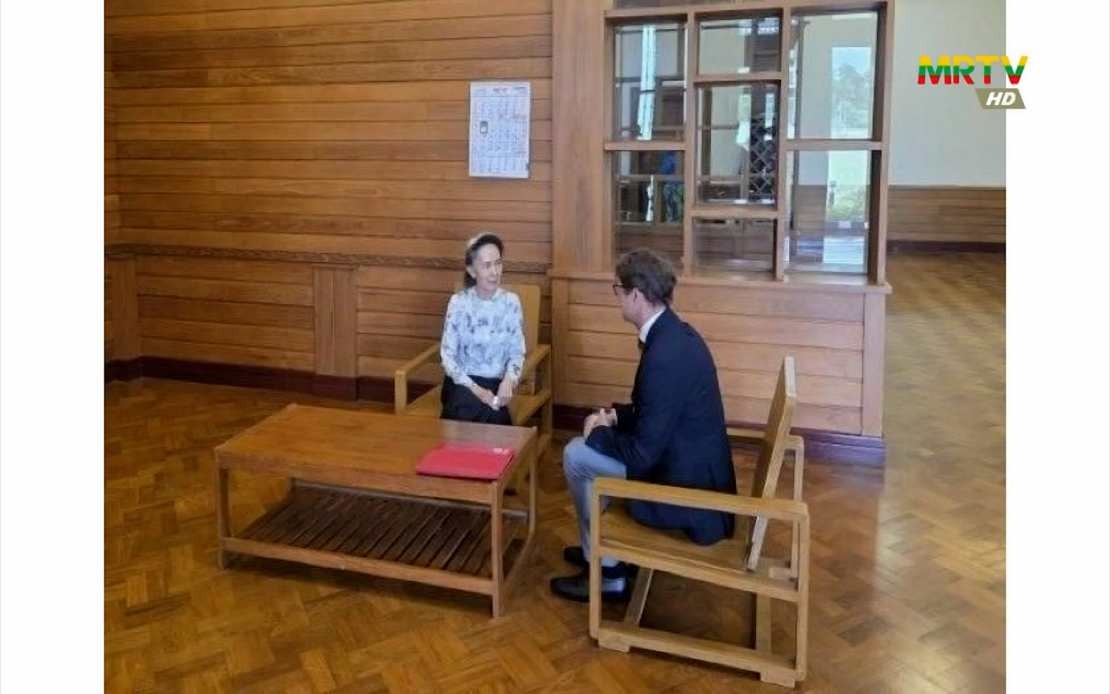
Myanmar's government revealed on Monday that Aung San Suu Kyi, the country's ousted civilian leader, has met with Arnaud de Baecque, the International Committee of the Red Cross resident representative to Myanmar, in the capital Naypyitaw. The encounter marks a rare breach in the secrecy surrounding the 81-year-old Nobel Peace Prize laureate, who has remained isolated since the military's February 2021 coup ended her government's decade-long democratic experiment. Government spokeswoman Khine Khine Soe announced the development through Telegram, alongside photographs purporting to show the meeting in a sparsely appointed wooden-paneled room and images of Suu Kyi celebrating a birthday.
For Malaysian observers and regional policymakers, this development carries significant implications for how Myanmar's military administration operates under international scrutiny. Since seizing power three and a half years ago, the junta has systematically excluded foreign dignitaries and diplomatic missions from meaningful access to Suu Kyi, maintaining an information blackout that has fuelled speculation about her actual condition. No foreign leader or official envoy has publicly met with her until now, making this Red Cross contact a potential turning point in how the Myanmar regime manages its international image and responds to external pressure on human rights matters.
The conviction record against Suu Kyi underscores the military's determination to neutralise her political influence permanently. Myanmar's courts conducted rushed, opaque trials following the coup, ultimately sentencing her to 33 years on charges spanning corruption allegations, election fraud incitement, and violations of state secrecy provisions. Her legal representatives and international observers have consistently characterised these prosecutions as politically motivated instruments designed to remove from contention the nation's most influential democratic politician. Subsequent reductions have whittled her sentence to 18 years remaining, yet even this figure effectively guarantees her detention beyond her natural lifespan, given her advanced age.
The government's handling of Suu Kyi's case reveals the junta's calibrated approach to managing external criticism whilst avoiding outright isolation. By orchestrating this Red Cross meeting and permitting photographs, Myanmar's leadership demonstrates tactical responsiveness to mounting regional demands for transparency. Thailand's Foreign Minister Sihasak Phuangketkeow openly called for international access to verify health claims during ASEAN meetings last month, whilst the Philippines previously requested permission for an ASEAN special envoy to visit. These coordinated regional voices have evidently pressured the military administration to make at least symbolic concessions to international concern.
However, the photographs themselves raise questions about authenticity and context. Reuters could not independently verify when or precisely where the images were captured, noting no earlier online circulation of the pictures before their official release. The birthday cake photograph, inscribed with a date of 19.6.2026, appears anomalous—suggesting either a celebration planned well in advance or documentation of an event from months prior. Such ambiguities reflect the opacity that has consistently characterised Myanmar's management of information about Suu Kyi, reinforcing international scepticism about official government claims regarding her wellbeing.
The human toll of Suu Kyi's detention extends beyond her immediate circumstance into family separation and genuine uncertainty about her longevity. Her son, Kim Aris, told Reuters last December that he receives only sporadic, secondhand reports about his mother's health struggles, including complications affecting her heart, bones, and gums. He has not heard directly from Suu Kyi in years, and expressed fears that she might perish without him gaining final contact. This isolation reflects the broader cruelty embedded within Myanmar's detention policies, where political adversaries face not merely imprisonment but deliberate estrangement from their closest family members.
The military's strategic repositioning on Suu Kyi's status occurred in tandem with broader institutional consolidation. In late April, following a controlled election process that elevated retired junta leader Min Aung Hlaing to the presidency, authorities announced Suu Kyi's relocation to house arrest. This ostensible softening coincided precisely with Myanmar's military-engineered electoral architecture, which maintained the armed forces' dominant political position whilst creating the superficial appearance of democratic participation. The timing suggests that authorities believed they had sufficiently consolidated power to afford minor humanitarian concessions without compromising control.
For Southeast Asian governments grappling with Myanmar policy, this development presents a strategic dilemma. The Red Cross meeting offers minimal substantive verification whilst providing the junta with valuable propaganda material—evidence of openness that can be weaponised against international critics. ASEAN's historically weak mechanisms for addressing member-state human rights abuses mean that regional pressure, whilst morally justified, carries limited enforcement capacity. Myanmar's recent military administrations have demonstrated consistent willingness to ignore external criticism when core power interests remain unchallenged, and Suu Kyi's political neutralisation constitutes precisely such a core interest.
The broader historical context illuminates the cyclical nature of Myanmar's democratic struggles. Suu Kyi herself endured 15 years of house arrest under a previous military dictatorship, confined to her family residence at Yangon's Inya Lake, where she delivered celebrated speeches to supporters gathering beyond the compound's metal gates. That earlier detention showcased her extraordinary resilience and became emblematic of Myanmar's democratic aspiration. Her current incarceration, by contrast, has been characterised by deliberate isolation and information suppression, reflecting the military's lessons from previous encounters with Suu Kyi's symbolic power and public magnetism.
The International Committee of the Red Cross, as a neutral humanitarian organisation, operates under strict confidentiality protocols governing such visits. The ICRC's delayed response to media inquiries suggests either institutional caution about confirming the meeting's substantive content or disagreement with the military's framing of the encounter. Red Cross visits typically focus on detention conditions rather than political advocacy, yet any independent assessment of Suu Kyi's health and living conditions would carry significant documentary weight in international forums. Whether such assessment remains genuinely independent or has been compromised by the Myanmar regime's control over access and environment remains an open question.
For Malaysia and regional democracies, Myanmar's trajectory represents a cautionary case study in how military forces, once returned to power, systematically dismantle institutional constraints on their authority. The methodical erasure of Suu Kyi from public and political life, orchestrated through judicial mechanisms and information control, demonstrates the fundamental incompatibility between military rule and democratic governance. As ASEAN navigates its non-interference doctrine against growing international human rights concerns, the Suu Kyi case exemplifies the tensions between respecting sovereign decision-making and condemning demonstrable abuses of detained political opponents.

