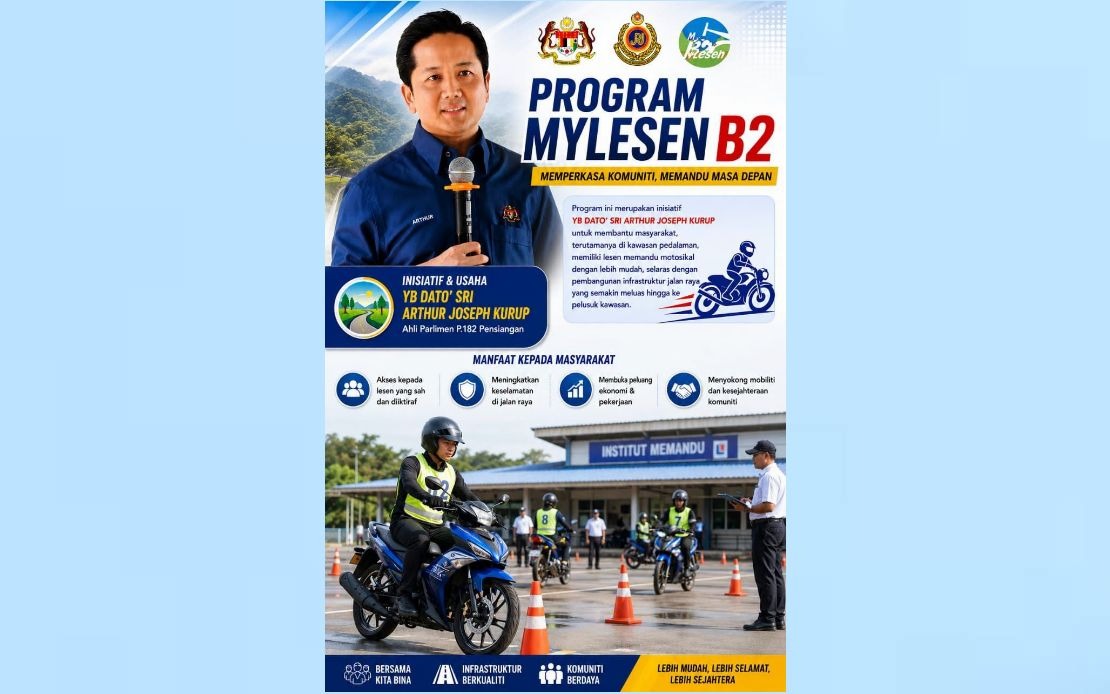
The MyLesen B2 mobile licensing initiative has made its return to Pensiangan in Sabah's interior, marking a renewed commitment to bringing formal motorcycle licensing services within reach of residents in remote areas who would otherwise face significant travel burdens to obtain proper documentation. Pensiangan Member of Parliament Datuk Seri Arthur Joseph Kurup, who also serves as Natural Resources and Environmental Sustainability Minister, unveiled the programme's resumption as part of broader efforts to improve road safety and economic mobility across rural Malaysian communities.
The programme addresses a genuine challenge facing many interior communities: the geographic isolation that makes accessing conventional driving schools and testing centres impractical for residents lacking personal transport or sufficient income for travel expenses. By decentralising the licensing process, MyLesen B2 eliminates a structural barrier that has historically discouraged rural residents, particularly younger people, from formalising their riding qualifications. This localised approach acknowledges that distance and cost remain significant deterrents, even for those otherwise motivated to comply with legal requirements.
Participants enrolled in the programme will not bypass established safety standards. Instead, the initiative brings the necessary coursework and testing protocols to the community, ensuring that all riders gain the required knowledge of traffic regulations and practical riding competency before receiving their licences. This maintains licensing integrity while addressing the accessibility problem that has left many rural riders operating informally without proper credentials. Arthur emphasised that this combination of accessibility and rigour serves the dual purpose of facilitating legal compliance whilst building genuine road safety awareness among populations whose driving patterns often differ substantially from urban contexts.
The economic and social dimensions of motorcycle licensing carry particular weight in rural Sabah, where two-wheelers serve not merely as personal transportation but as essential tools for livelihood. Young people in agricultural and resource-dependent communities frequently rely on motorcycles to reach employment, markets, and services. Lacking a formal licence creates vulnerability to enforcement actions and excludes individuals from economic opportunities that explicitly require proper documentation. Arthur highlighted that a valid motorcycle licence, once obtained, remains functional throughout a person's life subject to regulatory compliance, making it a durable asset that expands long-term economic horizons.
The programme targets residents aged 16 to 63, with priority given to first-time applicants who have never previously held driving documentation. This inclusivity extends opportunity across age cohorts, recognising that licensing barriers affect both young people entering the workforce and adults whose circumstances have previously prevented formalisation. By removing the excuse of inaccessibility, the initiative sets clearer expectations for legal compliance across the community whilst demonstrating government willingness to meet residents halfway rather than demanding they navigate urban bureaucracies.
For Malaysian policymakers, the MyLesen B2 model represents a pragmatic approach to translating licensing frameworks into lived reality across diverse geographic and socioeconomic contexts. Rural areas throughout Malaysia face analogous infrastructure and accessibility constraints; the lessons from Pensiangan's experience could inform similar interventions in Peninsular Malaysia's rural zones and other East Malaysian communities. Mobile licensing programmes acknowledge that policy implementation requires adaptation to local conditions rather than uniform, one-size-fits-all administration.
The broader implications extend to road safety discourse in Malaysia. Formal licensing serves not only administrative functions but also represents an entry point for driver education and safety awareness. Rural communities often experience disproportionately severe traffic outcomes relative to accident frequency, reflecting patterns of inadequate training, less-developed road infrastructure, and higher speed differentials between vehicles and vulnerable road users. By formalising riding practices through accessible licensing, MyLesen B2 potentially contributes to measurable safety improvements, though effectiveness ultimately depends on post-licensing compliance and sustained enforcement.
Registration for the Pensiangan programme operates through two service centres: the Pensiangan Parliamentary Service Centre and the Sook State Assemblyman's Service Centre, making application points reasonably distributed across the constituency. This administrative decentralisation mirrors the programme's broader philosophy of bringing government services closer to residents rather than concentrating access in single locations that may remain geographically or financially inaccessible to portions of the target population.
The timing of MyLesen B2's return to Pensiangan reflects renewed attention to rural development priorities within the current political landscape. Arthur's dual portfolio spanning parliamentary representation and a ministerial position overseeing natural resources and environmental matters suggests integration of licensing accessibility into broader rural welfare considerations. This suggests that motorcycle licensing, whilst ostensibly a traffic administration matter, has acquired recognition as a development and livelihood issue worthy of ministerial-level attention.
Longer-term success of the Pensiangan initiative will depend on sustained commitment beyond the initial launch period. Rural programmes frequently suffer from inconsistent implementation or premature withdrawal once political attention shifts. Ensuring that MyLesen B2 maintains regular operational schedules and that licensing remains genuinely accessible requires institutional embedding rather than episodic deployment. For residents, the immediate benefit is clear: formalising their riding status whilst remaining within their communities, but the enduring value depends on whether government commitment matches the initial enthusiasm.
The programme also carries implicit messaging about inclusive governance in Malaysia's federal structure. Sabah residents, historically expressing concerns about development parity relative to Peninsular Malaysia, may view targeted initiatives like MyLesen B2's return as recognition of legitimate grievances about service accessibility. Conversely, the programme's success could model approaches applicable across Malaysian regions facing similar rural-urban service disparities, potentially influencing policy conversations about how centralised systems can better accommodate distributed populations without requiring individuals to absorb prohibitive transaction costs.

