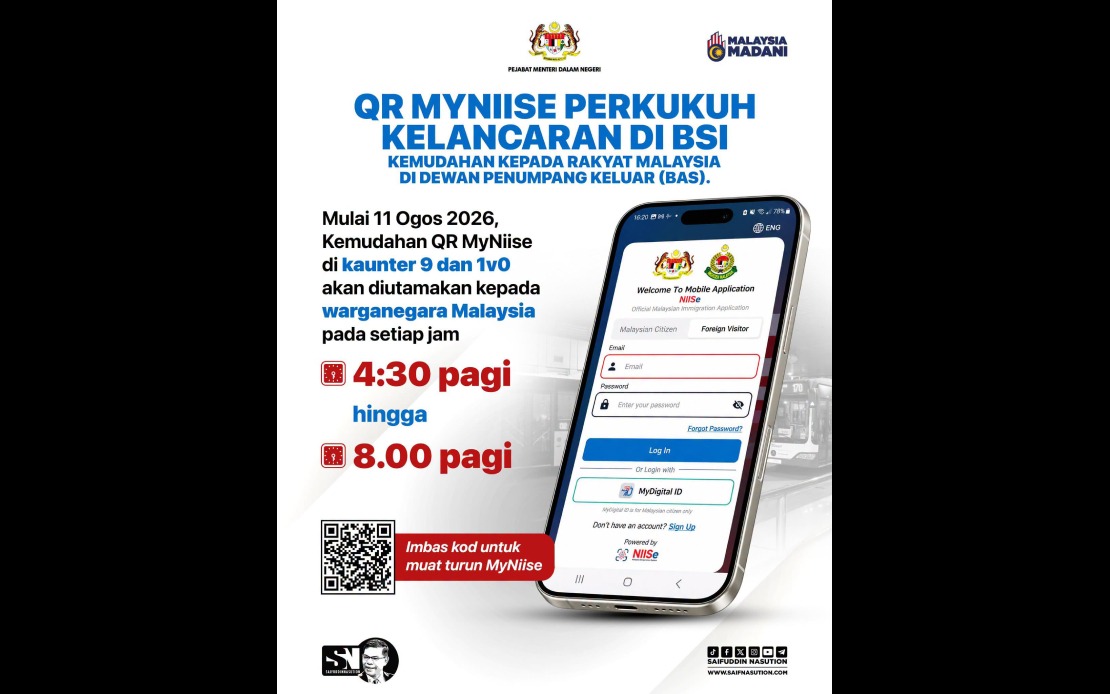
Malaysia's Home Minister Datuk Seri Saifuddin Nasution Ismail has unveiled an expedited border-crossing initiative designed to streamline the daily migration of commuters heading to Singapore. Beginning August 11, travellers who have downloaded the National Integrated Immigration System (MyNIISe) QR code will receive prioritised processing at Bangunan Sultan Iskandar, the major land checkpoint between the two nations. This move represents a tangible application of the government's broader digitalisation agenda, which has sought to reduce administrative friction at key entry points across Malaysia.
The priority lanes will operate from counters 9 and 10 located within the Bus Departure Hall, functioning during the heaviest flow period from 4.30 am to 8 am. This timing directly addresses a significant pain point for cross-border commuters, particularly those employed in Singapore's commercial and industrial sectors who must navigate morning congestion while catching scheduled coach services. The Home Minister acknowledged the genuine hardship faced by these daily travellers, noting that many depart Malaysia during the pre-dawn hours to secure their place on buses and arrive at Singaporean workplaces on schedule. By concentrating the intervention during these critical morning hours, authorities have identified where the system experiences maximum strain and where efficiency gains will yield the greatest benefit.
MyNIISe represents one of the Malaysian government's flagship technological reform initiatives, reflecting a wider regional trend toward digitised border management. The system can be accessed through multiple platforms—Apple's App Store, Google Play Store, and Huawei App Gallery—ensuring compatibility across Android, iOS, and Huawei devices. This multi-platform approach removes barriers to adoption, particularly among users with older smartphones or those preferring alternative ecosystems. The availability across these channels demonstrates the administration's commitment to inclusive technological accessibility rather than vendor lock-in, a consideration increasingly important in Southeast Asia where device preferences vary widely.
The introduction of dedicated MyNIISe QR lanes at Bangunan Sultan Iskandar must be understood within the context of Malaysia-Singapore border dynamics. The two countries maintain one of the world's highest-volume land border crossings, with hundreds of thousands of daily movements. The checkpoint has historically experienced bottlenecks during peak periods, creating externalities that ripple through both economies—delayed workers, missed meetings, and cascade effects on bus operators and logistics networks. By creating differential processing speeds based on technological adoption, the initiative creates an incentive structure encouraging digital engagement while simultaneously unburdening conventional counters.
For Malaysia-based readers, particularly those in the Klang Valley and Johor who regularly traverse this border, the announcement carries immediate practical implications. The creation of priority lanes effectively establishes a two-tier system where early technology adopters gain measurable time savings during rush periods. However, this also raises questions about digital equity—those lacking smartphones or unfamiliar with app-based systems remain channelled through conventional lanes. The initiative's success will depend partly on how effectively authorities communicate the system to potential users and whether alternative mechanisms remain available for those unable to utilise the digital pathway.
The timing of this announcement reflects broader Southeast Asian trends in border modernisation. Singapore and Thailand have implemented similar systems, creating pressure on Malaysia to maintain competitive standards in facilitating cross-border commerce and labour movement. The MyNIISe initiative sits within this regional competition for efficient border processes, particularly as ASEAN economic integration deepens and cross-border workforces become increasingly normalised. Malaysian policymakers have recognised that border efficiency directly impacts the nation's attractiveness as a logistics hub and employment destination.
From an operational perspective, the implementation appears carefully calibrated. Rather than attempting a wholesale transformation of the entire checkpoint, authorities have introduced the system at specific counters during defined hours, allowing for monitoring and adjustment before potential expansion. This phased approach permits data collection on adoption rates, processing speed improvements, and user satisfaction—information essential for determining whether to expand the initiative to additional counters or time periods. The Bus Departure Hall location also proves strategic, as bus users represent a discrete, identifiable population whose behaviour patterns are predictable and measurable.
The practical benefits for daily commuters should prove substantial. Under normal circumstances, morning clearance at Bangunan Sultan Iskandar can consume 20-40 minutes depending on congestion levels. A functionally faster QR-based system could reduce this to 5-10 minutes, translating into meaningful time savings that accumulate across thousands of daily users. For those catching 5 am or 6 am departures to Singapore, this represents the difference between arriving comfortably early or narrowly missing their transport. Over a year, such savings compound into hundreds of hours recovered—time available for sleep, family interactions, or productive work preparation.
The initiative also hints at the government's longer-term vision for immigration processes. Digital QR systems require minimal physical infrastructure, reduce paperwork handling, and create audit trails that enhance security compliance. Should the Bangunan Sultan Iskandar trial succeed, similar implementations at other major checkpoints—Johor Bahru, Bukit Kayu Hitam, Padang Besar—would further cement Malaysia's position as a regionally progressive border administrator. This positioning carries economic significance, influencing decisions by regional companies regarding where to establish headquarters, warehouses, and operations centres.
For the broader Malaysian public, this announcement signals continued investment in technological solutions to administrative challenges. Whether citizens live near the Singapore border or not, the MyNIISe system demonstrates government capacity to identify problems, develop digital solutions, and implement them with reasonable efficiency. This generates confidence in other potential digital initiatives, from tax administration to licensing. However, the initiative's actual impact will ultimately depend on adoption rates and whether the promised time savings materialise in practice—metrics that authorities will presumably track and eventually publish.

