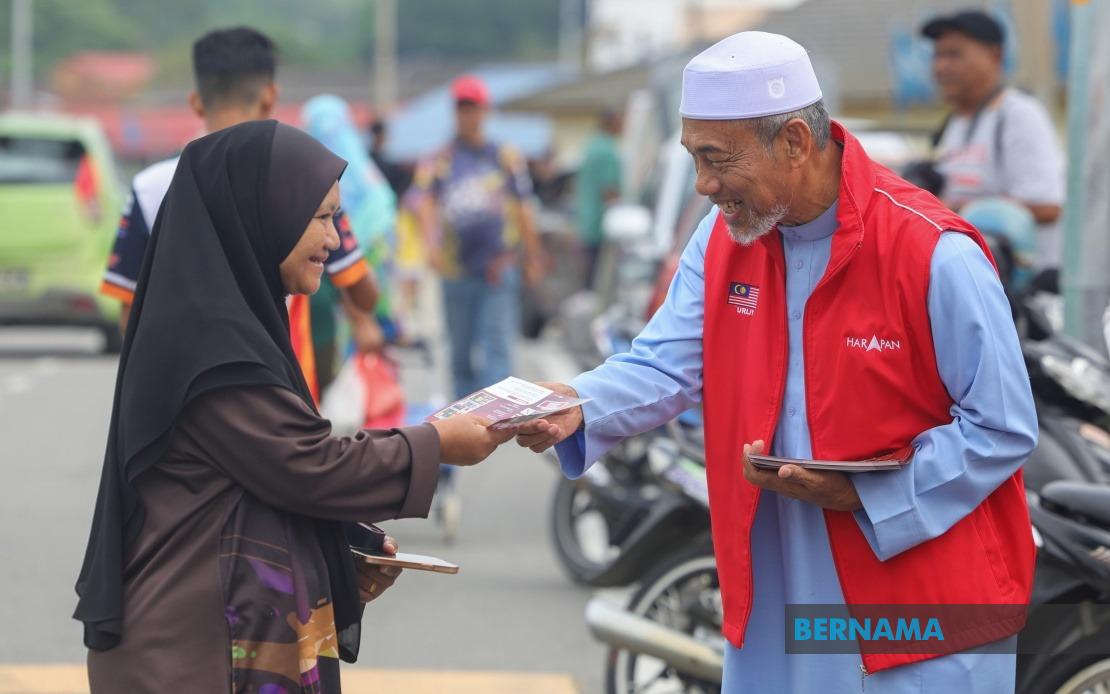
Candidates fighting the 16th Negeri Sembilan State Election have shifted into overdrive on the ground, launching an ambitious voter engagement strategy that sees many politicians criss-crossing their constituencies with packed daily schedules designed to maximise personal contact before the August 1 ballot. With just 12 days remaining in the campaign window, candidates spanning Pakatan Harapan, Barisan Nasional, and other contenders have adopted an intensive grassroots approach, eschewing large rallies in favour of intimate community interactions that allow them to address local concerns directly.
Menteri Besar Datuk Seri Aminuddin Harun, defending his Linggi state seat, exemplifies this ground-centric campaign model. On the second day of campaigning, Aminuddin began early, performing dawn prayers at Masjid Jamek Pasir Panjang before joining residents for breakfast—a deliberate move to embed himself within the constituency's rhythm. His subsequent walkabouts threaded through multiple residential areas and kampungs: Pasir Panjang town, Taman Setia, Taman Kekatong, Rumah Rakyat Telok Pelandok and Kampung Telok Pelandok. He concluded the morning programme with targeted community engagement, holding a special meeting with members of the Indian community, signalling an understanding that electoral success in diverse constituencies demands tailored outreach.
As the Negeri Sembilan Pakatan Harapan chairman and PKR vice-president, Aminuddin articulated the strategic rationale underlying such intensive engagement: these grassroots encounters offer irreplaceable opportunities to hear constituent grievances and understand the development priorities that matter most to ordinary Malaysians. His public remarks reflected a commitment to translating these conversations into action, framing the election not as a one-off political event but as a mandate-seeking exercise predicated on demonstrated responsiveness to community needs. The language employed—"strengthens my resolve to continue serving"—underscores how Malaysian politicians increasingly frame electoral campaigns as accountability checkpoints rather than purely competitive contests.
Opposition figures have adopted similarly aggressive ground strategies. Anthony Loke, the DAP secretary-general defending the Chennah seat, launched his campaign by conducting a walkabout at Seremban Central Market, a deliberate choice targeting working-class and merchant voters who frequent such spaces early in the day. His schedule included an evening state election dinner programme, structuring his day to reach voters across temporal and social segments. This approach reflects the tactical sophistication increasingly evident in Malaysian state-level politics, where candidates recognise that electoral victories are often determined not by grand narrative battles but by demonstrating visible presence and accessibility across multiple community touchpoints.
The intensity of these campaigns is reflected in candidate scheduling across the Pakatan Harapan slate. Kamarul Ariffin Wafa, the PH contender for Seri Menanti, has organised eight separate programmes, indicating that modern Malaysian election campaigns increasingly resemble marathon endurance tests rather than traditional sprint-based efforts. Similarly, Yaacob Mahmood, contesting Serting for PH, has adopted a breakfast-and-walkabout template, deliberately positioning himself in casual settings where voters engage without formal protocols or rehearsed messaging. He emphasised that such informal encounters facilitate genuine dialogue on local issues—a strategic acknowledgement that contemporary voters increasingly demand substantive engagement over ceremonial handshakes.
Barisan Nasional candidates have not been outpaced by these Pakatan Harapan initiatives. Datuk Seri Mohamad Hasan, the incumbent Rantau assemblyman and BN deputy chairman widely known as "Tok Mat", maintained visible presence within his constituency by spending time at the BN Polling District Centre in Mambau, underscoring the importance BN assigns to maintaining organisational infrastructure during campaigns. Datuk Seri Jalaluddin Alias, the Negeri Sembilan UMNO Liaison Committee chairman, adopted a community-focused approach by first attending a Pertang constituency youth sepak takraw tournament before visiting Orang Asli communities in Kampung Utara Putra. This sequencing demonstrates calculated targeting: engaging youth through sporting events builds momentum and media visibility whilst Orang Asli outreach addresses a traditionally marginalised demographic requiring sustained political attention.
The sheer volume of electoral activity reflects the demographic and competitive context of Negeri Sembilan's election. A total of 889,490 registered voters are eligible to cast ballots, comprising 867,151 ordinary voters alongside 16,884 military personnel and their spouses and 5,455 police personnel. This relatively large electorate necessitates sophisticated campaign logistics; the gap between early voting (July 28) and polling day (August 1) creates pressure to consolidate voter support within compressed timeframes. Candidates scheduling up to nine daily programmes are effectively acknowledging that in increasingly competitive Malaysian elections, victory margins often hinge on getting supporters to polling stations rather than swaying undecided voters.
The dissolution of the Negeri Sembilan State Legislative Assembly on June 5 triggered this electoral cycle, with the Election Commission setting out a campaign calendar that, whilst providing 12 days of intensive campaigning, compresses the period for voter persuasion. This structural constraint explains the frenetic pace evident in candidate schedules across all major coalitions. Malaysian state elections increasingly attract sophisticated campaign management approaches developed at federal level, complete with detailed polling, demographic targeting, and voter micro-segmentation—explaining why candidates now emphasise meeting diverse community groups rather than addressing undifferentiated crowds.
For Malaysian and Southeast Asian observers, the Negeri Sembilan campaign offers insights into how electoral competition operates in the region's mature democracies. Unlike some neighbouring nations where campaigning concentrates on individual personality cults or mass mobilisation spectacles, Malaysian state elections increasingly resemble sophisticated consumer marketing operations. Candidates systematically target demographic segments—business communities, religious groups, youth, indigenous peoples—using carefully timed and locally calibrated messaging. The emphasis on breakfast walkabouts and informal market visits rather than formal rallies reflects recognition that Malaysian voters, particularly in urbanised or semi-urbanised areas, increasingly demand evidence of accessibility and responsiveness rather than rhetorical grandstanding.
The competitive intensity visible in Negeri Sembilan also reflects the state's political significance within Malaysia's broader electoral landscape. As a swing state where control has alternated between coalitions, Negeri Sembilan elections serve as crucial testing grounds for campaign methodologies and policy platforms before federal contests. Candidates and party strategists invest accordingly, treating the state as a laboratory for testing voter preferences on emerging issues. The grassroots intensity observed here will likely provide valuable feedback for both Pakatan Harapan and Barisan Nasional as they prepare for potential federal electoral contests, making the seemingly localised Negeri Sembilan campaign consequential for national political trajectories.
Ultimately, the packed schedules and grassroots saturation strategies evident across Negeri Sembilan's campaign reveal how Malaysian electoral politics continues evolving toward ground-based, voter-engagement-intensive models. Rather than attempting to win through media dominance or centralised messaging, contemporary candidates increasingly compete on their demonstrated presence within communities and their willingness to engage voters in informal, personalised settings. This shift, whilst resource-intensive for campaigns, may ultimately strengthen democratic accountability by creating multiple touchpoints where politicians must respond directly to constituent concerns without institutional filters.

