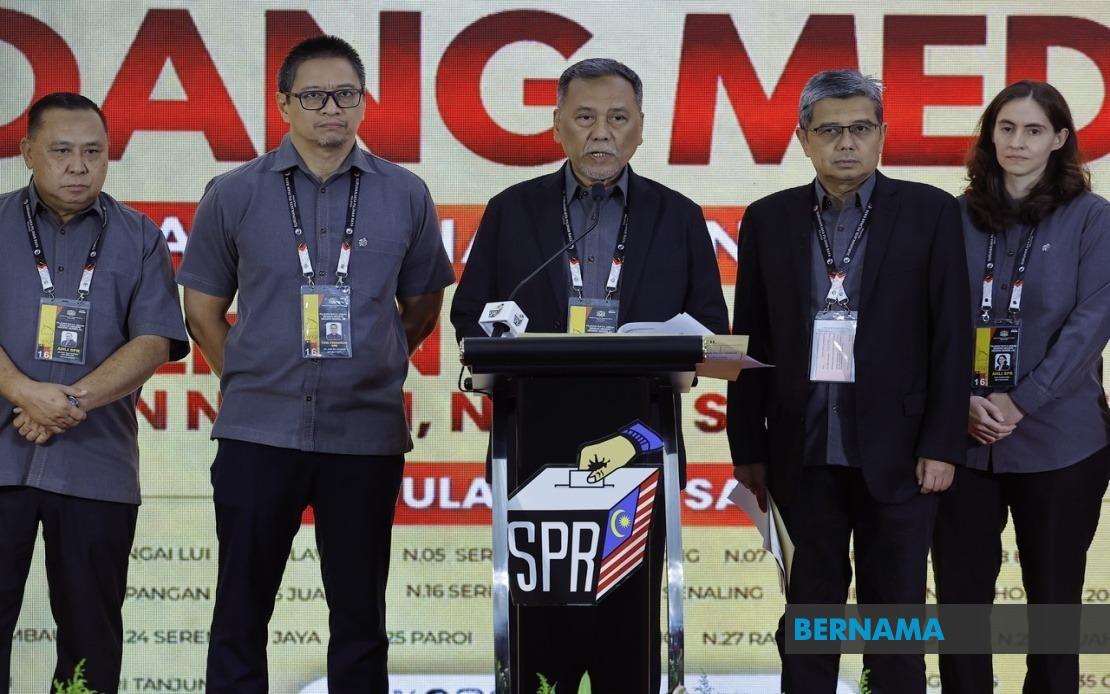
The Negeri Sembilan state election is shaping up to be a fragmented and competitive affair, with the Election Commission confirming that 103 candidates have met all eligibility requirements to contest the 16th state assembly polls. Election Commission chairman Datuk Seri Ramlan Harun made the announcement on July 18 after the nomination verification process concluded at eight designated centres across the state, with all submissions processed by the 10 am deadline.
Pakatan Harapan maintains a commanding presence in the contest by fielding the largest slate of candidates at 36 across all available seats. This represents a dominant show of force in what appears to be a three-cornered or multi-cornered fight in most constituencies. Barisan Nasional, the long-time governing coalition at the federal level, has nominated 25 candidates, positioning itself as a credible challenger but in second place. The landscape has become considerably more crowded with the emergence of Bersatu as a significant player, putting forward 24 candidates, and Perikatan Nasional contributing 11 more to the mix.
What distinguishes this election is the genuine splintering of the electoral battlefield. Beyond the major coalitions, smaller parties have secured representation on the ballot. Barisan Jemaah Islamiah Se-Malaysia (Berjasa), the Malaysian Orang Asli Party (ASLI), and the Socialist Party of Malaysia (PSM) each entered one candidate into the fray, while four independent candidates also cleared the nomination hurdle. This mosaic of contestants reflects broader shifts in Malaysian politics where traditional two-coalition contests have given way to more fluid, multi-party competition, particularly in state-level races where local grievances and personalities can override national partisan loyalties.
The configuration of contests across the state presents an intricate puzzle for voters. Datuk Seri Ramlan indicated that exactly 21 of the 36 seats will be contested by three candidates, the most common scenario. Meanwhile, 11 seats will see straight fights between two candidates only, offering voters a clearer binary choice. However, four seats have proven even more contentious. Nilai and Sri Tanjung will each witness five-cornered battles, where voters face the broadest selection of options, whilst Jeram Padang and Rahang are set for four-way contests. This uneven distribution means that voters' experiences will vary dramatically depending on their constituency, with some facing complex decisions among half a dozen options while others enjoy simpler choices.
The candidate pool itself reflects Malaysia's persistent gender disparities in electoral politics. Of the 103 nominees, 94 are men whilst only nine are women, underscoring the challenges women continue to face in securing party nomination and advancing their political careers at the state level. The age spectrum demonstrates remarkable diversity, with the oldest contender being 70 years old, running for Pakatan Harapan in Gemencheh, whilst the youngest is merely 23, representing Bersatu in Sri Tanjung. This generational range suggests that both establishment and insurgent political forces are attempting to balance experienced leadership with fresh momentum.
The electoral franchise for this contest encompasses 889,490 eligible voters spread across the 36 constituencies. The bulk of this electorate comprises 867,151 ordinary civilian voters who will cast ballots through standard polling procedures. However, the franchise extends beyond typical civilians to include 16,884 military personnel and their spouses, reflecting Malaysia's constitutional provisions for armed forces voting rights. Additionally, 5,455 police officers will participate, a smaller but politically significant segment that some observers monitor as an indicator of government influence within security forces. The total voter population, relative to Negeri Sembilan's size as a mid-tier state, suggests moderate-sized constituencies with manageable voting populations.
The Election Commission has structured the contest's timeline with several key dates. Early voting was scheduled for July 28, allowing voters with legitimate reasons for unavailability on polling day to cast their ballots beforehand. The main election day is set for August 1, providing what the commission considers adequate time for campaign activities and candidate promotion between the nomination deadline and the vote itself. This calendar represents standard practice for Malaysian electoral administration and provides competing parties roughly two weeks to mobilise their supporters and mount campaign efforts.
The triggering event for this election occurred on June 5 when the Negeri Sembilan state assembly was dissolved, initiating the constitutional process leading to fresh elections. This dissolution stemmed from political developments within the state that rendered the previous assembly untenable, though the specific circumstances reflected the fluid nature of state-level Malaysian politics where coalition formations and party allegiances can shift. State elections do not follow fixed five-year cycles in Malaysia as strictly as federal elections do, creating unpredictability in the electoral calendar.
For Malaysian politics observers, the Negeri Sembilan contest assumes significance beyond the state itself. As a mid-sized state with a mixed demographic profile and no overwhelming urban or rural character, it often serves as a bellwether for national political trends. The performance of Pakatan Harapan relative to Barisan Nasional will be closely monitored as an indication of voter sentiment regarding these coalitions' respective political fortunes. Furthermore, the showing of Bersatu and Perikatan Nasional, relative newcomers to the Malaysian electoral landscape, will provide evidence of whether these entities can consolidate support or whether they remain marginal forces in electoral politics.
The election also carries implications for the broader Southeast Asian region, where Malaysian state-level contests occasionally signal shifts in the regional political economy and power dynamics. Negeri Sembilan, whilst smaller than Selangor or Johor, remains economically and strategically relevant, and changes in its governance could have minor but discernible effects on regional supply chains and political alignments. International observers and analysts often use Malaysian state elections as early indicators of how democratic processes function in the region and what constituent pressures shape political outcomes.

