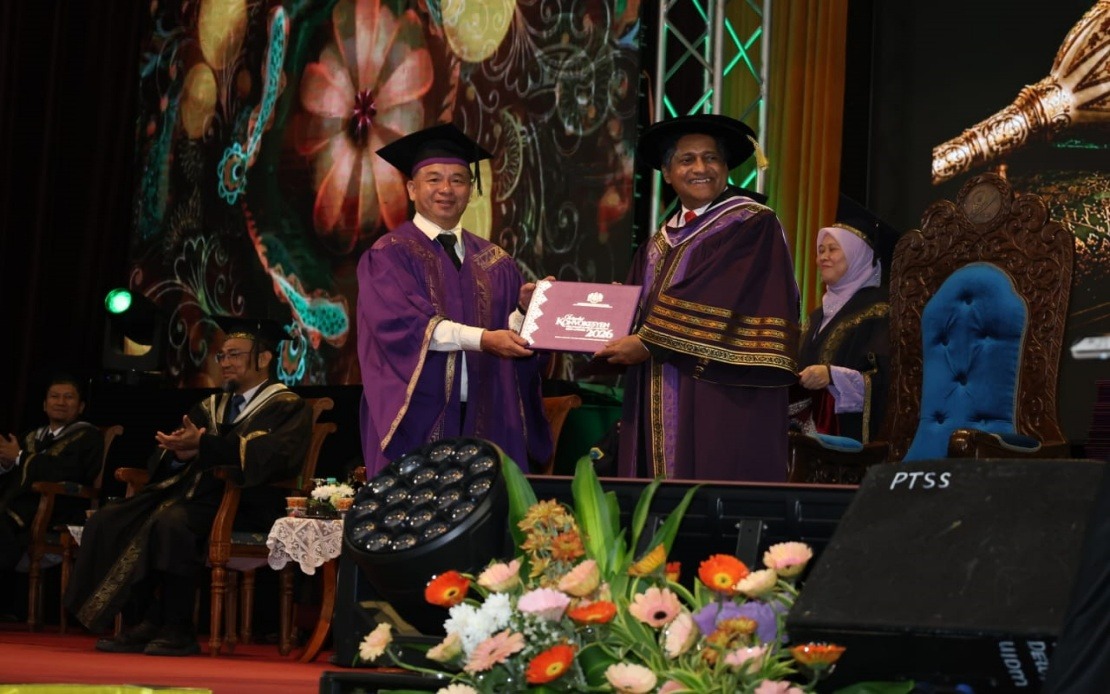
Heng Meng Lai has shattered age-related assumptions about education by graduating from Seberang Perai Polytechnic at 57, marking a historic milestone for the Bukit Mertajam institution. His achievement during the PSP Convocation Ceremony 2026 serves as a powerful testament to the viability of lifelong learning in Malaysia's technical education landscape, challenging prevailing notions about when formal qualifications must be obtained.
The journey to his Diploma in Electrical and Electronic Engineering spanned nearly five decades, interrupted by the competing demands of employment and family responsibilities. Rather than viewing this extended timeline as a failure of circumstance, Heng reframed it as an opportunity deferred, ultimately completing his studies with determination and focus that impressed both his educators and the institution's leadership. His persistence demonstrates that educational aspiration need not conform to conventional timelines, a message with significant implications for Malaysia's ageing population and career-switchers seeking formal qualifications.
Heng's early life shaped his resolve to pursue formal education as a pathway to self-improvement. Following his father's death when he was nine years old, his mother assumed the primary financial burden for their family of seven children, working in a sewing factory while young Heng navigated formative years marked by economic hardship. These circumstances instilled in him a conviction that education represented a genuine lever for upward mobility, even if immediate circumstances prevented him from exercising that option. Decades later, this foundational belief propelled him back into the classroom despite the accumulated weight of years and the daunting prospect of studying alongside teenagers and young adults.
Heng's selection of electrical and electronic engineering was not arbitrary but emerged organically from his extensive workplace experience. His career trajectory—progressing from storekeeper to production line supervisor at an electronics factory—exposed him to the technical dimensions of industrial manufacturing. This hands-on exposure cultivated a genuine intellectual curiosity about the engineering principles underlying the machinery and processes he encountered daily. By the time he enrolled at PSP, he brought not merely an abstract desire for credentials but a contextualised motivation rooted in years of observed professional practice.
The academic environment at Seberang Perai Polytechnic proved unexpectedly conducive to his learning despite the pronounced age differential between himself and classmates. Heng emphasised that faculty members provided patient, sustained encouragement throughout his programme, actively facilitating his integration into classroom dynamics rather than permitting his atypical student profile to become a source of alienation or marginalisation. This institutional responsiveness reflects PSP's broader commitment to inclusive pedagogy, demonstrating that Malaysian polytechnics can accommodate diverse student populations spanning wide demographic ranges without compromising educational quality or social cohesion.
Heng's immediate post-graduation plans reveal pragmatic ambition rather than romantic idealism about his newfound qualification. Rather than immediately pursuing advanced credentials, he intends to return to employment, applying and consolidating the theoretical knowledge and technical competencies acquired through his diploma programme. This measured approach acknowledges the economic realities facing a mature graduate while maintaining trajectory toward further formal education. His subsequent aspiration to pursue a bachelor's degree signals commitment to progressive credentialing, suggesting that his polytechnic diploma functions as a foundation for ongoing academic advancement rather than a terminal qualification.
From an institutional perspective, Heng's achievement carries significance beyond individual accomplishment. Mohd Ruzi Hamzah, the PSP director, positioned the graduate's success as validation of the polytechnic's institutional mission and demonstrated capacity to serve population segments extending far beyond traditional school-leavers. Heng's trajectory from shop floor worker to diploma-holding engineering technician illustrates the tangible mobility that technical education can facilitate, particularly for individuals whose earlier circumstances precluded conventional academic pathways. This visibility serves important signalling functions within Malaysia's technical education ecosystem, potentially encouraging similarly-situated adults to pursue formal qualifications they may have previously deemed inaccessible.
The Malaysian government has explicitly championed lifelong learning as a policy priority, recognising that demographic ageing and technological disruption will require continuous workforce reskilling. Heng's achievement aligns precisely with these national aspirations, exemplifying the human capital development outcomes that policymakers envision. By demonstrating successful completion of a demanding technical diploma programme by a mature student, his graduation validates the feasibility and effectiveness of inclusive polytechnic policies that accommodate non-traditional learners. PSP's institutional commitment to providing quality technical education across demographic segments thus translates concrete outcomes aligned with broader national development objectives.
The narrative of Heng Meng Lai also carries resonance for Malaysian society's evolving relationship with age and productivity. His refusal to accept age as disqualifying for educational participation or professional advancement challenges embedded assumptions about life-stage appropriateness for various endeavours. At 57, he began rather than concluded his formal technical training, inverting conventional expectations about where career development should occur. This inversion becomes increasingly important as life expectancy increases and mandatory retirement ages gradually extend, creating extended post-traditional-working-life phases during which individuals may logically pursue education either for personal development or enhanced employability.
For Southeast Asia more broadly, Heng's achievement illuminates possibilities within regional technical education systems. As countries across the region grapple with skills shortages and seek to maximise human capital utilisation, inclusive polytechnic models that welcome mature learners represent underexploited strategic advantages. Malaysia's demonstration that such models function effectively—as evidenced by PSP's successful accommodation of a 57-year-old diploma student—may offer instructive lessons for neighbouring nations developing technical education infrastructure. The scalability of such inclusive approaches could meaningfully expand the regional talent pool available for sectors experiencing persistent skills deficits.
Heng's experience also highlights the often-overlooked intersection between work experience and formal technical education. His decades in electronics manufacturing provided contextualised understanding that many younger students might lack, potentially enabling him to derive greater applied value from theoretical instruction. This suggests that mature learners may constitute a distinct pedagogical category whose educational experiences and outcomes warrant specific research attention. Understanding how polytechnics can optimise learning for students who arrive with extensive workplace familiarity could refine instructional design and assessment approaches, benefiting not only non-traditional learners but potentially enhancing overall programme effectiveness.

