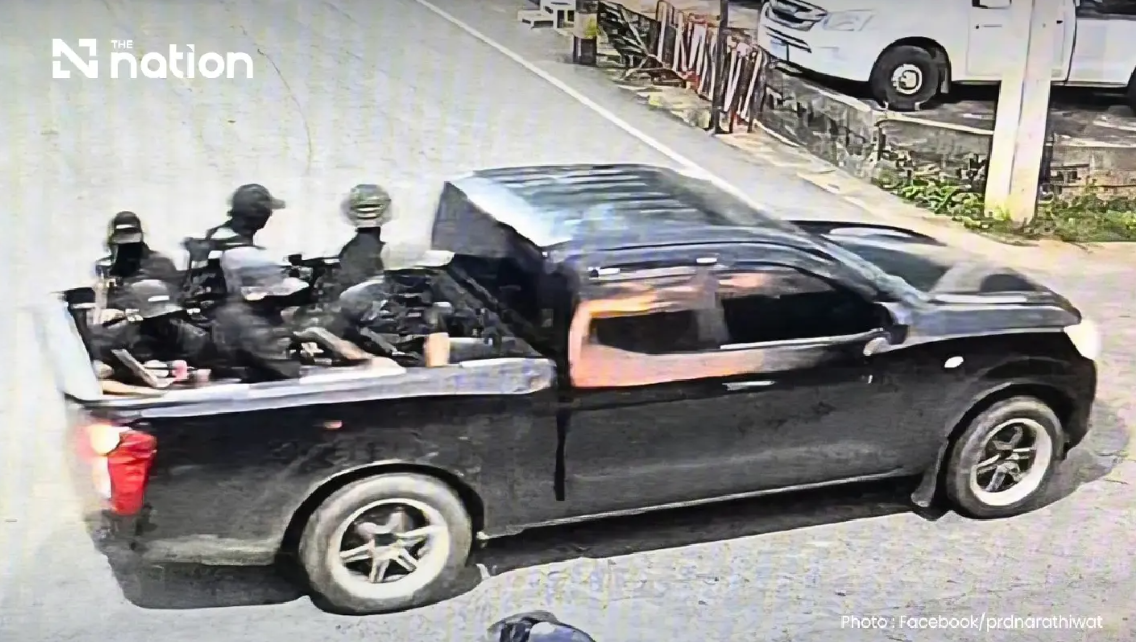
A coordinated assault on the Bukeh Sami checkpoint in Narathiwat province has exposed the sophistication of militant operations in Thailand's troubled southern region. Security camera recordings show nine attackers executing their raid in just 90 seconds on the evening of July 22, a duration that underscores the level of planning and coordination behind the operation. The attack resulted in five deaths among the paramilitary ranger force stationed at the outpost and left six civilians—including a child—requiring hospital treatment.
The incident occurred around 6:45pm at the checkpoint located in Village 7 of Tanyong Mat subdistrict, Ra-ngae district. The facility was staffed by personnel from the 4509th Ranger Company operating under the 45th Ranger Regiment Task Force, a unit responsible for counter-insurgency operations across the province. Authorities initially thought six individuals were responsible, but analysis of video footage from multiple camera angles proved investigators were substantially underestimating the scale of the attack. The recording revealed a well-organized two-pronged approach involving a primary assault vehicle and a supporting motorcycle team.
The main assault group travelled in a black Nissan pickup truck registered in Songkhla under the plate ผน 6866. Seven individuals were packed into the vehicle—one operating as driver and six positioned in the truck bed, all dressed in dark clothing that resembled paramilitary uniforms and topped with wide-brimmed hats designed to obscure their faces. A secondary team followed on a red-and-white Honda Wave motorcycle whose registration details remained unclear in the footage. This trailing unit comprised two men; the operator wore a white shirt and helmet while carrying an 11mm pistol, while his passenger disguised himself in a black women's hijab and wielded an AK-pattern rifle. The motorcycle functioned as mobile fire support, providing covering fire as the pickup approached from the direction of Tanyong Mat market.
The attack unfolded with methodical brutality. Three rangers stationed at the roadside checkpoint became the immediate targets as the pickup slowed in front of their position. Gunfire erupted from the truck bed as attackers armed with M16 and AK-pattern rifles opened fire, swiftly cutting down the three soldiers. The vehicle then halted and several assailants dismounted to maintain suppressive fire toward the main checkpoint structure and its fortified bunker, where two additional rangers had taken positions. This two-phase approach—mobile assault followed by dismounted engagement—demonstrated tactical knowledge that reflected substantial military training among the perpetrators. The entire exchange lasted barely more than a minute, yet it proved devastating to the checkpoint's defensive capability.
Once they had overwhelmed the position, the attackers methodically searched the facility and collected weapons before regrouping for their escape. As the raiding party retreated toward their vehicles, one militant hurled an explosive device—identified as a pipe bomb—toward an elevated structure positioned beside a nearby bridge. The pickup and motorcycle then fled toward Dusongyo subdistrict, vanishing into the rural landscape of Ra-ngae district. All five rangers were pronounced dead at the scene, identified as Sergeant Major First Class Theerayut Somakerd and volunteers Sakiriya Jena, Wimon Dabthong, Nattasit Kaewsena, and Salahuding Pi. The six injured civilians included a ten-year-old boy, highlighting how insurgent violence in Narathiwat continues affecting communities indiscriminately.
The subsequent forensic investigation conducted overnight under the direction of Narathiwat Governor Boonchuay Homyamyen revealed the intensity of the firefight. Forensic teams, bomb-disposal specialists, and tactical police personnel recovered more than 100 spent cartridge cases scattered across the checkpoint vicinity. The ammunition represented multiple weapon types—rounds consistent with M16 rifles, AK-pattern rifles, and 11mm pistol ammunition, with some rounds showing evidence of having been manually extracted from jammed chambers. The checkpoint bunker bore extensive bullet scarring that documented the sustained barrage of incoming fire. Investigators recovered fragmentation evidence from the pipe bomb detonated near the bridge structure, establishing additional details about the attackers' arsenal.
The militants succeeded in acquiring a substantial cache of weaponry during their assault. Authorities documented the theft of four folding-stock AK-pattern rifles, one 11mm pistol, and four ammunition magazines. Additionally, four bulletproof vests disappeared from the checkpoint. Security officials cautioned that the full inventory of missing items remained under review, as initial accounts from ranger personnel contained discrepancies regarding both the quantity and specific types of equipment taken. This loot would likely equip similar future operations and represented a significant tactical gain for the insurgent group responsible for the assault.
The vehicle suspected of serving as the primary assault platform was discovered abandoned and incinerated in what authorities described as an attempt to eliminate forensic evidence. This destruction of the Nissan pickup eliminated potential leads related to ownership and registration details that might have supported identification of the perpetrators. Security forces throughout the region rapidly established checkpoints and roadblocks along likely escape corridors, though the two-hour window between the attack and implementation of these measures allowed the militants considerable distance to disperse their forces. The incident exemplifies the persistent challenge facing Thai security services in Narathiwat province, where insurgent groups maintain the capability to coordinate complex military operations against hardened targets despite ongoing counter-insurgency efforts.

