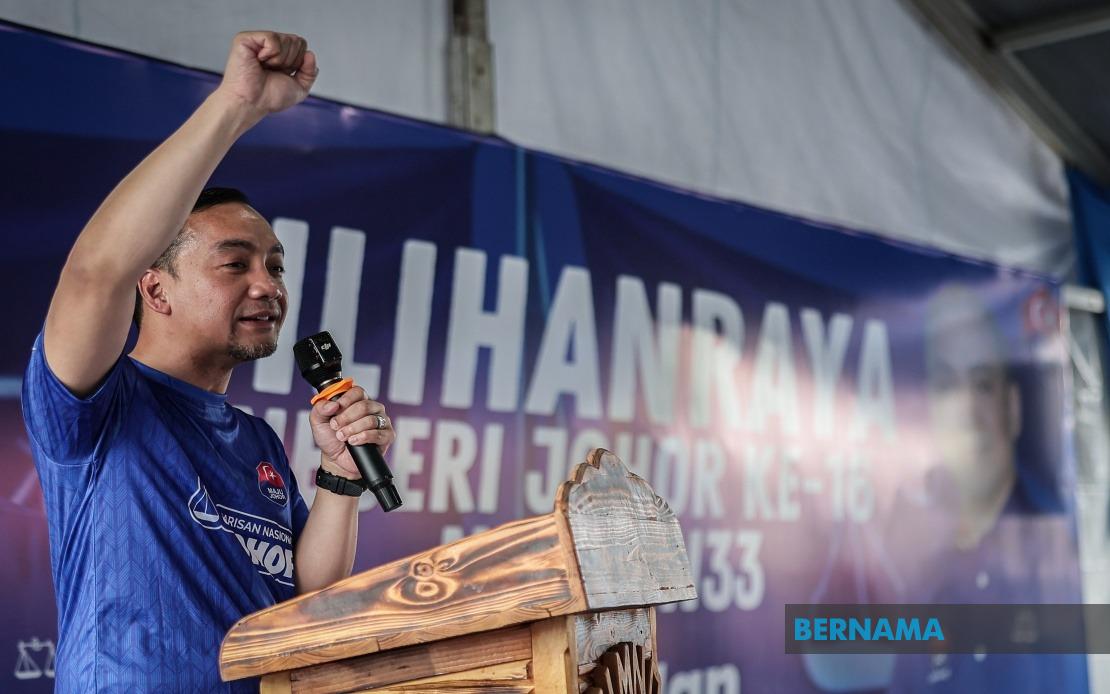
Barisan Nasional's campaign machinery in Johor appears to be firing on all cylinders as the coalition enters the final stretch before the July 11 state election. Menteri Besar Datuk Onn Hafiz Ghazi struck an upbeat tone while campaigning in Endau on Saturday, attributing the party's positive momentum to an encouraging public reception for its Endau candidate, Alwiyah Talib, known locally as "Kak Awi."
The BN chairman's remarks underscore the significance of Alwiyah's candidacy in the coalition's electoral strategy for Johor. Her political trajectory offers insight into the broader dynamics reshaping Malaysian politics post-2022. Alwiyah previously contested the Endau seat in 2022 under the Perikatan Nasional banner, securing the seat with a majority of 3,041 votes in a five-way contest. Before that, she had held the constituency as a BN representative during the 14th General Election before defecting to Bersatu. Her return to BN represents a calculated political repositioning that the coalition has embraced as part of its broader coalition-building agenda.
The Rumah Bangsa concept, spearheaded by UMNO president Datuk Seri Dr Ahmad Zahid Hamidi, provides the ideological framework through which BN is contextualising Alwiyah's return. This initiative prioritises unity and inclusiveness within the coalition, positioning it as an antidote to the fragmentation that has long plagued Malaysian politics. Onn Hafiz's endorsement of Alwiyah despite her opposition party background signals BN's willingness to prioritise pragmatism over historical party loyalty, a potentially significant shift in how the coalition operates.
The Johor election carries particular importance for the federal political landscape. As the heartland of UMNO and one of the country's most crucial electoral battlegrounds, Johor's result will reverberate through Malaysia's political corridors. A strong BN performance would strengthen the government's hand in parliament and reinforce the coalition's claim to represent Malaysia's political mainstream. Conversely, any significant losses could embolden opposition forces and complicate the coalition's federal governance.
Onn Hafiz reported that the campaign across both Endau and Tenggaroh—where BN has fielded Mohd Youzaimi Yusof as its candidate—has proceeded smoothly without major incidents. This stability contrasts with some of the acrimonious campaigns seen in previous Malaysian elections, though campaign discipline alone rarely determines electoral outcomes. The real test lies in whether the positive grassroots reception translates into actual voter turnout and ballot box support.
Alwiyah's personal appeal appears central to BN's Endau strategy. Described by Onn Hafiz as a capable leader with a proven track record of serving constituents regardless of party affiliation, her credentials might resonate with voters fatigued by partisan tribalism. Her previous work in the constituency provides continuity that new faces often cannot match, potentially offsetting any voter skepticism about her party switching.
The early voting scheduled for July 7 will provide an initial barometer of voter sentiment, offering the campaigns a final week to adjust tactics if needed. Traditional BN strongholds like Johor typically show strong early voting turnouts, potentially benefiting the coalition if its machinery operates efficiently during this period. However, early voting patterns have become less predictive in recent Malaysian elections, as opposition parties have substantially improved their mobilisation efforts.
From a regional perspective, the Johor election matters beyond Johor itself. Neighbouring states like Pahang and Terengganu, along with the broader Southeast Asian context where electoral competition has intensified, are watching how BN performs. A victory would vindicate the coalition's modernisation efforts and inclusive messaging. A setback could accelerate calls for greater internal reform and potentially weaken BN's hand in any future federal coalition negotiations.
The seven-day countdown to polling day will be decisive. While Onn Hafiz expressed confidence that campaign momentum would persist until July 11, electoral history teaches that apparent advantages can evaporate quickly. Ground sentiment matters less than actual voting behaviour, and the composition of the electorate on the day itself—including turnout rates—will ultimately determine outcomes.
For Malaysian observers, the Johor election represents a test of whether BN's inclusive coalition politics can succeed in practice, or whether it remains more aspirational than operational. Alwiyah's candidacy embodies this question. If she wins comfortably, it suggests voters reward pragmatic politics and capable candidates over rigid partisan boundaries. If she struggles, it would indicate that the Rumah Bangsa concept, while rhetorically appealing, has not yet overcome voter reservations about party-switchers. Either way, the election will provide valuable data about Malaysian political preferences as the nation navigates an increasingly complex electoral landscape.
With polling day approaching rapidly, both the coalition and its opponents are finalising their ground operations. BN's apparent confidence in Johor reflects genuine organisational strength, but electoral surprises remain possible. The true measure of campaign momentum will arrive on July 11.

