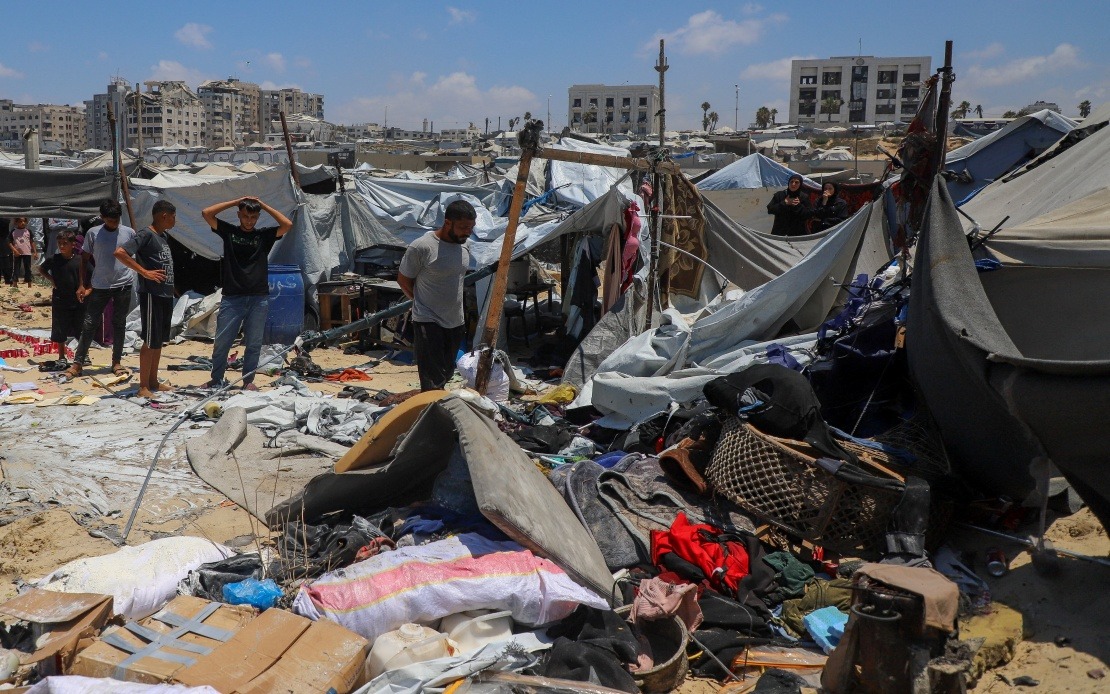
The scale of destruction across the Gaza Strip has reached catastrophic levels, with more than 90 per cent of the densely populated territory now in ruins according to official Palestinian documentation. A situation report issued Monday by the Palestinian Government Communication Centre at the Prime Minister's Office reveals that Israeli occupation forces have consolidated control over approximately 80 per cent of the war-devastated enclave, presenting a grim portrait of the humanitarian crisis engulfing the region.
The assessment, compiled from local sources and covering the period from June 29 to July 6, documents an intensification of military operations concentrated across Khan Younis, Rafah, and Gaza City. During this single week alone, eight Palestinians lost their lives from military strikes, according to medical sources on the ground. The relentless tempo of operations underscores the sustained military campaign that has reshaped Gaza's physical and demographic landscape over months of conflict.
Beyond the raw destruction, the report details systematic tactics employed across residential zones. Israeli occupation forces have deliberately shelled civilian areas, razed homes to the ground, and forced thousands of additional Palestinian families to flee their dwellings in search of shelter. This pattern of displacement compounds existing humanitarian challenges, as internally displaced persons compete for scarce resources in an already overcrowded territory where basic services have largely collapsed. The destruction of housing stock represents not merely physical damage but the erasure of family histories and community bonds woven over generations.
The instability has expanded well beyond Gaza's borders into the occupied West Bank, where Israeli military operations have intensified dramatically during the same period. Coordinated raids swept through Palestinian population centres including Ramallah, Nablus, Hebron, Bethlehem, Jenin, Qalqilya, Tulkarem, and occupied Jerusalem. These operations typically involve forced entries into homes, arbitrary detentions of Palestinians, severe restrictions on movement between towns, and strategic road closures that fragment economic activity and social cohesion. Such measures effectively isolate communities and restrict Palestinians' ability to access employment, healthcare, and educational facilities.
Parallel to formal military operations, the report documents a troubling surge in attacks perpetrated by Israeli settler militias operating across the West Bank. These non-state actors have engaged in arson attacks on Palestinian commercial establishments, including the deliberate burning of a cafeteria in al-Lubban ash-Sharqiya village. Coordinated assaults on Palestinian herders east of Bethlehem represent attempts to dispossess communities of their livestock and livelihoods. Blockades preventing access to villages like Burqa further fragment the Palestinian territorial landscape and impose collective punishment on civilian populations. The proliferation of settler violence, often conducted with impunity, reflects the broader destabilisation of the West Bank fabric.
For Malaysia and broader Southeast Asian observers, these patterns carry particular significance given the region's substantial Palestinian diaspora and deep historical solidarity with Palestinian causes. The systematic targeting of Palestinian agricultural infrastructure represents an assault on economic self-sufficiency and food security, dimensions that resonate across developing nations concerned about resource sovereignty and the right to sustainable livelihoods.
The destruction of agricultural capacity takes on heightened urgency when examined through the Palestinian Ministry of Agriculture's latest documentation. A staggering 2,559 olive trees were uprooted, burned, or deliberately damaged during the reporting week, concentrated primarily across the Salfit, Jenin, and Nablus governorates that form the Palestinian agricultural heartland. Olive cultivation holds profound cultural and economic significance for Palestinian communities, spanning generations and representing both livelihood security and ancestral connection to land. The targeting of this sector devastates not merely individual farmers but the entire regional economy dependent on agricultural exports and food production.
The human cost of this agricultural assault extends across at least 125 farming families whose entire productive capacity has been undermined. Financial losses documented by the ministry reach approximately US$11.78 million, a figure that dramatically understates the long-term harm inflicted on communities dependent on seasonal cultivation. The destruction of mature olive groves represents decades of accumulated agricultural investment erased in days, with recovery timelines spanning years or decades. For Palestinian communities already compressed into shrinking territorial space and facing movement restrictions, agricultural destruction eliminates critical survival strategies and deepens vulnerability to food insecurity.
This constellation of developments—mass destruction in Gaza, territorial fragmentation in the West Bank, settler violence, and systematic agricultural targeting—presents a coherent pattern rather than scattered incidents. The combination reflects strategic choices about territorial control, population displacement, and the elimination of Palestinian economic autonomy. For regional stakeholders and international observers, understanding these interconnected dimensions is essential for assessing humanitarian trajectories and the conditions necessary for eventual stabilisation.
The implications extend beyond immediate humanitarian concerns into questions of long-term regional stability and the reconstruction imperatives that any eventual resolution would entail. The scale of documented destruction suggests that rebuilding Gaza and restoring Palestinian territorial integrity would require unprecedented international investment and coordination spanning decades. Southeast Asian nations, several operating within frameworks emphasising non-interference but committed to humanitarian principles, face mounting pressure to reconcile diplomatic positioning with accountability for large-scale civilian harm and breaches of international humanitarian law.
The Palestinian Government Communication Centre's reporting, while representing one perspective within contested narratives about the conflict, provides concrete documentation of specific harms through institutional channels rather than isolated testimony. The systematic nature of the documentation—tracking specific governorates, quantified damages, and affected populations—creates evidentiary records relevant to international investigations and accountability mechanisms. For Malaysian policymakers and regional analysts, such reports contribute essential factual grounding for informed engagement with this protracted crisis.

