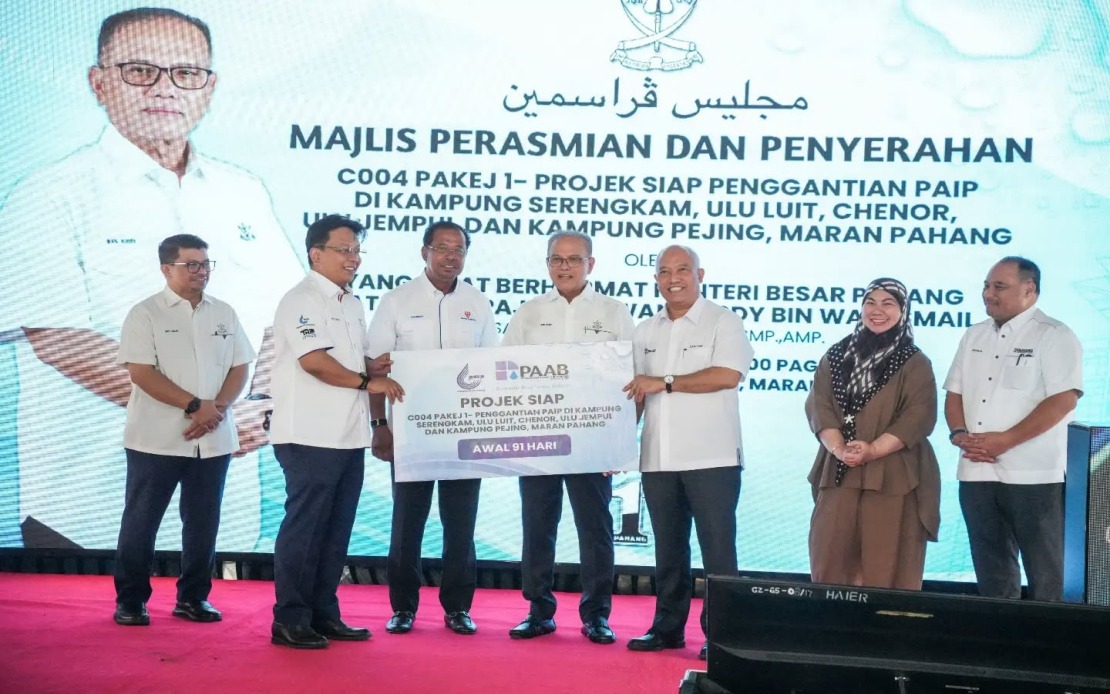
A long-standing water crisis affecting residents across Maran in Pahang has finally been addressed with the completion of a RM11.19 million infrastructure overhaul by Pengurusan Aset Air Berhad (PAAB), which replaced almost 30 kilometres of deteriorating pipelines that had plagued the district for nearly two decades. The project, officially handed over at the Chenor Water Treatment Plant, represents a significant turning point for a community that has endured repeated supply disruptions and the associated pressures on domestic life and economic activity.
The scale of the challenge was substantial. Ageing and corroded pipes spanning 29.6 kilometres across five separate communities—Kampung Serengkam, Ulu Luit, Pejing, Ulu Jempul and Chenor—had become the primary source of water service failures throughout the district. These infrastructure weaknesses were particularly acute during seasonal peaks, when dry periods intensified demand and festive seasons placed additional strain on systems already compromised by decades of wear. The concentration of problems in Chenor, where residents had faced the most persistent supply cuts, highlighted the urgency of systematic renewal rather than temporary remedial measures.
What distinguishes this project is not merely its completion but its early delivery. PAAB finished the work three months ahead of the originally planned timeline, suggesting effective project management and coordinated execution despite the technical complexity of large-scale pipe replacement across multiple municipalities. This accelerated completion has immediate practical benefits for residents who can now rely on uninterrupted service rather than the periodic shortages that had become routine. Pahang Menteri Besar Datuk Seri Wan Rosdy Wan Ismail presided over the formal handover ceremony, with support from federal representatives including Deputy Energy Transition and Water Transformation Minister Datuk Seri Abdul Rahman Mohamad and Deputy Economy Minister Datuk Mohd Shahar Abdullah, underscoring the project's importance within broader state and national development priorities.
The direct outcomes are measurable and substantial. Nearly 10,000 residents now benefit from continuous access to clean, reliable water—a foundational requirement for public health, household productivity and dignified living standards. Beyond the immediate consumer experience, the project has eliminated the chronic burst pipe incidents that had disrupted daily life and diverted maintenance resources into reactive rather than preventative activities. The reduction in non-revenue water, a critical efficiency metric in developing water systems, represents resources being directed toward actual consumption rather than lost through leakage. Water pressure stabilisation means that households throughout the affected areas receive consistent service quality, removing the uncertainty that had previously characterised supply during peak-demand periods.
This completion also signals a broader strategic commitment to water infrastructure renewal across Pahang. PAAB and its state partner, Pengurusan Air Pahang Berhad (PAIP), have committed to developing comprehensive infrastructure plans across multiple districts over the next three years. The Felda Jengka settlement faces parallel improvements through electrical system upgrades at its water treatment facility, addressing supply disruptions in satellite communities across that region. These complementary projects reflect an integrated approach to infrastructure problem-solving rather than isolated interventions at individual sites.
Two additional major projects underscore the scale of investment currently underway. A RM35.7 million initiative will replace 76.2 kilometres of ageing pipes in Jerantut and Lipis, connecting areas around Pulau Tawar and Kuala Tahan and addressing supply challenges across a broader geographic footprint. Simultaneously, PAAB is directing RM13 million toward replacing 11 kilometres of pipes in Felda Keratong, specifically targeting efficiency improvements in the Rompin water supply network. These overlapping commitments demonstrate that the Maran completion is not an isolated victory but part of a systematic program to modernise Pahang's increasingly stressed water infrastructure.
The financial commitment from PAAB reflects confidence in the sector's trajectory and the institution's mandate. As of July, the organisation had allocated RM1.17 billion toward water infrastructure projects throughout Pahang, with approximately RM69.79 million already spent on completed works, RM66.94 million on projects under active construction and RM981.04 million committed to schemes still in planning and design phases. This distribution reveals that major infrastructure renewal is accelerating, with a pipeline of projects designed to address systemic vulnerabilities across the state's water network over the medium term.
PAAB itself represents an institutional response to recognised sector fragmentation. Established in 2006 under the Water Services Industry Act 2006, the body was created to facilitate implementation of the National Water Services Industry Restructuring Plan, consolidating fragmented service delivery into a more coordinated framework. As a wholly owned subsidiary of Minister of Finance Incorporated, PAAB operates under oversight from the Ministry of Energy Transition and Water Transformation (PETRA), situating water infrastructure within the federal government's broader energy transition agenda. This institutional arrangement has proven effective in mobilising capital and technical expertise for large-scale projects that individual state operators might find fiscally or operationally challenging.
For Malaysian readers and Southeast Asian observers, the Maran project illustrates both the challenges and possibilities of large-scale infrastructure renewal in developing regions. Two decades of service disruptions represent not merely inconvenience but an enormous cumulative cost to household economic productivity, public health outcomes and community wellbeing. Yet the project's successful completion and early delivery demonstrate that systematic investment, clear institutional frameworks and coordinated execution can resolve even long-standing infrastructure deficits. As climate change intensifies seasonal water stress across the region and urbanisation concentrates demand in expanding metropolitan areas, the lessons from PAAB's approach—strategic planning, integrated design, regional coordination—become increasingly relevant to water security policy throughout Southeast Asia.

