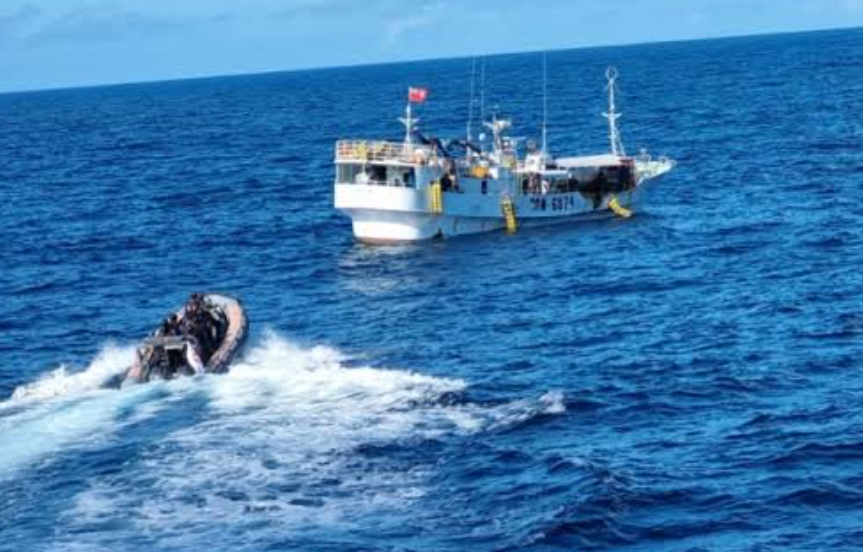
Pacific island authorities have intensified enforcement against illegal fishing operations, with multiple vessels from China and Indonesia seized or brought to port during an aggressive crackdown this month. The Pacific Islands Forum Fisheries Agency reported that four boats were detained across Kiribati, Palau and Papua New Guinea for violations ranging from unlicensed fishing to breaches of existing agreements, underscoring rising tensions between resource-rich island states and distant-water fishing nations seeking to exploit some of the world's richest marine ecosystems.
The enforcement action formed part of Operation Island Chief, a two-week coordinated surveillance initiative conducted between early and mid-August across an enormous maritime zone encompassing 28 million square kilometres. The operation mobilised resources from eleven island nations and featured sophisticated monitoring capabilities, including aerial surveillance provided by Australian military aircraft alongside maritime patrols conducted by United States Coast Guard vessels and regional police forces. Despite the extensive coverage and boarding of more than 100 vessels during this period, participating authorities have remained reticent about publicly identifying specific boats or fishing companies involved, reflecting the delicate diplomatic and economic considerations surrounding the region.
The fisheries sector represents an outsized economic and social pillar for Pacific island communities, many of which face existential threats from climate change and rising sea levels. Annual revenues generated through fishing access fees and export earnings exceed US$1.7 billion collectively, while the industry sustains livelihoods for roughly one-third of all households across the Pacific islands. The region produces approximately half of the world's global tuna catch, yet local island economies capture minimal value from this abundance. Only 15 per cent of tuna caught in Pacific waters receives processing or handling by island-based enterprises, meaning the overwhelming majority of profits flow to foreign fishing companies and Asian markets where the fish ultimately reach consumers.
This structural imbalance between resource endowment and economic benefit has created mounting frustration among Pacific leaders. Long-distance fishing fleets from distant nations, predominantly operating under Chinese and Indonesian flags, pay licence fees to access the exclusive economic zones belonging to small island states, effectively outsourcing the extraction of marine resources without generating meaningful local employment or value-added processing. The concentration of fishing wealth in foreign hands has prompted regional governments to reassess their approach to marine resource management and seek improved terms of engagement with international fishing operators.
Naming and publicly identifying fishing vessels suspected of illegal activities carries significant political weight within the Pacific region. Chinese companies operate extensive long-distance fishing fleets and maintain joint venture partnerships with several island nations, creating intricate commercial relationships that complicate straightforward enforcement. When authorities do detain Chinese vessels, they risk diplomatic tensions and potential disruption to established business arrangements. This sensitivity became evident in the region's restrained public communication regarding Operation Island Chief, with authorities declining to provide detailed information about the sixteen additional vessels flagged as requiring closer investigation.
A recent incident in Tuvalu illustrates both the prevalence of violations and the complexities surrounding enforcement. Tuvalu authorities apprehended a Chinese fishing boat engaged in unlicensed fishing while broadcasting false location data to evade detection. The vessel remained in custody for 24 days before facing a fine and release, according to Peter Hammarstedt, captain of the conservation vessel Sea Shepherd, which provided maritime patrol support to Tuvalu police. Tuvalu's diplomatic recognition of Taiwan rather than the People's Republic of China may have emboldened authorities to pursue the case more aggressively than island nations maintaining relations with Beijing.
Historical patterns reveal systemic compliance challenges among distant-water fishing fleets. Between 2008 and 2026, inspectors working for the Western and Central Pacific Fisheries Commission documented 278 penalty notices issued to Chinese fishing boats for various infractions, representing the second-largest tally globally. Only Taiwan, with 319 recorded infringements, exceeded this figure, suggesting that vessels flagged under both jurisdictions account for disproportionate levels of fishing violations across the Pacific. These statistics underscore that illegal fishing constitutes not an occasional anomaly but rather an endemic challenge requiring sustained and coordinated regional responses.
The August 30 meeting of 18 Pacific Island leaders convening in Palau represents a critical juncture for regional fisheries policy. The agenda will address development of updated strategies designed to strengthen Pacific control over fishing rights and substantially increase government revenues derived from marine resources. Climate change impacts on fish stocks add urgency to these deliberations, as warming ocean temperatures and shifting current patterns threaten the productivity of traditional fishing grounds. Island leaders recognise that without decisive action to assert sovereignty and capture greater economic value from their maritime resources, the long-term sustainability of fishing-dependent economies faces serious jeopardy.
For Southeast Asian perspectives, these developments carry relevance across multiple dimensions. Indonesia, as a significant fishing nation with vessels operating across the Pacific, faces scrutiny alongside Chinese operators for compliance with regional fishing regulations. Malaysia, which maintains substantial fishing interests throughout Southeast Asia and maintains maritime boundaries with multiple nations, tracks these developments closely as precedent for how ocean governance and resource management evolve in shared maritime spaces. The Pacific experience with enforcement coordination and transnational cooperation in combating illegal fishing offers both cautionary lessons and potential models for Southeast Asian countries seeking to protect their own exclusive economic zones.
The fundamental issue animating this enforcement push concerns the basic equity of resource distribution in an era of globalised fishing operations. Small Pacific island nations possess sovereign rights over marine zones extending to 200 nautical miles offshore, yet lack the technological capacity and financial resources to independently monitor and enforce these rights across vast ocean distances. By coordinating surveillance operations and sharing information through the FFA framework, island states have developed greater collective capacity to detect violations and hold foreign fishing operations accountable. This cooperative model demonstrates how smaller nations can pool resources to exercise meaningful control over their marine territories, a lesson with clear application throughout Southeast Asia and the broader Indo-Pacific region where similar dynamics around maritime resource extraction and regulatory compliance persist.

