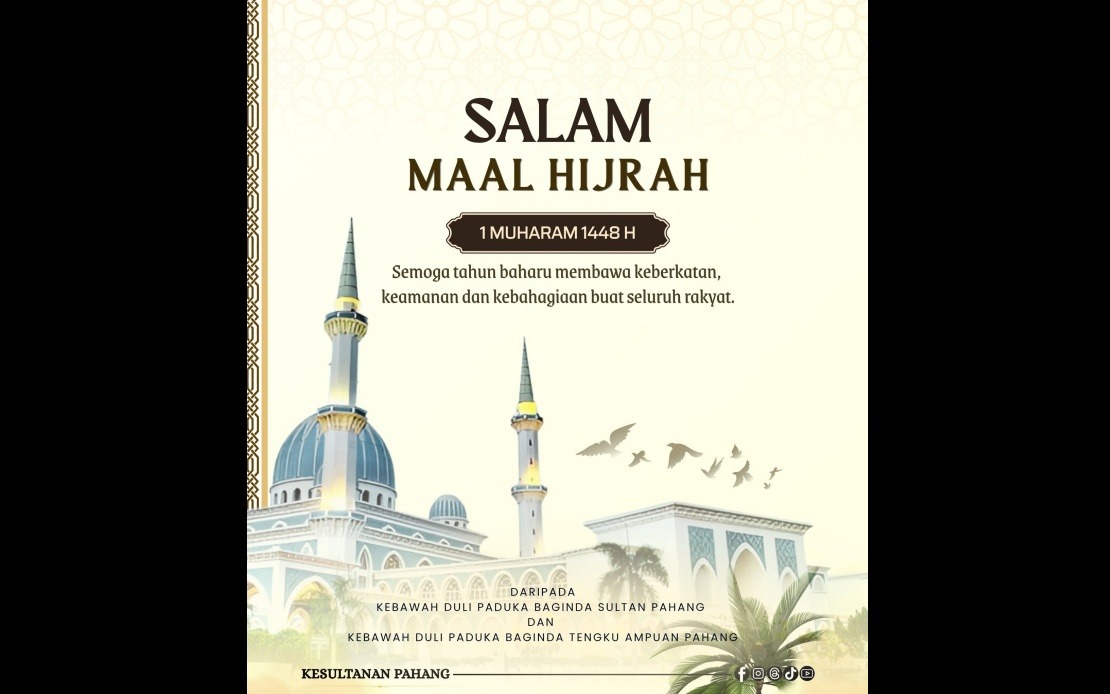
The Sultan of Pahang, Al-Sultan Abdullah Ri'ayatuddin Al-Mustafa Billah Shah, alongside Tengku Ampuan Tunku Azizah Aminah Maimunah Iskandariah, marked the Islamic new year by extending formal greetings to the Muslim population of the state on the occasion of Maal Hijrah 1448H.
The royal message, disseminated through the Kesultanan Pahang's official social media channels, represented a traditional acknowledgment of the significant religious milestone in the Islamic calendar. Their Majesties took the opportunity to articulate wishes that the incoming year would usher in an abundance of blessings, tranquillity, and contentment for all residents of the east coast state.
The observance of Maal Hijrah, which commemorates the Prophet Muhammad's migration from Mecca to Medina, holds profound spiritual significance across Malaysia's Muslim-majority population. The occasion typically prompts reflection on personal growth, spiritual renewal, and societal advancement aligned with Islamic principles. For state leadership, it represents a moment to reinforce collective values and galvanize public commitment to shared developmental objectives.
Pahang's Menteri Besar Datuk Seri Wan Rosdy Wan Ismail amplified the official sentiment through his own message, positioning the new Islamic year as a pivotal juncture for personal introspection and community strengthening. He called upon the Muslim population to seize the occasion as a catalyst for reaffirming their religious commitments and deepening their spiritual observance throughout the year ahead.
The Menteri Besar's remarks extended beyond individual piety to encompass broader societal imperatives. He urged the adoption of what he termed the spirit of the Prophet Muhammad's Hijrah—a principle of transformative change undertaken with purpose and integrity. By invoking this historical reference, state leadership sought to frame contemporary challenges and aspirations within an Islamic historical framework that emphasizes sacrifice, perseverance, and moral renewal.
Central to the state leadership's message was an emphasis on strengthening social cohesion and reinforcing foundational values within Pahang's diverse communities. The call for enhanced unity, coupled with an insistence on upholding integrity across all spheres of activity, reflected concern with both interpersonal relations and institutional conduct. Such messaging carries particular resonance in Malaysia's complex plural society, where religious observances frequently intersect with nation-building narratives.
Datuk Seri Wan Rosdy's articulation also prioritized charitable engagement and benevolent action as expressions of religious faith. This framing aligns with broader Islamic teachings emphasizing the integration of spiritual devotion with practical service to others. By encouraging increased charitable endeavours, the Menteri Besar implicitly acknowledged social needs within Pahang and positioned religious observance as a motivation for addressing communal welfare concerns.
The invocation of divine blessing and protection in official statements carries ceremonial weight within Malaysia's constitutional monarchy framework. By petitioning for Allah's mercy and guidance, state leadership demonstrated alignment with the predominantly Muslim electorate's worldview whilst also affirming the role of religious values in legitimizing governance and public policy. This rhetorical strategy has deep historical roots in Malay-Muslim political culture.
For Pahang specifically, such royal and executive messaging during significant Islamic observances represents an opportunity to reinforce state identity and leadership commitment to Muslim constituents. The east coast state, with its historical significance in Malaysia's sultanate system, maintains particular emphasis on Islamic heritage and royal-religious authority. Public acknowledgment of Maal Hijrah by both palace and executive administration underscores continuity of this tradition.
The emphasis on state development and public welfare improvement within religious messaging reflects contemporary governance approaches that integrate spiritual narratives with developmental objectives. Rather than treating religious observance and administrative progress as separate domains, Pahang's leadership framed them as complementary endeavours. This synthesis appeals to citizens who view religious commitment and civic responsibility as mutually reinforcing.
The circulation of such messages through social media platforms demonstrates modernization of traditional forms of royal and executive communication. While the content and sentiments remain rooted in conventional religious and ceremonial language, the digital medium ensures rapid, widespread dissemination to geographically dispersed audiences. This approach maximizes reach whilst maintaining the formal, official character of state communications.
The collective expression of Maal Hijrah greetings from multiple levels of state authority—royal palace, chief executive, and through official institutional channels—reflects coordination of messaging around significant religious occasions. Such alignment reinforces the message's importance and suggests institutional consensus regarding the value of public religious engagement by government figures. For Pahang's Muslim population, the convergence of messages from various authority figures signals unified state recognition of the occasion's significance.