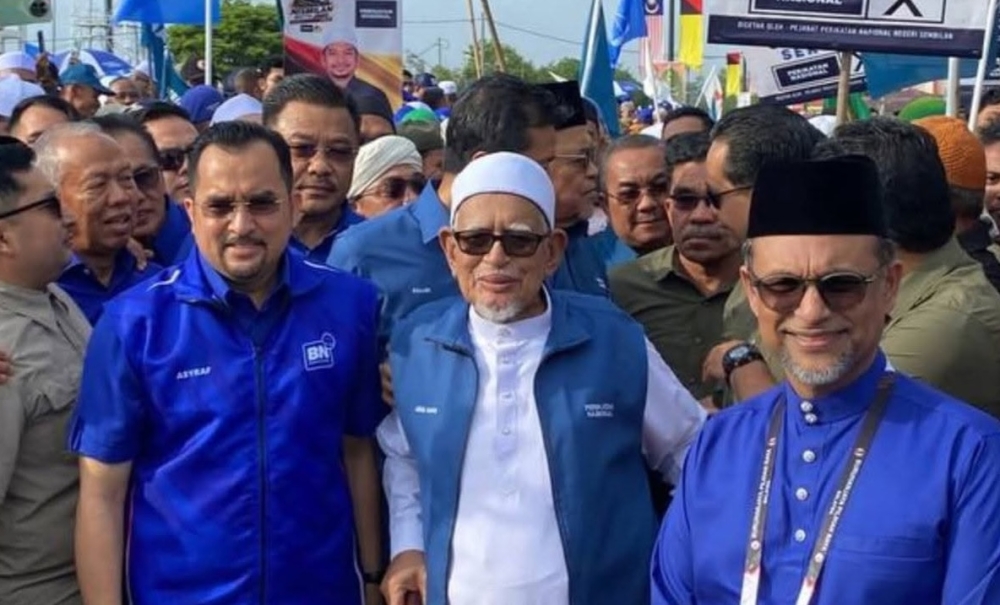
The two major political coalitions governing Malaysia have agreed to throw their combined weight behind one another's candidates in the upcoming Negeri Sembilan state election, according to PAS president Tan Sri Abdul Hadi Awang. The arrangement represents a significant show of unity between Perikatan Nasional and Barisan Nasional, the two blocs that together command the federal government, and signals a strategic alignment in state-level politics.
Tan Sri Abdul Hadi's announcement, made in Kuala Lumpur on July 18, indicates that both coalitions will actively campaign to support each other's respective slate of candidates contesting in the Negeri Sembilan polls. Such coordinated campaign efforts are designed to amplify voter reach and consolidate support across constituencies, leveraging the organisational machinery and volunteer networks of both political fronts. This type of arrangement underscores how Malaysian politics has evolved toward coalition-based governance at multiple political levels.
For Negeri Sembilan, a state that has alternated between different political administrations over the years, the joint campaign approach could prove decisive. The state has traditionally been competitive, with no single coalition commanding overwhelming dominance. By pooling campaign resources and coordinating messaging, Perikatan Nasional and Barisan Nasional aim to present a unified political front that could sway undecided voters and consolidate support among their respective bases.
The decision to campaign jointly reflects broader patterns in Malaysian politics where federal coalition partners seek to extend their influence into state elections. Such arrangements are not unprecedented but remain strategically important, as state governments control significant resources and policy levers affecting local development, education, and infrastructure. For Negeri Sembilan residents, the joint campaign signals that both national coalitions view the state election as significant enough to justify coordinated intervention.
From a regional perspective, the announcement demonstrates how Southeast Asian political coalitions operate in practice. Unlike purely adversarial two-party systems, Malaysia's coalition-based structure allows for flexible alliances that can strengthen or weaken depending on electoral calculations and intra-coalition dynamics. The joint campaign decision suggests that current dynamics favour cooperation over competition between Perikatan Nasional and Barisan Nasional at the state level.
This arrangement also carries implications for smaller component parties within both coalitions. Member parties of Perikatan Nasional and Barisan Nasional will need to coordinate candidate nominations carefully to avoid fielding competing candidates in the same constituencies. Such internal negotiations are typically complex, requiring careful balancing of each party's representation and seat allocations. The joint campaign announcement therefore presupposes that these technical details have been or will be satisfactorily resolved.
For Malaysian voters in Negeri Sembilan, the coordinated campaign approach means they will likely encounter messaging emphasising federal stability and coalition unity. Both coalitions will probably highlight their collective track record in government and present a joint vision for the state's development. Opposition coalitions, meanwhile, will presumably focus their messaging on pointing out perceived shortcomings or promoting alternative policy directions.
The timing of Tan Sri Abdul Hadi's announcement is significant, coming as political parties begin ramping up their ground operations ahead of state elections. Early public statements about campaign cooperation allow both coalitions to mobilise their respective party structures, distribute resources, and plan joint activities. Such announcements also signal to party members and grassroots supporters that leadership is committed to the alliance, which can boost morale and volunteer participation.
Historically, Negeri Sembilan has been politically important to both coalitions, and its state government's policies on economic development, agriculture, and state affairs have regional implications. The state sits in Malaysia's western corridor and serves as a hinterland for major economic centres. A government backed by both Perikatan Nasional and Barisan Nasional would likely pursue policies aligned with the federal administration's broader development agenda.
The joint campaign arrangement also raises questions about the structure of any resulting government. If the coordinated campaign succeeds, how would the coalition partners share ministerial positions and state assembly committee roles? Such questions remain unaddressed in public statements, though they will become crucial once election results are declared. Different coalition configurations could yield different governing arrangements and policy priorities.
For opposition parties preparing to contest the Negeri Sembilan election, the announcement of a joint Perikatan Nasional-Barisan Nasional campaign presents both challenges and opportunities. The unified approach will concentrate significant electoral resources against them, yet it may also create openings if voters perceive the campaign as overly centralised or disconnected from local concerns. Opposition campaigning will likely emphasise grassroots engagement and locally-focused alternatives to the coalition's federal-centric messaging.
The broader significance of this campaign coordination extends beyond Negeri Sembilan itself. It demonstrates the flexibility and adaptability of Malaysia's political system, where coalitions can present unified fronts when circumstances favour cooperation. This approach contrasts with more fragmented political systems elsewhere in the region and reflects how Malaysian parties have learned to work together while maintaining distinct organisational identities and policy positions within broader coalition frameworks.

