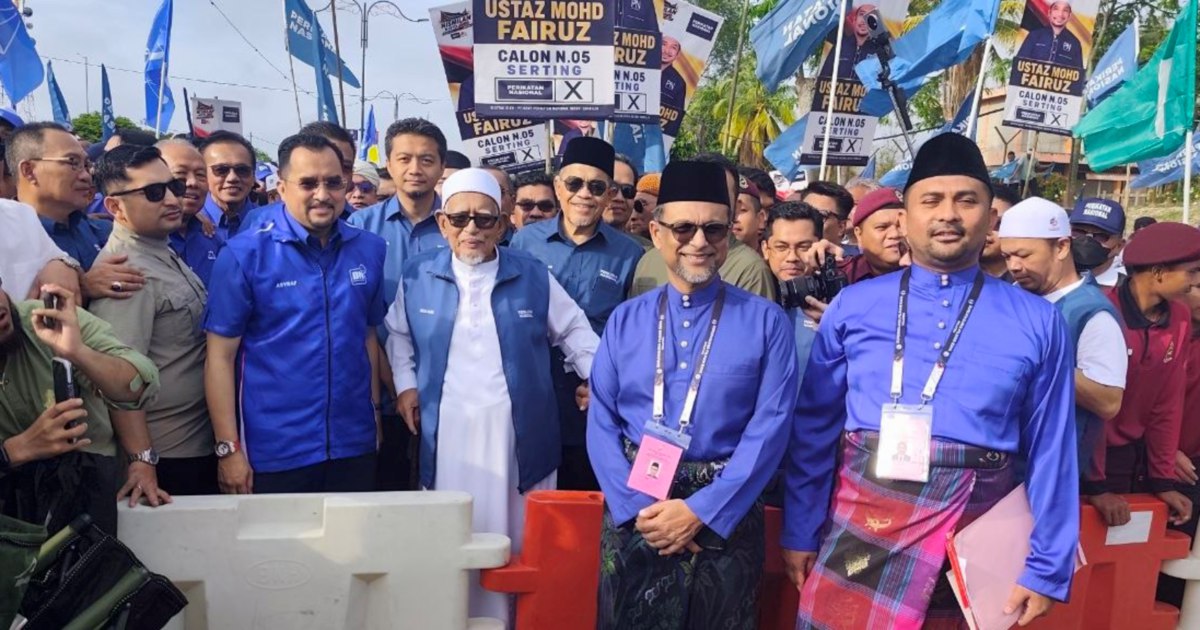
Perikatan Nasional will throw its weight behind Barisan Nasional during the campaign for the upcoming Negri Sembilan state election, PAS president Tan Sri Abdul Hadi Awang announced, underscoring the continued cooperation between the two major political coalitions at the state level.
The commitment, declared in Jempol, signals that despite tensions elsewhere in Malaysian politics, the two blocs recognise the strategic importance of presenting a united front in the resource-rich central state. Negri Sembilan has long occupied a crucial position in Malaysia's electoral map, and the coalition's decision to coordinate reflects both coalitions' assessment that a fragmented opposition could weaken their respective positions in what promises to be a tightly contested campaign.
Hadi's statement carries particular weight given PAS's transformation over the past decade from a primarily opposition force to an integral component of the governing coalition. The Islamic party's explicit pledge of campaign machinery and grassroots support demonstrates how thoroughly the political realignment that began with the 2022 transition to unity government has reshaped Malaysian coalition dynamics. What once would have been unthinkable—open coordination between Perikatan Nasional components and Barisan Nasional—now represents standard political practice.
For Barisan Nasional, securing Perikatan Nasional's active backing addresses a crucial vulnerability in states where Umno's traditional machinery has atrophied over years of opposition governance. The coalition's ability to mobilise PAS's substantially intact organisational network, particularly in rural constituencies where the party retains deep community roots, could prove decisive. Negri Sembilan's demographic composition and the distribution of PAS support in particular constituencies make this collaboration more than merely symbolic.
The timing of Hadi's announcement suggests careful calibration of the political message. By positioning Perikatan Nasional as a willing partner rather than a dominant force, he simultaneously reassures PAS's base of the party's continued independent stature whilst reinforcing to national audiences that the unity government framework continues to function effectively. This balancing act has become central to PAS's political strategy, allowing the party to claim both influence and distinction within the broader coalition architecture.
Negri Sembilan's electoral significance extends beyond mere seat count. The state has frequently served as a bellwether for national sentiment, with results often presaging broader shifts in voter preference. A coordinated Barisan-Perikatan campaign here would send clear signals to other state governments considering similar arrangements, potentially establishing templates for future electoral cooperation. This demonstration effect makes the state's election consequential for coalition politics far beyond Negri Sembilan's borders.
Historically, divided right-wing campaigns have benefitted opposition forces, a reality neither coalition forgets. The decision to formalise campaign cooperation rather than merely avoid direct confrontation reflects mature political calculation. Both coalitions appear to have concluded that maximising combined vote share serves their mutual interests better than pursuing narrow factional gains that might splinter the conservative voter base.
The announcement also merits consideration within Southeast Asian contexts where coalition politics remain fluid. Malaysia's evolving multi-bloc system, with Perikatan Nasional, Barisan Nasional, and opposition formations constantly recalibrating relationships, offers a living case study in democratic coalition management. That major partners can declare explicit campaign cooperation without formal constitutional requirement or binding agreement demonstrates both the flexibility and potential fragility of Malaysia's political arrangements.
For ordinary Negri Sembilan voters, coordinated campaigning means heightened exposure to unified messaging on development priorities, economic policy, and governance approaches. Whether this translates to enhanced voter choice or simply presents voters with a false binary between two variants of right-wing governance remains contested. Critics argue that genuine alternatives disappear when major blocs present combined fronts, whilst supporters contend that efficiency in governance requires stable majorities that cross-coalition cooperation enables.
Looking forward, Hadi's commitment will be tested by campaign realities. Maintaining coordination between PAS and Umno-dominated Barisan Nasional structures at grassroots level often proves more challenging than high-level pronouncements suggest. Local party operatives accustomed to competing fiercely sometimes resist subordinating ambitions to coalition discipline, requiring continuous management from central leadership to prevent intra-coalition conflicts from undermining the united campaign. The coming weeks will reveal whether this cooperation remains rhetorical or translates into meaningful integrated campaign operations across Negri Sembilan's constituencies.

