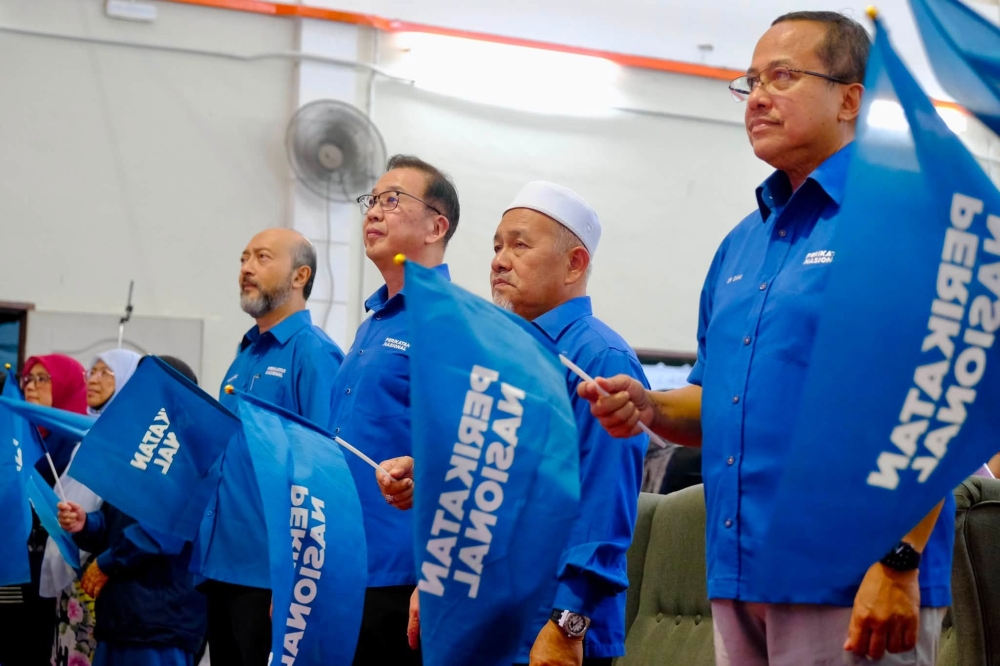
The leadership of Perikatan Nasional has signalled conditional openness to maintaining its partnership with Barisan Nasional beyond the next general election, with the success of their joint state-level arrangement in Negeri Sembilan serving as a crucial test case for deeper national cooperation. Datuk Seri Ahmad Samsuri Mokhtar, who chairs PN, made the remarks while discussing the coalition's trajectory and future possibilities, framing the Negeri Sembilan model as a template that could inform broader electoral and governing arrangements at the federal level in GE16.
The strategic statement comes at a time of considerable fluidity in Malaysia's political landscape, where coalition partnerships remain subject to continuous reassessment and negotiation. PN's openness to extending its arrangement with BN represents a notable development, as both coalitions have undergone significant recalibration since the 2022 general election that brought the current federal government into being. The explicit conditionality attached to such extension—namely the performance and viability of the Negeri Sembilan partnership—underscores that PN leadership views electoral mathematics and governing capacity as interdependent considerations rather than separate concerns.
Negeri Sembilan has emerged as a particularly significant battleground for coalition politics in Malaysia. The state's political dynamics have shifted notably over recent electoral cycles, and the PN-BN arrangement there represents an attempt to forge cooperative mechanisms that both strengthen individual component parties and reduce internal competition that might otherwise fragment votes. The Negeri Sembilan pact thus functions as a proof-of-concept for whether such alliances can deliver tangible benefits to both partners—electoral gains for their respective component parties and enhanced prospects for stable governance at the state level. Failure to demonstrate such benefits could significantly complicate PN's calculus regarding GE16 strategies.
The implications for Malaysian political realignment are substantial. A successful extension of the PN-BN alliance into GE16 would represent a consolidation of non-Pakatan Harapan forces, potentially reshaping the competitive environment for the next general election. Such an arrangement would need to resolve outstanding tensions over seat allocation, ministerial portfolios, and the distribution of campaign resources—challenges that have historically plagued Malaysian coalition politics. The willingness of PN's chairman to float this possibility publicly suggests that senior party figures have already commenced internal discussions about medium-term strategic positioning.
For Barisan Nasional, Ahmad Samsuri Mokhtar's comments represent an important signal. BN has been undergoing its own period of reassessment since its loss of federal power in 2018 and the turbulent years that followed. The coalition's recovery to a significant parliamentary presence in 2022 was followed by gradual expansion of its influence through incremental gains and strategic partnerships. An alliance with PN extending through GE16 would position BN as part of a larger anti-Pakatan coalition bloc, potentially offering greater leverage in post-election negotiations regardless of overall electoral outcomes.
However, significant hurdles remain before any such arrangement could materialize. Component parties within both PN and BN harbour divergent interests that do not always align. UMNO, as BN's dominant force, may be reluctant to embrace arrangements that limit its autonomy or that prioritize inter-coalition cooperation over competition with rival Malay-based parties. Within PN, Bersatu, PAS, and other components operate with distinct political cultures and electoral calculations. The requirement that Negeri Sembilan cooperation must succeed introduces an element of uncertainty—should the state-level experiment encounter difficulties, support for a national extension would likely dissipate rapidly.
The timing of Ahmad Samsuri Mokhtar's statement also warrants attention. With Negeri Sembilan's state elections having been held recently, PN leadership may be positioning itself to maximize the political benefits of whatever outcomes emerge from the Negeri Sembilan arrangement. Should the partnership deliver notable electoral success or demonstrate effective governance at the state level, similar cooperative frameworks could plausibly be extended to other states or projected nationally. Conversely, disappointing results would likely prompt a retreat to more competitive positioning between the coalitions.
From the perspective of Malaysian voters and political observers, the PN-BN alliance question connects to fundamental questions about governmental stability and the ongoing competition between different political blocs for national leadership. An extended alliance would affect everything from policy priorities to ministerial appointments to the strategic direction of government at federal and state levels. The suggestion that such continuation might occur signals that senior political figures across PN and BN are thinking about coalition arrangements not as fixed arrangements but as potentially evolving structures adapted to changing political circumstances.
The broader context of Malaysia's political economy also influences these calculations. Economic pressures, the need for policy consistency, and international considerations all create incentives for political stability and coalition coherence. Both PN and BN leadership may recognize that fractious competition between them could fracture support for non-Pakatan agendas and weaken prospects for delivering the economic and administrative outcomes that regional voters have demanded. This practical dimension may prove as important as ideological or partisan considerations in determining whether the Negeri Sembilan model proves replicable at larger scales.
Looking toward GE16, Ahmad Samsuri Mokhtar's comments suggest that Malaysian political calculations are already underway among senior figures. While many variables remain unresolved and numerous obstacles could prevent alliance extension, the willingness of PN leadership to publicly discuss continued partnership with BN indicates that such scenarios are being taken seriously within highest circles of both coalitions. The Negeri Sembilan arrangement has thus acquired significance far beyond state-level politics—it has become a testing ground whose results will likely shape federal coalition strategies for years to come.

