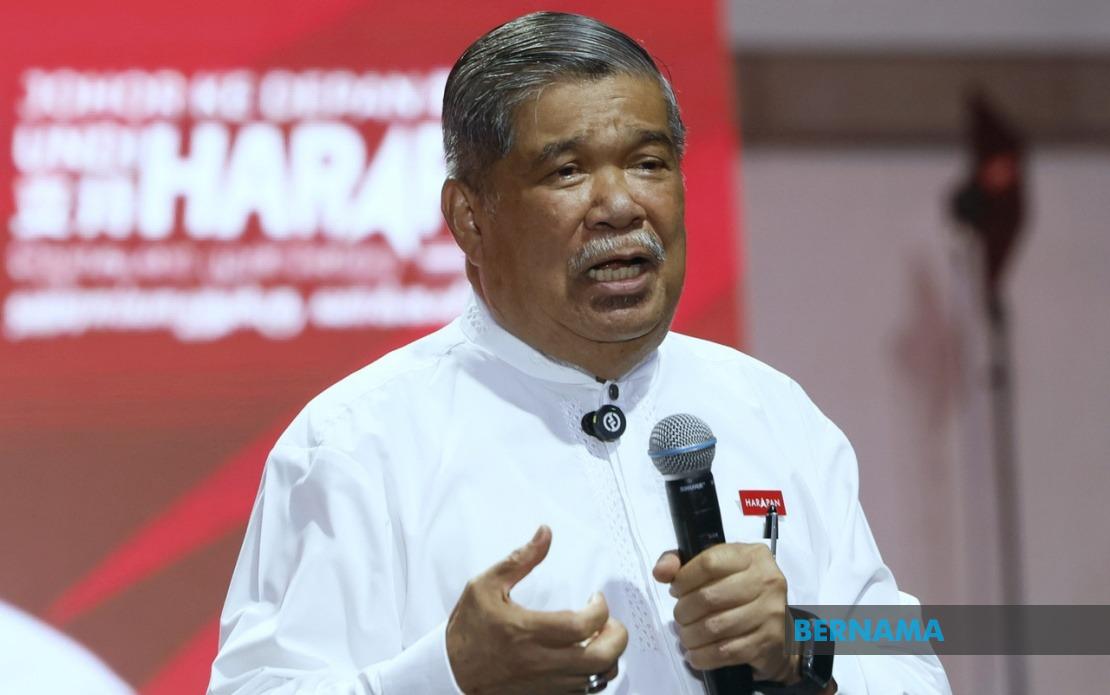
Pakatan Harapan is pressing ahead with its campaign strategy for the Johor state election despite a directive from PAS that instructs its supporters to back Barisan Nasional candidates in seats the Islamic party is not contesting. Amanah president Datuk Seri Mohamad Sabu, speaking after a campaign event in Permas Jaya on July 1, dismissed suggestions that such moves would derail the coalition's momentum as voters prepare to head to polls on July 11.
Mohamad Sabu, who also serves as Minister of Agriculture and Food Security, characterised PH's response as resolute and unflinching. He stated that the coalition's campaign machinery would continue operating at full capacity without pause or deviation, rejecting any notion that rival tactics might prove unsettling. The Amanah leader framed this composure as evidence of PH's fundamental confidence in its political foundation and voter support base across the state.
The coalition's competitive edge, according to Mohamad Sabu, stems from its ability to unite diverse racial and religious communities under a shared political umbrella. This multiracial and multi-religious dimension of PH, he argued, provides the bedrock for sustainable political stability and underpins the nation's broader economic advancement. By emphasising unity rather than division, PH hopes to position itself as the custodian of inclusive governance at a time when sectarian appeals threaten to fragment the electoral landscape.
Mohamad Sabu appealed directly to Johor voters to base their electoral choices on practical grounds rather than emotional appeals. He urged constituents to evaluate candidates on their competence, their demonstrated track record of service delivery, and their commitment to upholding justice and fair governance. This messaging reflects PH's strategic bet that voters are increasingly pragmatic and will penalise parties that rely primarily on identity-based appeals at the expense of concrete policy outcomes.
A key element of PH's pitch centres on administrative coherence between state and federal governments. The coalition argues that voters would benefit substantially from having the same political coalition controlling both Putrajaya and the Johor state capital, facilitating coordinated implementation of major infrastructure and development initiatives. Mohamad Sabu highlighted several projects as examples of what aligned governance could deliver: modernisation of the public transport network, upgrades to border facilities, and sustained investment attraction efforts to grow the state economy.
DAP strategic director Liew Chin Tong, who holds the rank of Deputy Finance Minister, added another dimension to PH's analysis by identifying youth voter participation as potentially decisive in determining the election outcome. Liew reflected on the 2022 Johor state election, observing that lower voter turnout had advantaged the incumbent BN coalition. He noted that COVID-19 travel restrictions had prevented many Johor residents employed across the causeway in Singapore from returning home to cast votes, a factor that likely suppressed turnout among younger, more mobile demographics typically inclined toward electoral reform.
Liew pressed for the second phase of campaigning to shift focus from partisan attacks toward substantive policy discussion. He identified employment creation as a critical issue, particularly the need to generate high-quality jobs offering competitive remuneration that could discourage Johor's younger workforce from crossing into Singapore to earn livelihoods. Such labour migration, while economically rational for individuals, represents a net loss of human capital and skilled talent for Johor itself, a dynamic that improved local job markets could help reverse.
The DAP leader outlined additional priority areas that he contended should anchor state government planning and implementation: improvements to public transport infrastructure, flood mitigation and prevention, maintenance of drainage and river systems, preparation for demographic ageing among the population, and expansion of childcare facilities to support working families. These issues, Liew suggested, transcend traditional political dividing lines and represent universal concerns affecting quality of life for ordinary Johorians across demographic groups.
Critically, Liew emphasised that successful delivery on these policy objectives requires seamless coordination between federal and state administrations. The Johor-Singapore Special Economic Zone represents a flagship example of the type of bilateral state-federal project that could unlock investment flows and employment generation if both tiers of government operate in concert. Fragmented governance, by contrast, can create bottlenecks, bureaucratic confusion, and delayed project rollout that ultimately harm Johor's competitive positioning and economic trajectory.
PH and BN are both fielding candidates in all 56 state assembly seats, indicating a genuinely competitive contest without the strategic seat-sharing arrangements that characterise some state elections. Early voting takes place on July 7, with the main polling date set for July 11. The election outcome will test whether the coalition can consolidate gains from previous contests or whether residual voter concern over PAS's political direction and the broader Malay-Muslim dimension of politics will provide openings for BN recovery. The election results will carry significance beyond Johor itself, potentially signalling the direction of Malaysian electoral politics more broadly as the country moves toward the next federal general election cycle.

