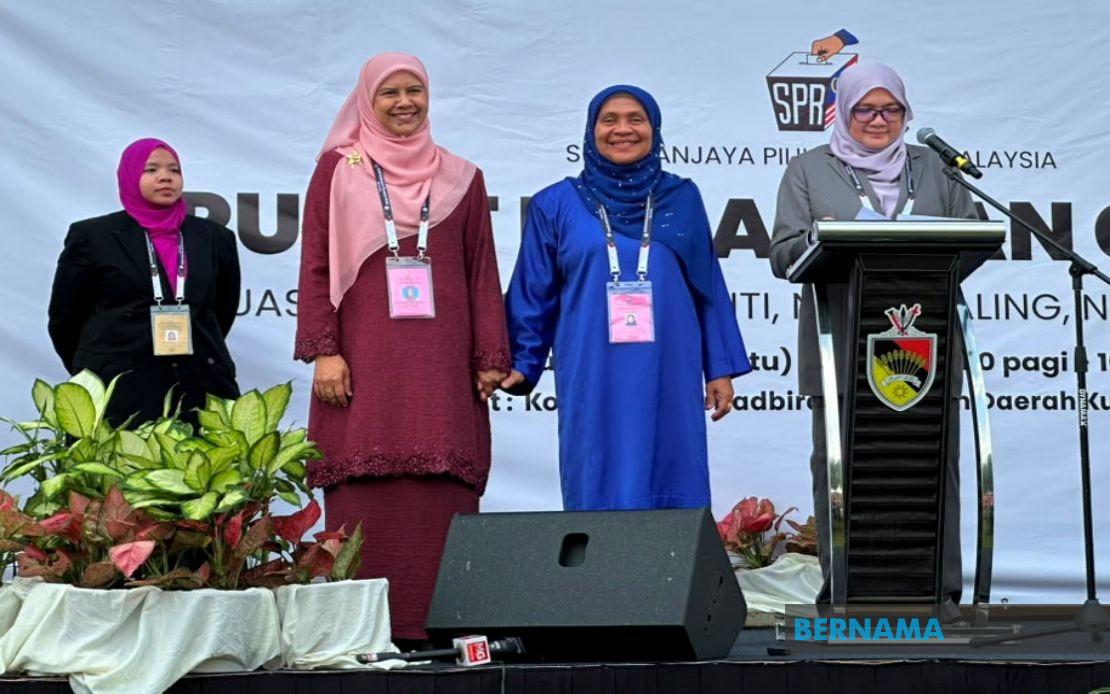
The Pilah state seat in Negeri Sembilan will witness a historic straight fight between two women candidates when voters go to the polls on August 1, signalling a notable milestone in the state's political representation. Datuk Noorzunita Begum Mohd Ibrahim, the incumbent representing Pakatan Harapan, will square off against Barisan Nasional's S. Leza Md Yasin in what promises to be a closely watched contest. The announcement came after the nomination process concluded on July 18, with both candidates filing their papers at the District and Land Office in Kuala Pilah, with Noorzunita Begum submitting her nomination at 9.03 am and S. Leza following at 9.09 am.
The emergence of two female candidates in Pilah reflects the gradual shift towards greater women's participation in electoral politics across Malaysia. Both contestants bring different party ideologies and grassroots networks to the competition, with Noorzunita Begum seeking to retain her seat after serving as the incumbent, while S. Leza represents BN's push to reclaim territory in the state. This development carries symbolic weight beyond the immediate contest, suggesting that parties across the political spectrum are increasingly recognising women as viable standard-bearers for competitive constituencies. The straight fight format also means that both candidates can focus resources entirely on one opponent, potentially making for a more intense campaign compared to three-cornered contests elsewhere in Negeri Sembilan.
The broader 16th Negeri Sembilan State Election will be considerably more fragmented in most other constituencies, with three-cornered contests shaping the political dynamics in several key seats. The Juasseh state seat will see Mohd Aidil Abdullah of PH battle incumbent Datuk Ismail Lasim of BN and Bersatu's Mohd Zuhami Md Yusof, each competing to mobilise their respective voter bases. Similarly, Seri Menanti is set for a three-way scramble involving PH's Mohd Kamarul Arifin Mohd Wafa, the incumbent Muhammad Sufian Maradzi from BN, and Bersatu's Datuk Seri Megat D. Shahriman Zaharuddin, a seasoned political operator. These contests introduce multiple variables into seat calculations, as votes can fragment across ideologically diverse options, potentially enabling unexpected outcomes where second or third-placed parties gain surprising margins.
The Senaling state seat will add another three-cornered dimension to the election, with PH's Mohd Hanis Mohd Alimin, BN's Mohamad Qayyum Abd Jalil, and Bersatu's Mohd Izzafi Khan all vying for voter support. This fragmentation across several constituencies reflects the broader Malaysian political landscape, where Bersatu's presence in key battlegrounds continues to complicate traditional two-party dynamics. The party's participation in multiple contests underscores its determination to maintain relevance in state-level politics despite setbacks in federal elections. In contrast, Johol will see a cleaner two-way contest between PH's Mohd Zailan Mohd Munawar and incumbent Datuk Saiful Yazan Sulaiman of BN, reducing the variables candidates must navigate during their campaigns.
High-profile federal ministers accompanied candidates during the nomination process, underlining the national significance parties attach to the Negeri Sembilan election. PKR Wanita chief Fadhlina Sidek, who serves as Education Minister, personally escorted PH candidates through the registration procedure, signalling strong party commitment to the state contest. Her presence also highlighted the symbolic importance of the all-female Pilah matchup to PH's broader messaging around women's political empowerment. Dr Mohammed Taufiq Johari, Youth and Sports Minister and Angkatan Muda Keadilan vice-chief, bolstered the PH contingent, while Deputy Investment, Trade and Industry Minister Sim Tze Tzin, who represents Bayan Baru in Parliament, further demonstrated federal coalition engagement. This ministerial cavalry deployment is typical of state elections involving coalition partners, as parties use such occasions to project internal unity and national relevance to local voters.
On the BN side, Deputy Home Minister Datuk Seri Dr Shamsul Anuar Nasarah, a senior UMNO figure on the party's Supreme Working Council, marshalled the coalition's campaign machinery for candidate registration. His involvement reflected BN's determination to regain state-level traction in Negeri Sembilan after several difficult electoral cycles. Accompanying him was Perak Menteri Besar and Perak UMNO chairman Datuk Seri Saarani Mohamad, whose presence highlighted the cross-state coordination that BN often deploys in competitive elections. Such ministerial presence serves multiple functions: it boosts candidate morale, signals party investment in winning particular seats, and demonstrates to voters that their constituency matters to senior national figures.
The election calendar provided by the Election Commission creates a two-week sprint from early voting on July 28 to polling day on August 1, a compressed timeframe that intensifies campaign activity and voter engagement. This schedule allows voters to cast ballots before election day, accommodating those unable to vote on August 1 due to work, illness, or other commitments. Early voting periods have become standard features of Malaysian elections, widening the franchise window and reducing administrative bottlenecks on election day itself. However, the tight timeline means candidates and parties must mount coordinated, efficient campaigns, with limited opportunity for course corrections or messaging evolution as public sentiment develops.
For Malaysian political observers, the Negeri Sembilan election offers a microcosm of contemporary electoral competition at state level. The mix of straight fights and three-cornered contests reflects broader coalition dynamics, with PH defending its position against both traditional BN opponents and the newer Bersatu challenge. The presence of female candidates in prominent seats, particularly in the headline Pilah contest, indicates changing demographics within party candidate selection processes. Noorzunita Begum's position as incumbent gives her organisational advantage and name recognition, while S. Leza brings BN's machinery and resources to compete for voter loyalty. Their contest will likely attract external observers interested in women's representation in Malaysian politics and how female candidates perform in direct competition.
The state election carries implications for Negeri Sembilan's governance trajectory and may influence calculations for future federal elections. A PH victory would reinforce the coalition's viability as a governing force at state level and potentially boost morale ahead of any hypothetical federal contest. Conversely, a BN breakthrough would suggest that the coalition retains electoral appeal in states where it has faced recent setbacks. Bersatu's performance across multiple constituencies will provide data on whether the party can sustain political relevance and whether its presence genuinely shifts outcomes or merely fragments vote distribution without affecting final seat allocations. The Pilah result will carry additional weight given its historic all-female dimension and the national visibility that context generates.
Voter interest in Negeri Sembilan's state election will likely focus on bread-and-butter governance issues—local development, service delivery, and economic opportunities—rather than the ideological abstractions that sometimes dominate federal campaigns. State elections in Malaysia typically engage voters on more intimate grounds, with concerns about constituency-level infrastructure, housing developments, and municipal services taking precedence. The Pilah contest may additionally attract voters motivated by questions about women's representation and whether female candidates can effectively advocate for their constituencies. Ultimately, the August 1 election will determine which party controls Negeri Sembilan's state assembly and shapes the administrative direction of the state for the coming term.

