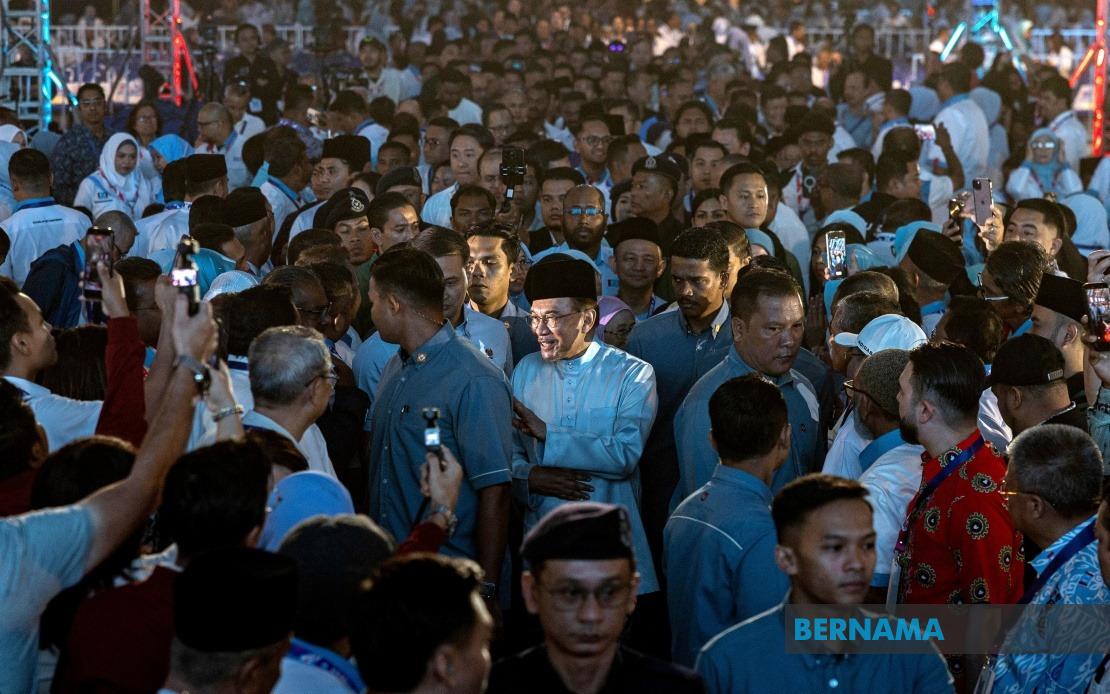
The 2026 PKR National Congress should mark a turning point for the party to unite its fractured membership, fortify internal structures, and recover ground among voters who have grown sceptical of its performance, according to Tengku Datuk Seri Zafrul Tengku Abdul Aziz, the Prime Minister's senior political adviser and an ex-officio member of the PKR Political Bureau. Speaking in Melaka on August 15, Tengku Zafrul articulated a vision of introspection and renewal that suggests the party recognizes significant challenges to its standing within the ruling coalition and broader electorate.
The message arrives against the backdrop of disappointing results in recent state elections, which have prompted soul-searching within PKR's ranks about the party's strategic direction and relevance. Rather than deflecting blame onto coalition partners or external circumstances, Tengku Zafrul's remarks position the party as responsible for its own fortunes. This framing is notable within Malaysian politics, where factional parties often resort to mutual recrimination when electoral performance falters. His insistence that PKR focus on controllable variables—its own organizational capacity and message delivery—reflects a pragmatic understanding that the party cannot influence the behaviour of its component partners in the Unity Government, namely DAP and Amanah, but it can take command of its own destiny.
The call for comprehensive self-assessment extends across the party's entire hierarchical structure, from grassroots branches through to the central party apparatus. This sweeping scope suggests that PKR's leadership recognizes weaknesses are not localized to a single tier but permeate the organization. Effective political machines require seamless coordination between local mobilization and strategic direction from the top. By explicitly naming both dimensions, Tengku Zafrul has implicitly acknowledged that PKR's machinery has suffered operational friction that has diminished its capacity to translate organizational resources into electoral gains and policy implementation.
A second strand of Tengku Zafrul's critique addresses the gap between governmental output and public perception. The framing—that citizens may not yet perceive tangible results from PKR's efforts in government—points to a communication and messaging breakdown. For Malaysian voters, the proximity between government formation and visible delivery of campaign promises typically determines whether they view their ruling coalition as effective. When that connection weakens, voters grow cynical. Tengku Zafrul's emphasis on the party's responsibility to communicate "more clearly and effectively" suggests that PKR has either failed to articulate its achievements adequately or that its achievements themselves remain too modest to offset public frustration over cost of living, employment, and service delivery concerns.
The directive to listen to public grievances without rushing to formulate responses carries particular weight in a nation where political alienation has deepened in recent years. Malaysian voters frequently complain that elected representatives are inaccessible or dismissive of local concerns. By urging party members to approach community engagement with genuine receptiveness rather than defensive posturing, Tengku Zafrul is advocating for a listening-first posture that could rebuild interpersonal trust between party members and their constituents. This approach assumes that many voter complaints are substantive rather than merely rhetorical, and that acknowledging unresolved problems—rather than minimizing them—constitutes the foundation for restoring credibility.
The three-step framework Tengku Zafrul articulates—listen, acknowledge, deliver—amounts to a basic accountability model that many governing parties in Malaysia have historically struggled to implement consistently. In a context where patronage networks and factional loyalty have traditionally superseded constituent service, this emphasis on responsive governance signals an attempt to reorient PKR toward a more service-oriented model. Whether individual party cadres will embrace this principle systematically remains an open question, but the articulation of such expectations from senior leadership establishes at least a nominal standard against which performance can be measured.
Within the broader Unity Government framework, PKR occupies a middling position. It is neither the largest nor the smallest coalition component, and it has historically competed with DAP for urban votes and with Amanah for reform-minded constituencies. Recent electoral weakness has likely intensified internal pressure on PKR's leadership to demonstrate that the party retains relevance beyond its seat count. The 2026 congress will serve as the arena where these leadership dynamics play out, with the composition of party office-holders potentially reflecting whether the party chooses consolidation under existing management or pivots toward renewal.
The reference to disappointment with Unity Government partners, coupled with the insistence that external factors cannot be controlled, reveals a delicate balancing act. PKR cannot openly distance itself from coalition governance without triggering immediate political consequences, yet it must signal to its base that it remains responsive to grassroots concerns even when coalition arithmetic constrains unilateral action. This tension between governmental responsibility and political autonomy will likely characterize PKR's messaging strategy through 2026 and beyond.
For Malaysian voters and regional observers, Tengku Zafrul's intervention underscores the fragility of consensus-based coalitions. When component parties within a government begin publicly emphasizing their separate identities and distinct accountability to their supporters, it often signals underlying strain. The necessity of PKR's senior leadership issuing calls for internal discipline and renewal, rather than celebrating organizational vitality, implies that complacency or faction-driven drift has eroded party cohesion. Whether the 2026 congress galvanizes the party toward genuine institutional reform or devolves into ritual affirmations of unity without substantive change will largely determine whether PKR can stabilize its electoral standing heading into the 2028 general election cycle.

