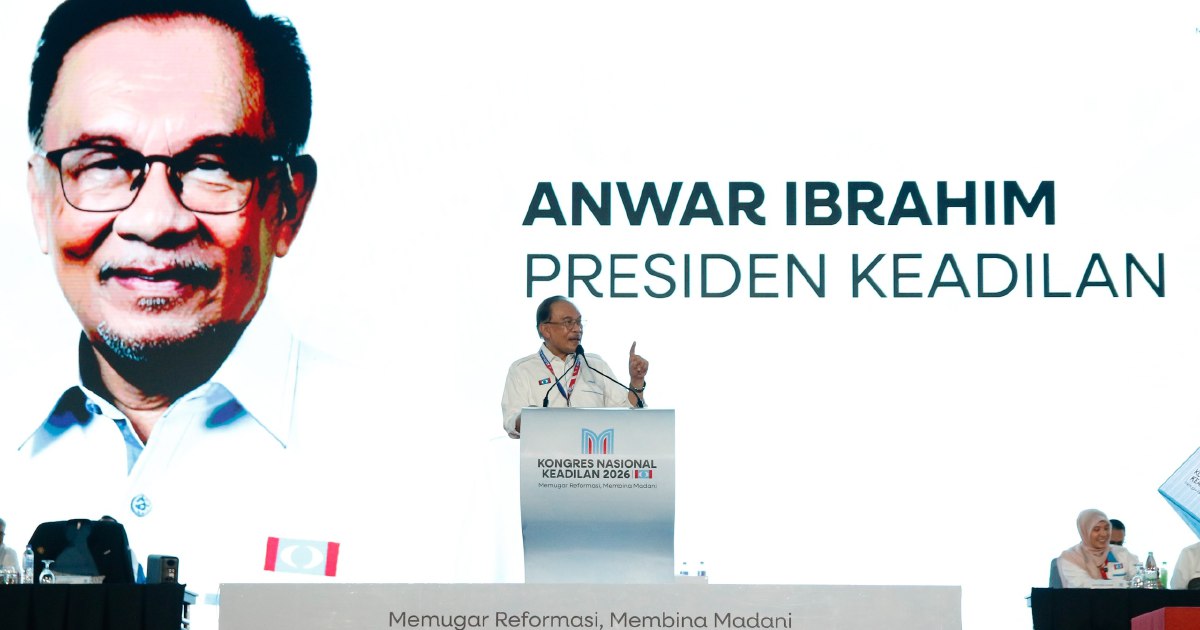
PKR's political positioning continues to navigate a delicate equilibrium as Datuk Seri Anwar Ibrahim confirmed the party's commitment to parallel coalitional arrangements at the federal level. Speaking in Ayer Keroh, the PKR president outlined a strategy that sees Malaysia's largest opposition-aligned party serving as a crucial bridge between competing political blocs rather than fully committing to either.
The move reflects Malaysia's increasingly complex political landscape, where coalition mathematics frequently override traditional party loyalties. Since the 2022 elections reshaped parliamentary alignments, PKR has occupied a strategic position that neither fully aligns with Barisan Nasional-Umno nor completely distances itself from Pakatan Harapan partners DAP and Amanah. This positioning has allowed the party to maintain influence in both government formation discussions and opposition strategy sessions, though it continues to draw scrutiny regarding its long-term political direction.
Anwar's clarification addresses persistent questions from within PKR's coalition partners about the party's real priorities. DAP and Amanah have periodically expressed concern about PKR's willingness to cooperate with Barisan Nasional, viewing such arrangements as compromising Pakatan Harapan's original reform agenda. The federal-level arrangement, however, distinguishes PKR's approach from abandoning its Pakatan Harapan commitments entirely, suggesting a state-by-state flexibility rather than wholesale realignment.
Understanding PKR's strategic rationale requires examining Malaysia's post-2020 political fragmentation. The collapse of the Pakatan Harapan government under Mahathir's watch, followed by Muhyiddin's Perikatan Nasional administration, demonstrated the volatility of coalitions dependent on narrow parliamentary majorities. PKR's dual engagement allows the party to avoid being marginalised should federal coalitions shift, a concern that has animated Malaysian politics since the Sheraton Move upended expectations in 2020.
The federal-level cooperation with Barisan Nasional has already taken concrete form in parliamentary voting on key legislation, where PKR MPs have at times aligned with government positions. This pragmatism contrasts with the more ideologically consistent stance maintained by DAP, which has historically resisted accommodating Umno despite occasional collaboration on specific issues. PKR's willingness to separate coalition identity from issue-based cooperation reflects Anwar's broader belief that principle need not override practical governance needs.
Regional implications extend beyond Malaysia's domestic politics. Southeast Asian observers note that PKR's balancing act influences how Malaysian politics interfaces with broader democratic movements in the region. A PKR fully committed to reform-oriented coalitions carries different regional messaging than one comfortable negotiating with traditional establishment parties. The party's bifurcated approach suggests Malaysian politics will continue mixing old and new political forces rather than achieving a clean democratic transition.
For state-level politics, PKR maintains distinct arrangements reflecting local electoral realities and coalition configurations. Selangor and other Pakatan Harapan-governed states continue under PH governance, while other state-level negotiations may involve different partners. This compartmentalisation allows PKR to simultaneously claim fidelity to multiple coalitions, though critics contend it demonstrates strategic ambiguity rather than principled commitment.
The party's position also reflects evolving thinking about Malaysia's political future. Rather than viewing Barisan Nasional as irredeemable, Anwar and PKR increasingly present the party as amenable to modernisation through engagement. This contrasts with earlier Pakatan Harapan messaging that depicted Barisan Nasional as categorically opposed to reform. Whether such engagement will actually shift Barisan Nasional's institutions or merely entrench PKR within a broader establishment coalition remains contested among Malaysian political analysts.
Democratic accountability concerns persist regarding PKR's coalition flexibility. MPs and party members increasingly face questions about whether their elected representatives' loyalty lies with coalition partners, party leadership, or parliamentary constituencies. The dual approach potentially diffuses responsibility, allowing PKR to claim credit for federal achievements while maintaining opposition credibility if government initiatives fail. Such hedging strategies, while politically astute, risk public trust in political institutions.
Looking forward, PKR's sustainability as an equilibrium-maintaining force depends partly on external factors. Further fragmentation within Umno or dramatic shifts in DAP's strategic calculations could force clearer choices. Similarly, Malaysian voters may increasingly demand explicit statements regarding coalition preferences rather than accepting ambiguous multi-directional commitments. The party's performance managing this balancing act will significantly influence whether Malaysia develops stable coalition configurations or continues cycling through alignments responsive to parliamentary arithmetic rather than consistent policy platforms.
Anwar's reaffirmation of dual commitment suggests PKR intends maintaining its current position through the medium term, betting that Malaysia's fractionalised political landscape will reward flexibility over consistency. Whether this constitutes mature pragmatism or problematic fence-sitting ultimately reflects broader Malaysian views regarding what coalition politics should achieve in a modern democracy.

