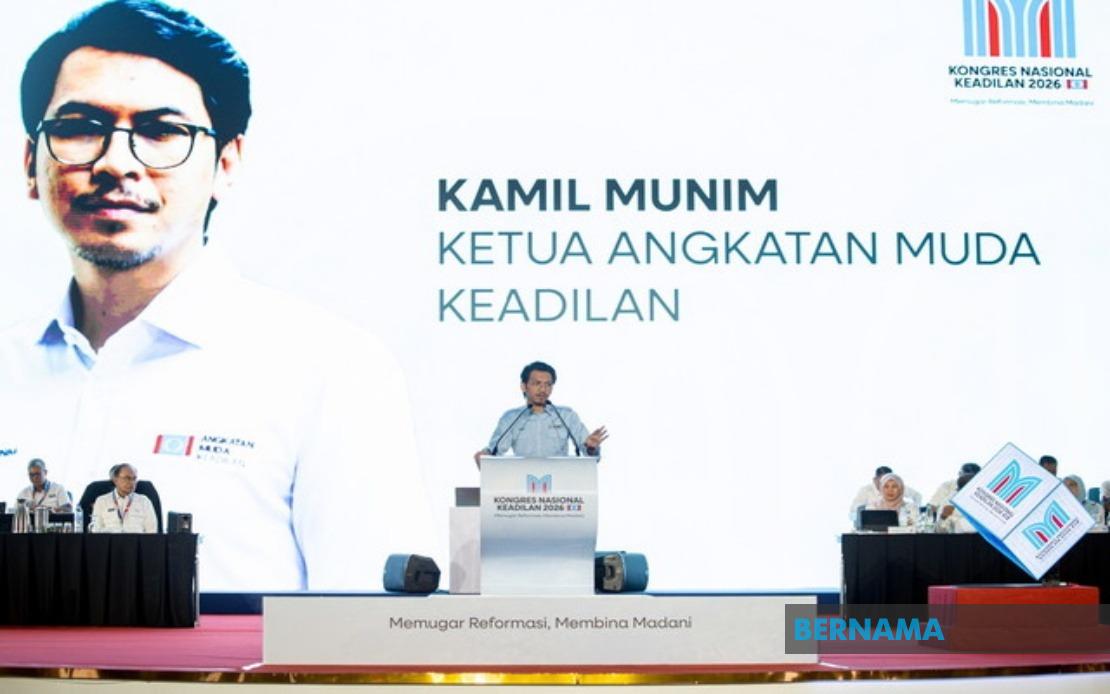
PKR Youth chief Muhammad Kamil Abdul Munim has urged the party's youth wing to undertake a comprehensive reassessment of its approach to politics, particularly in targeting voters aged 45 and below who constitute the single largest demographic in Malaysia's electoral register. Speaking at the PKR National Congress in Melaka on August 16, Muhammad Kamil highlighted that this age group's electoral significance makes them strategically indispensable for securing party victories in future elections, yet recent polling performances suggest the party has not sufficiently penetrated this crucial constituency.
The call for strategic recalibration follows disappointing results in the recent Johor and Negeri Sembilan state elections, which served as a wake-up call for PKR's leadership regarding the party's competitive position and voter mobilisation capabilities. Muhammad Kamil stressed that these electoral setbacks necessitated a thorough evaluation of the party's operational strengths and the tactical approaches currently deployed to win public confidence. Rather than dismissing the losses as isolated incidents, the PKR Youth chief framed them as indicators of deeper structural challenges within the party's messaging and engagement mechanisms that require immediate attention.
Underscoring the demographic imperative, Muhammad Kamil pointed to electoral data demonstrating that voters under 45 years old significantly outnumber older age groups on the electoral roll. This demographic reality underscores why the party cannot afford to maintain its existing approach if it intends to remain electorally competitive. The youth-skewed composition of Malaysia's voting population reflects broader demographic trends in Southeast Asia and creates both opportunities and challenges for traditional political parties struggling to maintain relevance among digitally native, socially conscious younger voters with distinct policy priorities and communication preferences.
A central element of Muhammad Kamil's critique focused on grassroots leadership quality and engagement depth. He cautioned party machinery against becoming overly preoccupied with administrative technicalities at the expense of genuine community relationship-building and substantive understanding of constituent concerns. This distinction between bureaucratic competence and authentic leadership resonates particularly in Malaysian political contexts where party machinery often privileges hierarchical structure over organic community integration. Muhammad Kamil argued that grassroots leaders must elevate their capacity to comprehend and address the lived experiences and anxieties of ordinary Malaysians, particularly in rural areas where traditional political loyalties have weakened considerably over the past decade.
The PKR Youth chief acknowledged that government performance assessments had generally been favourable among the public, yet the Johor and Negeri Sembilan electoral outcomes revealed persistent gaps between government initiatives and public perception or satisfaction. This contradiction suggests that positive policy outcomes do not automatically translate into electoral support without effective communication strategies and demonstrated responsiveness to community-level concerns. Muhammad Kamil identified this translation failure as a critical vulnerability requiring immediate remediation through enhanced direct engagement with local communities, particularly smaller population clusters in less urbanised areas where traditional grassroots organising remains more effective than digital campaigning.
Particular emphasis was placed on the necessity for party leaders to conduct intensive ground-level engagement with communities to surface underlying anxieties and grievances that might not surface through formal channels or polling mechanisms. Muhammad Kamil argued that understanding these concerns represented merely the first step; the party must then develop credible, locally-tailored solutions that address specific problems rather than deploying generic policy messaging. This ground-truth approach acknowledges that electoral support ultimately derives from voters' perception that a political party comprehends their situations and possesses both the will and capability to implement meaningful improvements in their material circumstances.
Muhammad Kamil issued a clear directive that the party machinery must immediately commence work identifying the specific concerns and anxieties that have created distance between PKR and significant voter populations. He framed this identification process as a shared responsibility of all grassroots leaders gathered at the congress, emphasising collective accountability rather than top-down directives. This collaborative framing reflects recognition that sustainable electoral recovery requires mobilisation of grassroots activists who possess intimate knowledge of local political terrain and community sentiment, rather than relying solely on central party apparatus.
Looking toward the next general election, which Muhammad Kamil characterised as approaching with increasing immediacy, the PKR Youth chief invoked the party's historical trajectory to inject cautionary optimism into the grassroots membership. He highlighted PKR's track record of generating electoral surprises at roughly decadal intervals, specifically referencing 2008 when the party helped deny Barisan Nasional its two-thirds parliamentary supermajority, and 2018 when Pakatan Harapan's coalition secured federal government control. These historical successes, Muhammad Kamil implied, demonstrated that even disadvantaged positions could be overcome through sufficient organisational effort, strategic clarity, and voter mobilisation intensity.
However, Muhammad Kamil cautioned that historical precedent provided no guarantee of future outcomes without rigorous preparation and substantive learning from previous electoral disappointments. The implicit critique suggested that complacency or reliance upon past success would prove counterproductive in a rapidly evolving electoral environment where voter preferences have become more volatile and younger cohorts demonstrate less partisan loyalty than previous generations. The general election timeline, while not precisely specified, carries sufficient urgency to demand immediate strategic implementation rather than postponed consideration.
The party leadership challenge Muhammad Kamil articulated extends beyond organisational mechanics to encompassing the comprehensive renewal of PKR's capacity to lead the nation and articulate a compelling vision for Malaysia's future. Convincing voters at grassroots levels demands more than electoral promises; it requires demonstrating authentic understanding of community priorities and establishing credible pathways toward material improvement. For Malaysian voters aged 45 and below, who have experienced economic volatility, uncertain employment prospects, and escalating cost-of-living pressures, this demonstration of comprehension and capability determination has become paramount in determining electoral choice. PKR's success in executing this strategic reorientation will substantially influence the trajectory of Malaysian politics in the approaching election cycle and potentially reshape the country's political landscape.

