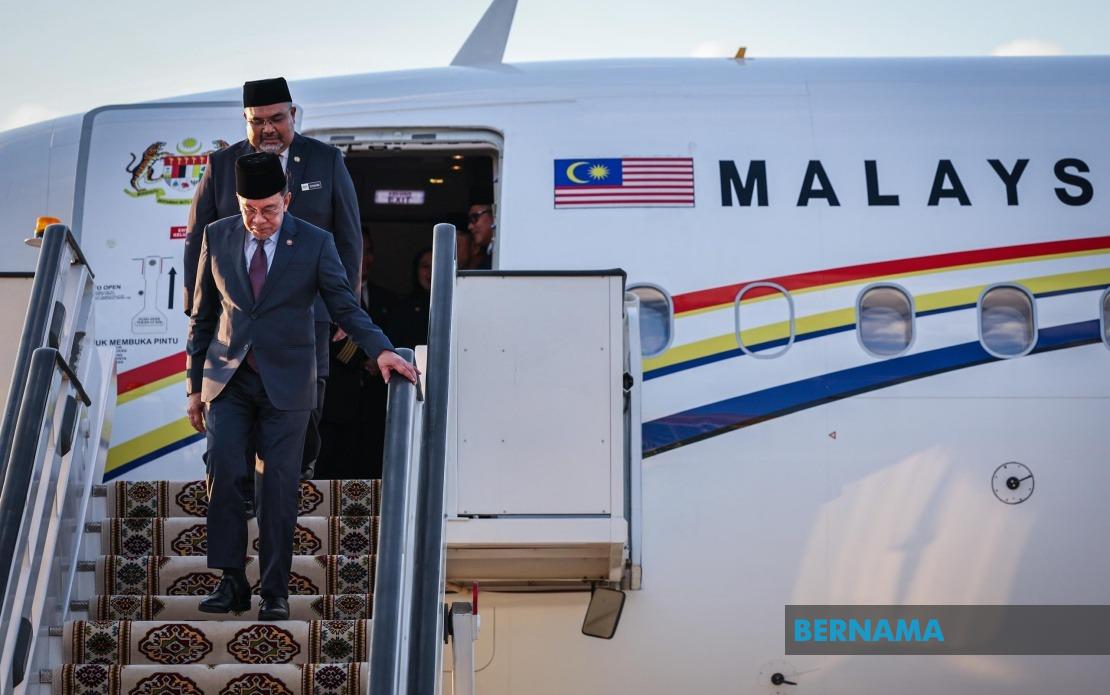
Prime Minister Datuk Seri Anwar Ibrahim landed in Ashgabat on June 18 for a two-day official visit to Turkmenistan, the latest leg of his broader Central Asian tour that began in Russia's Tatarstan region. His aircraft touched down at Ashgabat International Airport at 8 pm local time, marking the commencement of a carefully scheduled diplomatic engagement with President Serdar Berdimuhamedov that encompasses formal state ceremonies, bilateral negotiations, and the furthering of Malaysia's economic ties across the energy and trade sectors in one of Asia's most strategically positioned nations.
The delegation accompanying the Prime Minister reflects the broad economic scope of this visit. Minister of Investment, Trade and Industry Datuk Seri Johari Abdul Ghani, Minister of Economy Akmal Nasrullah Mohd Nasir, and senior officials from the Prime Minister's Office and Foreign Ministry travelled with Anwar, underscoring Malaysia's intent to deepen commercial and governmental relationships beyond ceremonial courtesy. Upon arrival, Malaysia's Ambassador to Turkmenistan Mohd Suhaimi Ahmad Tajuddin greeted the Prime Minister, while the Turkmenistan delegation was represented by Deputy Chairman of the Cabinet of Ministers for Oil and Gas Guvanch Agajanov—a deliberate choice that signals Turkmenistan's prioritisation of energy partnerships in these discussions.
This visit occurs at President Berdimuhamedov's formal invitation and serves as a reciprocal gesture following his December 2024 visit to Malaysia. The timing and nature of such exchanges demonstrate the strengthening of bilateral relations between the two nations. For Malaysia, this represents Anwar's inaugural official journey to Turkmenistan, though the country's diplomatic engagement runs deeper: this marks the fifth visit by a Malaysian prime minister to the Central Asian nation, indicating a sustained pattern of high-level engagement spanning previous administrations.
The scheduled programme for June 19 begins with considerable ceremonial significance. President Berdimuhamedov will host a formal welcoming ceremony at the Presidential Palace, followed by a one-on-one meeting that will allow both leaders to discuss matters of national importance in a private setting. These personal exchanges often prove instrumental in establishing the tone for broader bilateral discussions. Subsequent formal negotiations will lead to the signing of a joint statement and the exchange of agreements and memoranda of understanding that the two governments have previously negotiated, cementing commitments across multiple sectors of mutual interest.
Beyond the formal governmental agenda, the itinerary reflects both diplomatic protocol and cultural engagement. Anwar will attend an official luncheon hosted by President Berdimuhamedov, followed by prayers at the Turkmenbashi Ruhy Mosque, also known as the Gypjak Mosque. This religious observance carries symbolic weight in a nation where Islam remains central to national identity, and such participation by visiting dignitaries is typically understood as a gesture of respect toward Turkmenistan's cultural and religious foundations. The evening programme includes the joint opening of the Malaysia-Turkmenistan Forum at the Chamber of Commerce and Industry of Turkmenistan, a platform designed to facilitate business-to-business connections and investment exploration between the private sectors of both nations.
Malaysia's economic relationship with Turkmenistan has demonstrated consistent growth, though the volume remains modest relative to some other trading partners. In 2025, Turkmenistan ranked as Malaysia's fourth-largest trading partner among Central Asian nations, with total bilateral trade reaching RM75.80 million. Malaysian exports to Turkmenistan amounted to RM75.50 million, representing a nine per cent increase compared with the previous year. While these figures may appear modest in the context of Malaysia's overall international commerce, they reflect an expanding economic footprint and growing commercial confidence in a nation that occupies a crucial position along Asia's historical and contemporary trade corridors.
The most significant dimension of Malaysia's engagement with Turkmenistan centres on energy investment and resource extraction. Petroliam Nasional Bhd, commonly known as Petronas, has established itself as one of the nation's most substantial foreign investors in Turkmenistan. Since 1996, Petronas has accumulated investments totalling RM52.73 billion in the country, representing a strategic commitment spanning nearly three decades. This investment profile underscores why energy and resource sector discussions feature prominently during such high-level visits, as both nations possess shared interests in maximising the exploitation and distribution of hydrocarbon resources within a stable, mutually beneficial framework.
Turkmenistan's position in Central Asia carries implications extending beyond bilateral Malaysia-Turkmenistan relations. The nation commands significant natural gas reserves and serves as a transit point for regional energy distribution, making it strategically valuable to countries pursuing energy security and diversification strategies. For Malaysia, engagement with Turkmenistan forms part of a broader diversification strategy aimed at reducing dependency on any single energy source or region while maintaining healthy relationships with multiple suppliers and transit nations. Anwar's presence in the capital underscores the seriousness with which Malaysia's government regards these partnerships.
The broader context of Anwar's Central Asian tour—beginning in Tatarstan before moving to Turkmenistan—reveals a deliberate geographical strategy. Russia's Tatarstan region and Central Asian nations share certain economic and geographical characteristics that make them collectively attractive to Malaysian investors and policymakers. By visiting both regions in close succession, the Prime Minister signals Malaysia's commitment to deepening engagement across this broader zone, recognising that economic opportunities and geopolitical considerations increasingly demand a regional rather than purely bilateral approach.
Looking forward, the agreements and memoranda expected to emerge from this visit will likely address areas including trade facilitation, investment promotion, energy cooperation, and possibly tourism and cultural exchanges. Such documents typically establish frameworks for future collaboration without binding either nation to specific obligations, allowing for flexibility as circumstances evolve. The Malaysia-Turkmenistan Forum launching during the visit may develop into a regular mechanism for private sector engagement, creating channels through which business leaders from both countries can identify and pursue mutual opportunities outside formal governmental structures.
For Malaysian observers and businesses, this visit represents both symbolic and practical significance. Symbolically, it reaffirms Malaysia's commitment to expanding its presence and influence across Central Asia, a region increasingly recognised as economically significant and geopolitically consequential. Practically, it may generate opportunities for Malaysian companies operating in energy services, construction, and technology sectors to establish or expand operations in Turkmenistan. The attendance of economic ministers alongside the Prime Minister suggests that commercial considerations receive equal weight with diplomatic courtesy, a balance essential for sustainable bilateral relationships that benefit both nations' citizens and economies.