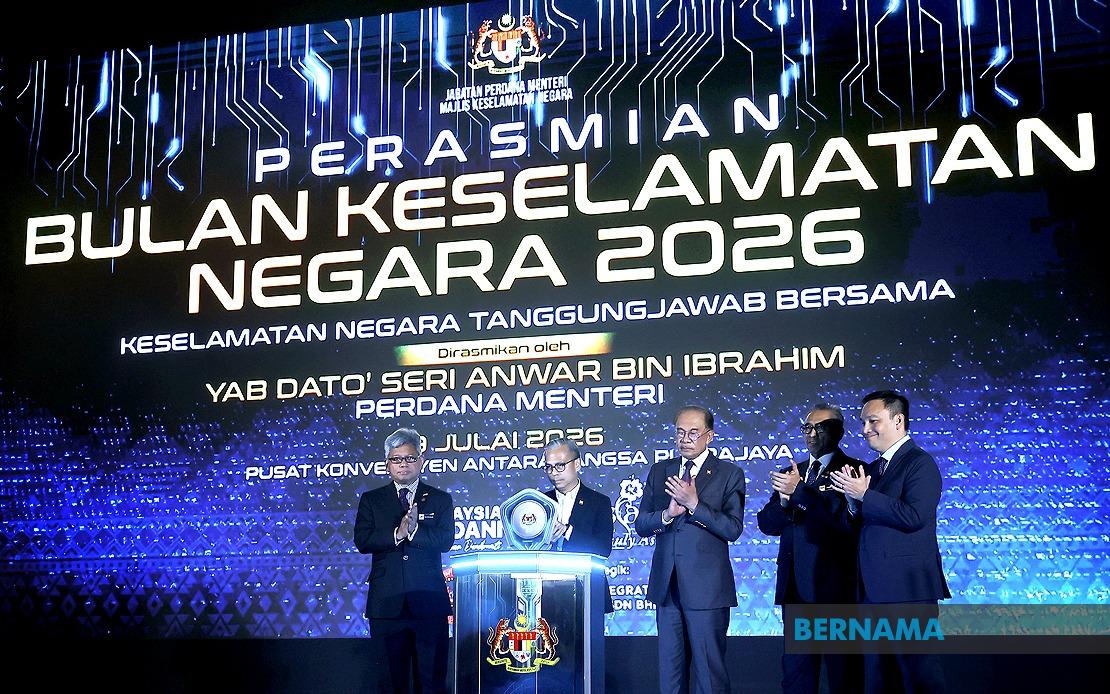
Prime Minister Datuk Seri Anwar Ibrahim has sounded a clarion call for national cohesion, expressing alarm at the persistent invocation of divisive themes rooted in identity politics at a time when Malaysia faces increasingly sophisticated security threats. Speaking at the launch of National Security Month 2026 in Putrajaya, Anwar highlighted the danger of allowing state, racial and religious grievances to dominate public discourse and policy debates, particularly when the nation confronts challenges that demand unified attention and resources. His intervention represents a direct challenge to entrenched political narratives that have long characterised Malaysian public life, signalling the government's determination to reorient the national conversation toward shared vulnerabilities rather than sectional interests.
The Prime Minister's remarks, delivered at an event organised by the National Security Council (MKN) and attended by Communications Minister Datuk Fahmi Fadzil and Chief Secretary to the Government Tan Sri Shamsul Azri Abu Bakar, underscore mounting concern within the highest echelons of government about the cost of perpetual identity-based antagonism. Anwar pointedly noted his frustration with parliamentary exchanges that rehash historical grievances and competing communal claims even as external and internal security pressures intensify. By framing identity politics as a distraction from substantive governance challenges, he implicitly argues that Malaysia's political class has misdirected energy and focus, wasting institutional capacity that should be deployed against contemporary threats.
The security landscape confronting Malaysia has grown markedly more complex over recent years, extending well beyond traditional concerns of border integrity and internal stability. Technological advancement has introduced asymmetric vulnerabilities that require sophisticated institutional responses, comprehensive coordination across agencies, and rapid adaptation to emerging methodologies employed by malicious actors. Cyber-enabled threats, digital manipulation campaigns, and information warfare represent domains in which the nation's defensive posture remains under continuous stress. Anwar's emphasis on these newer threat vectors reflects a pragmatic assessment that Malaysia cannot afford the luxury of inward-looking disputes when adversaries and hostile actors increasingly operate through networks that transcend borders and conventional security classifications.
Central to Anwar's argument is an implicit critique of political leadership that prioritises mobilising identity constituencies over addressing collective vulnerabilities. The Prime Minister suggested that governmental bodies and institutional actors at every level have become too reactive, waiting for crises to materialise before developing responses rather than anticipating and preventing threats. This characterisation points to systemic governance weaknesses—institutional silos, insufficient interagency coordination, and inadequate investment in forward-looking strategic analysis—that compound the difficulty of managing modern security challenges. By elevating the National Security Month 2026 platform, the government signals its intention to normalise security consciousness across society and institutional structures.
The Malaysian context gives particular weight to Anwar's intervention. The country has long navigated delicate communal arrangements rooted in constitutional and political settlements that institutionalise group identities within governance frameworks. Yet Malaysia also faces practical pressures that transcend these historically significant arrangements: terrorism originating from ideological extremism, transnational criminal networks, irregular migration, and increasingly, coordinated information operations designed to amplify social divisions. These threats operate according to logics that are indifferent to Malaysia's internal political demarcations, creating an objective condition where collective capacity becomes essential for national defence.
The burden of responding to Anwar's exhortation rests significantly on Malaysia's political class and institutional leaders. The Prime Minister implicitly called for a redirection of political energy away from identity mobilisation toward policy domains focused on technological literacy, institutional coordination, and proactive threat assessment. This transformation would require political actors to resist the temptative calculus that positions identity politics as a reliable electoral strategy, instead investing in narratives that emphasise shared stake in security and prosperity. For a political system in which identity-based parties have traditionally anchored mobilisation and coalition formation, such reorientation represents a substantial structural challenge.
The implications for Southeast Asian stability merit consideration as well. Malaysia's capacity to manage internal security pressures has regional resonance, given the nation's geographic position, economic significance, and role in regional institutions and partnerships. Persistent internal instability rooted in unresolved communal tensions could compromise Malaysia's ability to contribute effectively to regional security architecture, counterterrorism cooperation, and maritime security initiatives. Anwar's call for redirecting national attention toward unified security responses potentially positions Malaysia for more credible and capable engagement with regional partners confronting similar challenges across Southeast Asia.
Implementing Anwar's vision requires mechanisms beyond rhetorical exhortation. Institutional reforms that increase transparency and effectiveness in security institutions, training programmes that equip bureaucrats and security personnel with contemporary competencies, and investment in research capacity focused on emerging threats would provide substantive expression to the National Security Month 2026 campaign. The presence of the National Security director-general Datuk Raja Nurshirwan Zainal Abidin at the event suggests institutional commitment to translating the Prime Minister's messaging into operational adjustments and strategic planning priorities.
The fundamental tension Anwar has identified—between the gravitational pull of historical identity politics and the urgent demands of contemporary security challenges—will likely define Malaysian governance for the foreseeable future. His effort to elevate security consciousness and redirect political dialogue represents an attempt to create normative space within which identity concerns, while acknowledged, do not dominate governance at the expense of addressing collective vulnerabilities. Whether this reorientation can sustain traction amid entrenched political incentive structures that reward identity mobilisation remains an open question that will significantly influence Malaysia's capacity to navigate coming years.

