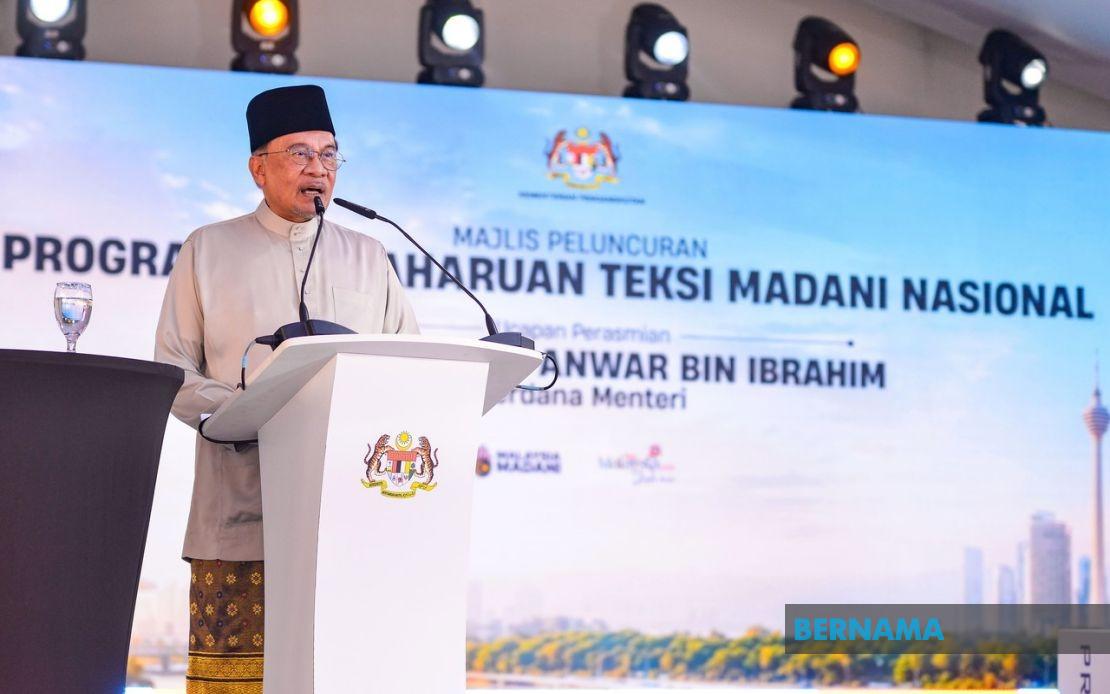
Prime Minister Datuk Seri Anwar Ibrahim has committed an additional RM10 million to accelerate the replacement of ageing taxis across Malaysia, signalling the government's deepening investment in transforming the nation's transport sector. The announcement, made during the launch of the National MADANI Taxi Reform Programme at Dataran Merdeka on July 3, represents a doubling of support beyond the original RM10 million allocation unveiled in Budget 2026, reflecting what officials describe as an overwhelmingly positive reception from the taxi industry.
The decision to inject extra resources underscores the government's recognition that taxi drivers face formidable obstacles when attempting to retire obsolete vehicles and transition to newer models. Many operators in Malaysia's taxi sector struggle with ageing fleets that rack up substantial maintenance costs, reduce fuel efficiency, and diminish passenger confidence in the service. By channelling additional funds through the Vehicle Replacement Matching Grant Programme, authorities aim to make vehicle acquisition more financially manageable for drivers who typically operate on tight profit margins.
Anwar, who holds the concurrent portfolio of Finance Minister, framed the investment as a matter of sectoral importance rather than routine budgetary allocation. His personal approval of the additional funding suggests that taxi reform has secured prominent standing within the government's economic and social agenda. This positioning reflects broader policy thinking that modernising the taxi fleet carries implications extending beyond individual driver welfare to encompass urban mobility, environmental sustainability, and the credibility of Malaysia's transport infrastructure in the eyes of both domestic and international passengers.
A critical component of the reform strategy involves a newly negotiated partnership between the government, automotive manufacturer Proton, and the Transport Ministry to establish tailored financing arrangements for taxi drivers seeking to purchase the Proton S70. This model vehicle offers a locally produced alternative with specifications designed to meet commercial transport requirements, potentially supporting domestic automotive manufacturing while simultaneously providing drivers with an accessible pathway to ownership. The dedicated financing scheme removes barriers that might otherwise exclude individual operators from vehicle acquisition, as conventional commercial lending often imposes stringent collateral requirements and credit assessments that marginalise small operators.
The Proton S70 initiative represents a shift in policy approach that links industrial development objectives with sectoral reform. Rather than relying purely on grant mechanisms, the financing arrangement channels government support through a structured product that stimulates domestic manufacturing demand. For Proton, the arrangement creates an identifiable market segment with government-backed purchasing power, potentially offering production volume certainty. For taxi drivers, the arrangement translates technical specifications and affordability into a concrete purchasing option that aligns with their operational needs and financial capacity.
The government's dual approach of combining grant assistance with specialised financing reflects sophisticated understanding of barriers facing taxi operators. A driver seeking to replace a vehicle confronts multiple challenges simultaneously: securing sufficient capital, accessing appropriate credit terms, selecting a suitable vehicle model, and managing the transition during replacement. By bundling grant support with dedicated financing and a designated vehicle option, the programme attempts to address these interconnected obstacles within a unified framework rather than treating them as separate problems requiring separate solutions.
Transport Minister Anthony Loke's presence at the programme launch signals coordination across relevant government portfolios. The transport ministry's involvement ensures that vehicle specifications align with safety standards, emissions regulations, and operational requirements specific to the Malaysian taxi industry. This cross-ministry collaboration transforms taxi reform from a narrow financial exercise into a comprehensive sectoral modernisation initiative encompassing regulatory, industrial, and social dimensions. Hannah Yeoh, Minister in the Prime Minister's Department (Federal Territories), and Chief Secretary to the Government Tan Sri Shamsul Azri Abu Bakar also participated, reflecting the high-level governmental attention directed toward the programme.
For Malaysian taxi drivers, these announcements offer tangible relief from a sector that has experienced prolonged pressure from ride-hailing competitors, deteriorating vehicle conditions, and stagnant fare structures. The modernisation initiative addresses at least one dimension of this multifaceted challenge by making vehicle replacement financially feasible. Updated vehicles can enhance service quality, potentially allowing drivers to remain competitive with alternative transport services by offering cleaner, more reliable transport with reduced mechanical failure risks.
The broader Southeast Asian context amplifies the significance of Malaysia's taxi modernisation effort. Across the region, transportation sectors grapple with technological disruption, environmental pressures, and changing consumer preferences. Malaysia's structured approach to supporting traditional taxi operators through vehicle modernisation offers a model demonstrating how governments can facilitate sectoral transition without abandoning established transport workforces. This contrasts with purely deregulatory approaches that might allow ride-hailing services to eliminate traditional operators, or laissez-faire policies that leave drivers to manage disruption independently.
Environmental implications of the programme merit consideration within Malaysia's broader sustainability objectives. Older taxi vehicles typically exhibit higher emissions profiles and reduced fuel efficiency compared to contemporary models. The Proton S70, as a modern vehicle, would likely demonstrate improved environmental performance, potentially contributing incrementally toward transportation sector decarbonisation goals. When aggregated across hundreds or thousands of replacement vehicles, environmental gains become measurable, though the scale depends on replacement rates achieved through the programme.
The programme's success will depend substantially on implementation efficiency and driver uptake. Government grant programmes sometimes encounter delays, bureaucratic complications, or eligibility requirements that discourage participation. The dedicated Proton financing scheme's performance will similarly hinge on whether interest rates, repayment terms, and eligibility criteria prove genuinely accessible to drivers operating in a sector characterised by variable income and limited conventional credit access. Transparent communication regarding application processes, approval timelines, and financing terms will prove essential for converting announced allocations into actual vehicle replacements.
Looking forward, the RM20 million combined allocation represents an opening gambit in what likely constitutes a longer-term modernisation process. Industry observers will monitor uptake rates closely to assess whether the initial funding proves sufficient or whether additional tranches of support become necessary. The government's willingness to approve supplementary allocation beyond Budget 2026 projections suggests flexibility to expand the programme should demand justify investment, though sustainability ultimately depends on balancing competing budgetary priorities.

