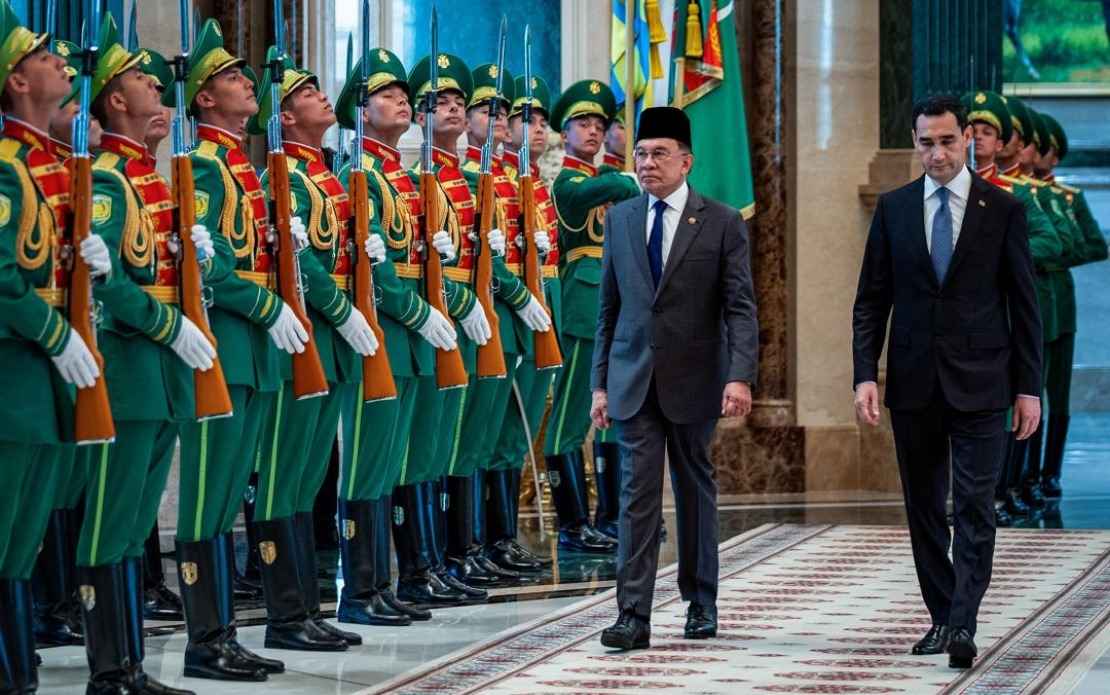
Prime Minister Datuk Seri Anwar Ibrahim was accorded full ceremonial honours at the Turkmenistan Presidential Palace on June 19, underscoring Malaysia's commitment to deepening ties with the resource-rich Central Asian nation. The official welcome ceremony, featuring a guard of honour and the simultaneous playing of Malaysian and Turkmenistani national anthems, marked a significant diplomatic moment for Malaysia in a region where the country has traditionally maintained lower-profile engagement compared to its Southeast Asian neighbourhood.
Turkmenistan President Serdar Berdimuhamedov personally received the Malaysian premier upon his arrival, demonstrating the high-level political attention accorded to the visit. This personal reception reflects Ashgabat's interest in cultivating stronger relations with Kuala Lumpur, as both nations explore avenues for enhanced cooperation across multiple sectors. The ceremonial elements of the welcome—carefully choreographed protocols involving national symbols and state honours—signal that both capitals view this engagement as more than routine diplomatic courtesy.
Following the formal reception procedures, Anwar was introduced to senior members of the Turkmenistan Cabinet and government officials, allowing for informal exchanges and relationship-building among the delegation members. The prime minister subsequently presented his own Malaysian delegation to President Berdimuhamedov, facilitating introductions that would lay groundwork for potential sectoral partnerships and people-to-people connections. Such introductions serve the practical purpose of creating pathways for future ministerial cooperation and trade negotiations between the two governments.
The diplomatic schedule progressed to a closed-door four-eyed meeting between the two leaders, followed by a more formal bilateral session with broader delegations present. These back-to-back meetings reflected an ambitious agenda aimed at identifying concrete areas of mutual benefit. The discussions centred on matters of mutual interest, a formulation that typically encompasses trade, investment, energy cooperation, and diplomatic coordination on regional and international issues. For Malaysia, such meetings with Central Asian counterparts often address energy security concerns, as nations in this region hold significant hydrocarbon reserves.
Anwar's two-day visit, which commenced on June 18, represents his inaugural official trip to Turkmenistan since assuming office as Malaysia's 10th Prime Minister in November 2022. The extended nature of the visit—spanning two days rather than a brief stopover—suggests substantive negotiations rather than ceremonial window-dressing. The invitation from President Berdimuhamedov personalises the engagement and indicates that the Turkmen leadership views Malaysia as a significant diplomatic partner worthy of presidential-level attention and scheduling priority.
This visit assumes heightened significance within the context of Malaysia's broader foreign policy trajectory under Anwar's premiership. Since taking office, the prime minister has actively pursued a diversified diplomatic engagement strategy, seeking to expand Malaysia's footprint beyond established regional partnerships. Central Asia, long considered a peripheral concern for Southeast Asian capitals, offers Malaysia opportunities to participate in continental affairs and position itself as a bridge between Asia's eastern and western regions. Turkmenistan, specifically, represents a gateway to energy markets and a platform for engagement with the broader Turkic-speaking world.
Turkmenistan itself holds particular strategic value for Malaysia's energy security considerations. As one of the world's leading natural gas exporters with reserves among the largest globally, Turkmenistan could feature in Malaysia's long-term energy diversification strategy. Additionally, the nation possesses significant petrochemical production capacity and mineral resources, creating potential avenues for Malaysian investment and technical expertise in downstream energy sectors. The bilateral discussions likely touched upon these economic dimensions, with both nations potentially exploring frameworks for enhanced trade and investment flows.
The timing of this visit also reflects Malaysia's positioning within broader geopolitical currents. As Western powers reassess their engagement with Central Asia and China expands its footprint through initiatives like the Belt and Road Initiative, Malaysia's visit signals Kuala Lumpur's intention to maintain an independent diplomatic posture and cultivate relationships based on mutual benefit rather than great power alignments. Malaysian engagement with Turkmenistan, positioned outside traditional Cold War power blocs, exemplifies this strategic autonomy.
For Southeast Asian observers, Malaysia's deepening engagement with Central Asian nations carries implications for regional diplomacy. As ASEAN seeks to maintain centrality in Asian affairs while managing great power competition, individual members' cultivation of diplomatic relationships beyond the region strengthens the overall association's global reach and negotiating leverage. Malaysia's presence in Turkmenistan contributes to a pattern of ASEAN members expanding their diplomatic horizons, potentially creating synergies for regional coordination on emerging global issues.
The bilateral meetings between Anwar and Berdimuhamedov would have naturally encompassed discussions on regional security, counterterrorism cooperation, and potential multilateral frameworks. Central Asia's proximity to Afghanistan and historical experiences with extremism make security cooperation a mutual concern. Malaysia's experience combating regional security threats could prove valuable in exchanges with Turkmenistan, while Central Asian perspectives on geopolitical developments offer Malaysian policymakers broader contextual understanding.
Looking forward, this visit establishes a diplomatic foundation upon which Malaysia and Turkmenistan can construct more elaborate institutional frameworks for cooperation. Subsequent visits by ministerial delegations, sector-specific collaborative projects, and potentially expanded cultural and educational exchange programmes would naturally follow from this prime ministerial engagement. The ceremonial welcome accorded to Anwar effectively opens doors that Malaysian officials and business representatives can subsequently walk through, translating presidential-level goodwill into tangible bilateral outcomes.