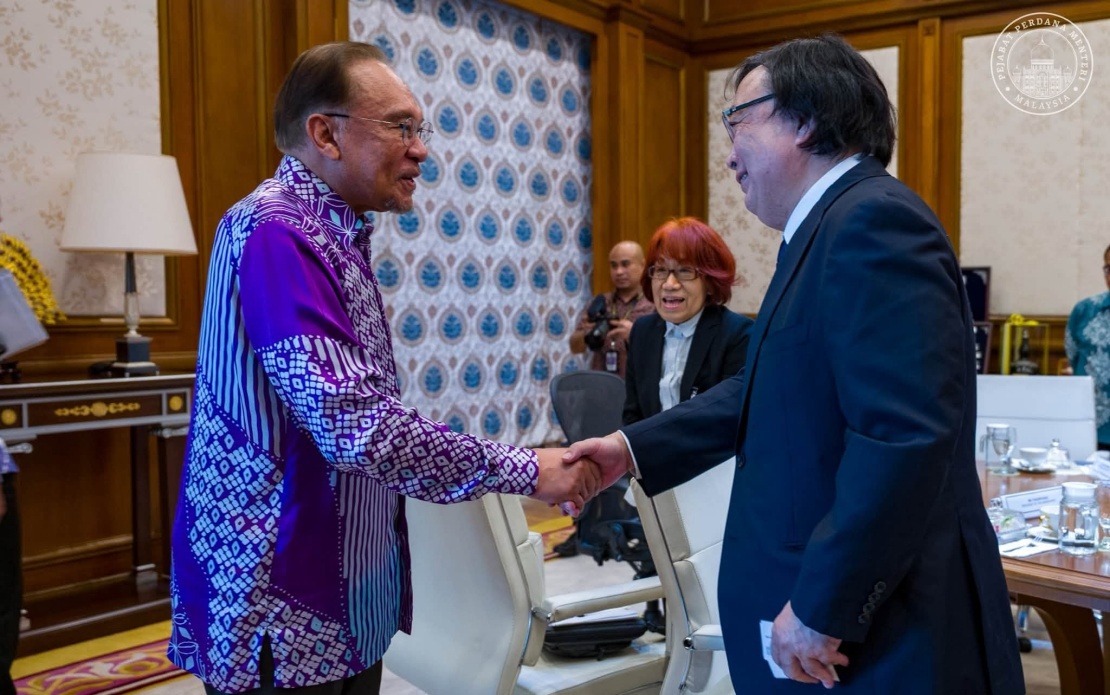
Prime Minister Datuk Seri Anwar Ibrahim hosted a courtesy call from The Genron NPO President Yasushi Kudo on July 23, underscoring Malaysia's commitment to deepening institutional dialogue channels with Japan through leading think tank networks. The meeting, documented on the Prime Minister's official Facebook page, centred on advancing the Asia Leaders Roundtable as a substantive forum for addressing interconnected regional and global concerns that require sustained multilateral engagement.
The Genron NPO, a prominent Japan-based non-profit independent think tank, has positioned itself as an influential platform for high-level policy discourse across Asia. Its focus on convening leaders and experts makes it a strategically important partner for governments seeking to shape regional narratives and coordinate responses to shared challenges. The organization's emphasis on independent analysis aligns with Malaysia's own approach to engaging with regional partners through multiple diplomatic and intellectual channels beyond traditional government-to-government mechanisms.
Anwar's emphasis on strengthening bilateral ties reflected Malaysia's consistent effort to deepen relationships with Tokyo across economic, strategic, and cultural dimensions. The Prime Minister's acknowledgement of Japan's hospitality during his June official visit demonstrated the reciprocal nature of these diplomatic exchanges, which have become increasingly important as both nations navigate shifting regional dynamics. Malaysia views such high-level interactions not merely as ceremonial occasions but as opportunities to align positions on critical regional matters.
The Prime Minister articulated Malaysia's assessment of its Comprehensive Strategic Partnership with Japan as among the nation's most consequential strategic and economic relationships. This characterization underscores how deeply embedded Japan is within Malaysia's foreign policy architecture, particularly given the economic interdependencies, defence cooperation frameworks, and shared interests in maintaining regional stability. The relationship encompasses investment flows, technology transfer, and coordinated approaches to maritime security in Southeast Asian waters.
Anwar's acceptance of Yasushi Kudo's invitation to participate in the Tokyo Conference 2027 signals Malaysia's intention to maintain visible representation at significant Japanese-hosted forums. This commitment extends to his previous contribution of a video message to the 2026 conference, demonstrating sustained engagement despite geographical distance. Such participation allows Malaysian perspectives to be integrated into broader Asian policy discussions and elevates the nation's profile within influential Japanese policy circles that shape Tokyo's regional strategy.
The Asia Leaders Roundtable itself merits attention as a platform addressing the practical challenge of facilitating candid dialogue among senior figures from diverse political systems and strategic backgrounds. By emphasizing this venue for strategic discussion, the Prime Minister indicated Malaysia's belief that informal, track-two mechanisms complement official diplomatic channels. These roundtables often tackle sensitive issues with greater flexibility than formal government negotiations, enabling exploratory conversations about regional tensions, economic cooperation, and emerging threats from pandemics to cybersecurity.
For Malaysian readers, this engagement illustrates the country's active positioning within Asian strategic networks rather than a passive stance in regional affairs. Malaysia's willingness to engage with Japanese think tanks and participate in multilateral forums reflects its self-perception as a central player in regional problem-solving. The consistent dialogue with institutions like Genron NPO demonstrates that Malaysia's foreign policy extends beyond bilateral government relations to encompass intellectual partnerships that inform long-term strategic thinking.
From a regional perspective, the Malaysia-Japan relationship serves as a model for how medium-sized powers can cultivate influence through multiple engagement channels. Rather than relying solely on formal diplomatic representation, both countries leverage business councils, academic exchanges, cultural initiatives, and think tank partnerships to sustain relationships across political cycles and leadership transitions. This diversified approach creates resilience in bilateral ties and facilitates cooperation on issues where formal government positions might be constrained by domestic political considerations.
The emphasis on shared peace, stability, and prosperity articulated by the Prime Minister reflects Malaysia's understanding that its prosperity is inextricably linked to regional order. Japan, as a major economic power with significant security interests in Southeast Asia, shares these concerns. Cooperation between Malaysian and Japanese leadership, supported by robust track-two dialogue mechanisms like those offered by Genron NPO, provides intellectual scaffolding for coordinating responses to transnational challenges that no single nation can address independently.
Looking forward, Malaysia's continued engagement with such forums signals an intention to remain an active participant in shaping regional narratives and strategic outcomes. The Asia Leaders Roundtable serves as a venue where Malaysian perspectives on issues ranging from economic integration to geopolitical competition can be presented directly to influential Japanese and other Asian decision-makers. Such exposure helps ensure that Malaysian interests and viewpoints are factored into regional strategy discussions among leading powers.

