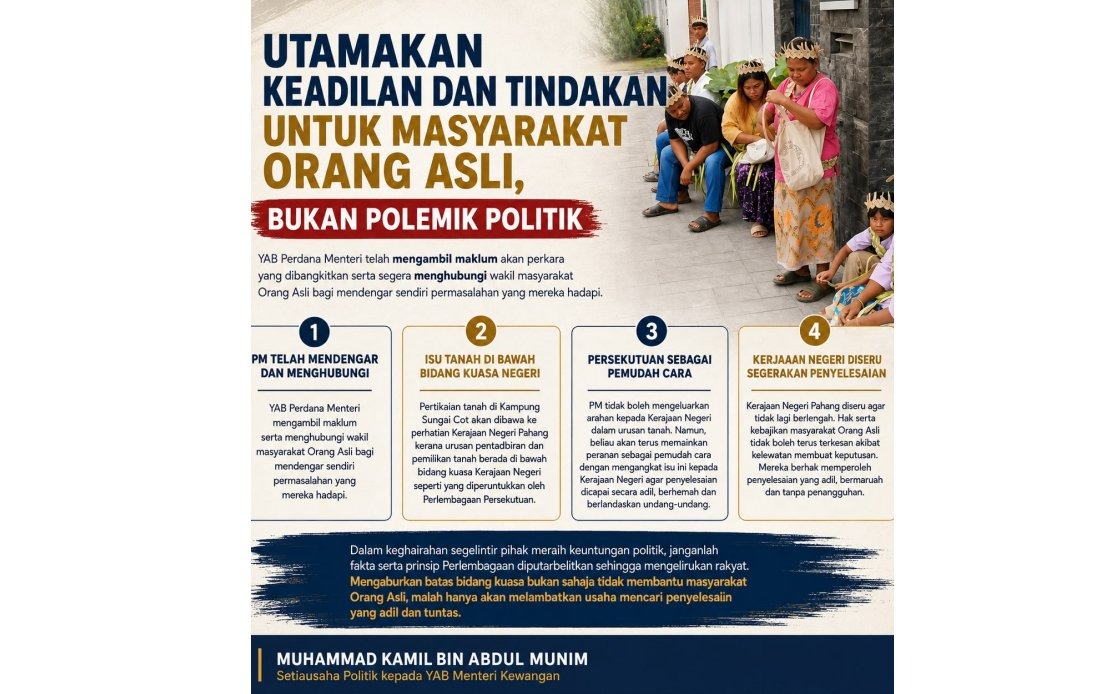
Prime Minister Datuk Seri Anwar Ibrahim is maintaining his commitment to help untangle the complex land ownership dispute affecting the Orang Asli residents of Kampung Sungai Cot in Maran, Pahang, according to a statement released by his office on July 23. The Premier has taken personal interest in the matter, reaching out directly to community representatives to understand the difficulties they confront, signalling a government-level engagement with what has become an increasingly contentious issue in the state.
Muhammad Kamil Abdul Munim, political secretary to the Finance Minister, clarified the scope and limits of the Prime Minister's involvement in addressing the dispute. While Anwar remains engaged and committed to supporting the affected community, constitutional arrangements place land administration squarely within state jurisdiction rather than federal purview. This constitutional reality means the central government must work through established channels with Pahang's state administration, which holds the regulatory authority to make binding decisions on land tenure and ownership questions.
Despite the constitutional constraints on his direct authority, Anwar has signalled that his office will not adopt a passive stance on the issue. Muhammad Kamil emphasised that the Prime Minister would escalate the matter to Pahang's government leadership, seeking their urgent and fair intervention. This approach represents a middle ground between federal overreach and complete disengagement, positioning the Prime Minister as an intermediary advocating for swift resolution while respecting the federal structure enshrined in Malaysia's founding document.
The land dispute in Kampung Sungai Cot reflects broader challenges facing indigenous communities across Malaysia, who frequently encounter complications involving property rights, resource access, and official recognition of their traditional territorial claims. These disputes often pit the rights and livelihoods of Orang Asli groups against commercial interests, government development projects, or competing claims to land ownership. The involvement of the Prime Minister's office underscores how deeply such conflicts can penetrate Malaysia's political landscape, particularly when media attention and public pressure intensify.
Muhammad Kamil's statement contained a pointed rebuke of what he characterised as opportunistic political posturing around the Kampung Sungai Cot situation. He cautioned against deliberate distortion of constitutional principles or factual circumstances undertaken to generate political advantage, arguing that such tactics ultimately harm rather than help indigenous communities seeking genuine solutions. This critique suggests tension between different political actors regarding how the issue should be handled and what role various stakeholders should play in negotiating an outcome.
The statement stressed that the Orang Asli community deserves prompt resolution of their grievances without the delays that have plagued similar disputes across Malaysia. Muhammad Kamil explicitly urged Pahang's state government to exercise its administrative responsibilities expeditiously, recognising that protracted uncertainty damages the affected community's welfare and dignity. This language reflected frustration with the slow pace of governmental decision-making on indigenous land matters, a persistent complaint from advocacy groups monitoring Orang Asli rights.
Anwar's July 21 Facebook statement had already flagged his intention to engage the Pahang State Government on the matter, providing public notice of his involvement and creating accountability for follow-through. By communicating directly to constituents through social media, the Prime Minister elevated the profile of the Kampung Sungai Cot situation beyond typical bureaucratic channels, implicitly signalling that the issue commanded his personal attention and warranted rapid government response. This public dimension potentially pressures Pahang officials to demonstrate visible progress.
The dispute highlights an enduring tension within Malaysia's federal system, where indigenous communities often find themselves navigating multiple layers of governance and competing claims to authority. State governments hold constitutional power over land matters, yet the Federal Government bears responsibility for safeguarding minority rights and ensuring equitable treatment of all Malaysian citizens. This structural reality creates situations where the Prime Minister can advocate and facilitate but cannot simply direct state officials to resolve disputes according to his preferences.
For the Orang Asli community at Kampung Sungai Cot, the Prime Minister's intervention offers both opportunity and uncertainty. Direct engagement from the highest executive authority can amplify their concerns and create political pressure for action, yet the reliance on state-level machinery means ultimate outcomes remain contingent on Pahang's political calculations and administrative capacity. Previous experiences with Orang Asli land disputes suggest that even high-level attention does not guarantee satisfactory or swift outcomes when state interests diverge from indigenous claims.
The situation also carries implications for Malaysia's broader development agenda and international standing on indigenous peoples' rights. As the country positions itself as a progressive regional player, visible commitment to protecting Orang Asli interests strengthens that narrative. Conversely, failures to resolve land disputes fairly risk damaging Malaysia's credibility and fuelling criticism from human rights organisations monitoring indigenous rights across Southeast Asia. The Prime Minister's personal engagement reflects awareness of these reputational stakes.
Moving forward, the effectiveness of Anwar's facilitation role will depend on cooperation from Pahang's state government, the responsiveness of relevant administrative agencies, and the willingness of all parties to prioritise the Orang Asli community's interests over competing claims. The emphasis on constitutional propriety, while legally sound, also creates space for state-level actors to move cautiously or maintain status quo arrangements if political incentives favour delay. Close monitoring of developments will reveal whether the Prime Minister's commitment translates into tangible progress for Kampung Sungai Cot residents seeking resolution of their longstanding land claim.

