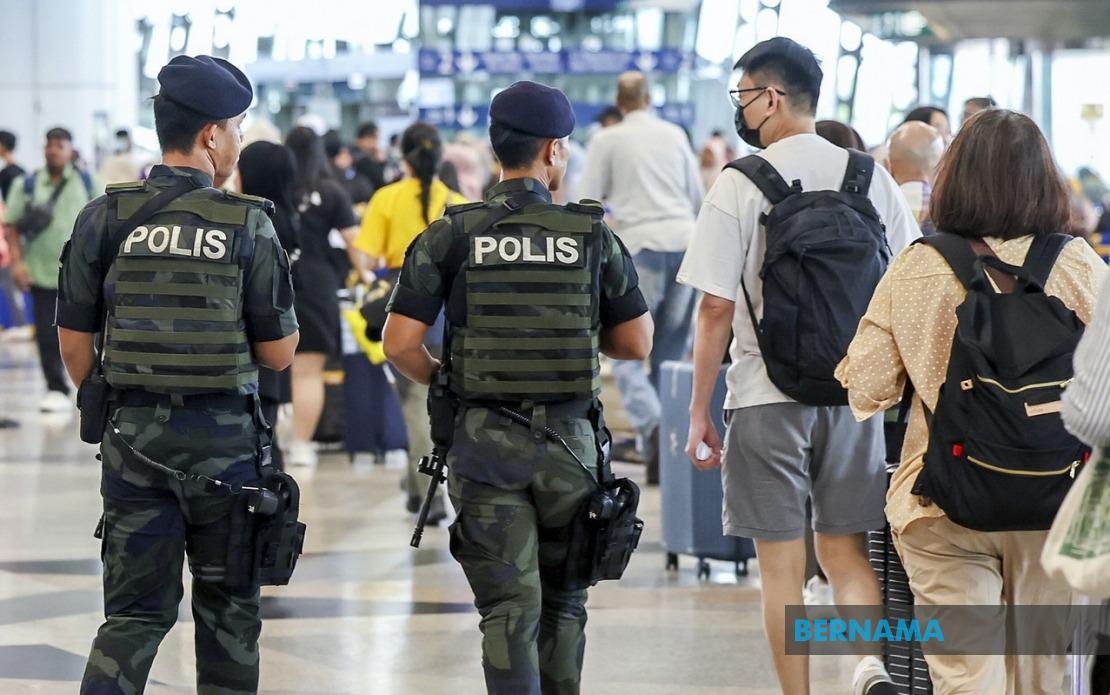
Malaysia's government is moving swiftly to reinforce security protocols at its airports by embedding personnel from the Royal Malaysia Police directly into Aviation Security units, Communications Minister Datuk Seri Fahmi Fadzil announced at a Cabinet meeting this week. The decision represents a tangible response to mounting concerns about vulnerabilities in airport operations, triggered by the recent detention of a 39-year-old Malaysian pilot at Jakarta's Soekarno-Hatta International Airport on suspicion of attempting to smuggle narcotics.
The structural change reflects a fundamental shift in how Malaysia will manage its critical aviation security infrastructure. Currently, the Aviation Security unit relies on auxiliary police personnel to oversee operations, a arrangement that authorities now view as insufficient. By transitioning to full Royal Malaysia Police staffing, the government aims to establish more rigorous oversight and tighter control mechanisms across all major terminals. This move carries particular weight given Malaysia's status as a regional aviation hub with significant passenger traffic and cargo volumes flowing through facilities like Kuala Lumpur International Airport.
The contraband intercepted at Jakarta's airport underscores the seriousness of the breach. Indonesian authorities discovered 15 packages containing approximately 70,114 capsules of ecstasy and methamphetamine, valued at roughly RM45 million according to Indonesian street prices. The magnitude of this seizure suggests an operation of considerable sophistication, one that apparently escaped detection systems designed to prevent precisely such smuggling attempts. For Malaysian authorities, the incident crystallised concerns about whether current screening and oversight mechanisms adequately protect national interests and international reputation.
Beyond the immediate deployment of police personnel, the Cabinet has directed Malaysia Aviation Group to undertake a comprehensive audit of its personnel vetting procedures. Both pilot and co-pilot recruitment protocols, as well as ongoing health and fitness assessments, will face renewed scrutiny. This signals that officials harbour concerns the arrested pilot may not have been an isolated case, but rather a symptom of gaps in how the aviation industry evaluates trustworthiness and suitability among flight crew. The reputational implications are substantial, as international partners scrutinise Malaysia's ability to prevent its own nationals from becoming vectors for transnational drug trafficking.
The Royal Malaysia Police and the Malaysian Border Control and Protection Agency have been tasked with conducting a forensic examination of airport security infrastructure to identify potential weaknesses. This systematic review goes beyond responding to a single incident; it represents a methodical approach to uncovering systemic vulnerabilities that bad actors might exploit. Such loopholes could exist in cargo handling procedures, crew access protocols, or gaps between domestic and international terminal operations. By prioritising immediate corrective action, authorities signal determination to prevent recurrence before additional incidents occur.
Fahmi indicated that the government has not yet decided whether to establish a dedicated task force specifically focused on this case, preferring instead to await comprehensive briefings from both the Transport and Home Ministries. This measured approach reflects the ongoing nature of the Indonesian investigation, which remains active under the jurisdiction of Indonesia's National Police. However, the Cabinet's directive to examine involvement by other parties suggests Malaysian authorities already suspect the arrested pilot may have been part of a larger network requiring extended investigation.
The timing of this security overhaul carries regional significance. Southeast Asian countries have long grappled with drug trafficking challenges, with sophisticated criminal networks exploiting lax security protocols and corruption vulnerabilities. Malaysia's swift response to the Jakarta incident positions the country as serious about addressing aviation-related security risks, a stance important for maintaining the confidence of international aviation authorities and passenger base. The measures also serve a diplomatic purpose, demonstrating to Indonesian counterparts that Malaysia takes bilateral security concerns seriously and is implementing concrete reforms.
For Malaysian airports and aviation authorities, the implementation phase will prove challenging. Transitioning from auxiliary police management to full Royal Malaysia Police deployment requires substantial resource allocation, training standardisation, and operational restructuring. Personnel already working in aviation security roles may face retraining or reassignment, creating temporary disruptions to existing workflows. The broader screening and assessment reforms within Malaysia Aviation Group will demand cooperation across multiple departments and potentially involve significant cost implications, though security experts argue such investments are essential.
The incident also exposes uncomfortable questions about corruption and complicity within Malaysia's aviation sector. A sophisticated smuggling operation does not succeed without either lax enforcement or active facilitation. Whether the arrested pilot acted alone or with assistance from ground crew, airport employees, or enforcement personnel remains a central investigative question. The government's emphasis on identifying co-conspirators suggests awareness that individual culpability, however significant, may obscure institutional failures requiring systemic correction.
For Southeast Asian governments and international aviation stakeholders, Malaysia's response serves as a cautionary tale and potential template. Aviation security represents a critical intersection between domestic sovereignty and international cooperation, where lapses in one country's procedures can affect neighbouring nations and international commerce. The measures announced represent Malaysia's acknowledgment that reputation and operational integrity demand swift, visible, and comprehensive action. As the Indonesian investigation unfolds and local proceedings advance, Malaysia's domestic reforms will be scrutinised internationally as evidence of commitment to preventing future breaches in this high-stakes domain.

