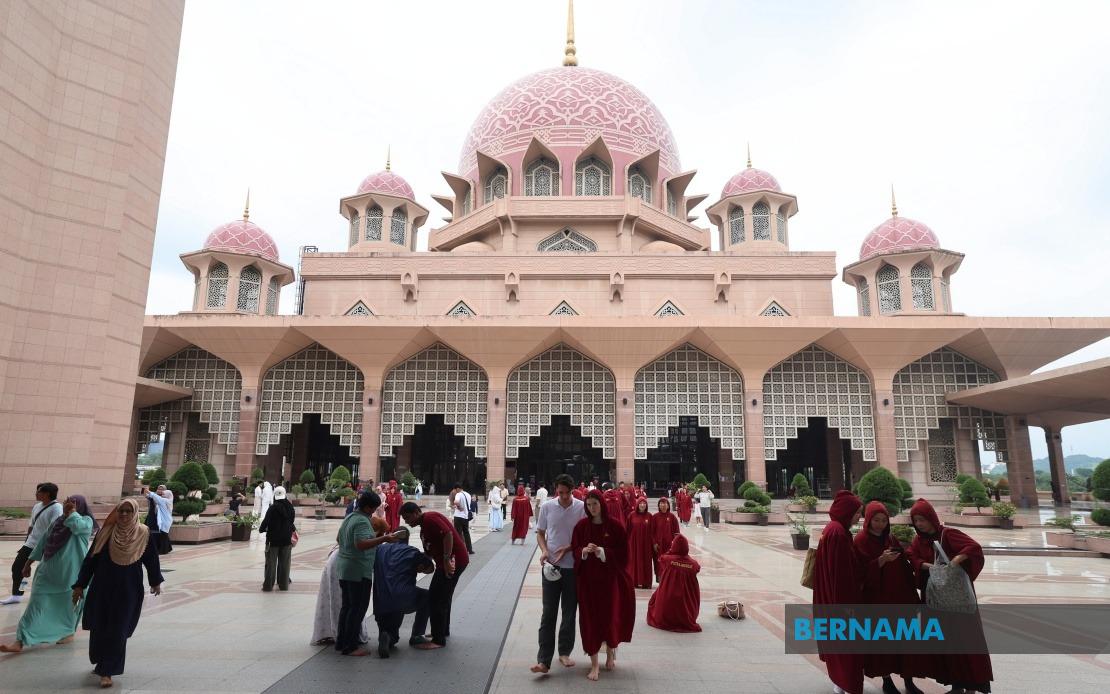
Malaysia's Islamic calendar marks another significant milestone as Putra Mosque in Putrajaya prepares to host approximately 5,000 local and international visitors for the National Maal Hijrah 1448H/2026M celebration. The gathering underscores the nation's commitment to commemorating the Islamic New Year with a ceremony that blends spiritual reflection and institutional recognition of Islamic scholarship and service across the Muslim world.
Sultan of Perak Sultan Nazrin Shah will preside over the occasion, lending royal patronage to an event that draws together Malaysia's highest political and religious leadership. Joining the Sultan are the two Deputy Prime Ministers, Datuk Seri Ahmad Zahid Hamidi and Datuk Seri Fadillah Yusof, alongside Cabinet ministers, foreign diplomatic envoys, heads of government departments and senior administrative figures. The assembly reflects the government's view of Maal Hijrah as a matter of national importance, transcending religious observance to become an official state ceremony.
The centrepiece of the celebration involves a keynote address by the Sultan, followed by the presentation of the National and International Tokoh Maal Hijrah Awards. These accolades represent one of Malaysia's premier mechanisms for honouring excellence within the Islamic world. Recipients are selected according to rigorous standards encompassing deep expertise within their professions, moral integrity of the highest order, and documented achievements that have advanced Islamic knowledge and practice both within Malaysia and on the global stage. The awards process thus elevates particular individuals as role models whilst simultaneously affirming Malaysia's self-positioning as a custodian of Islamic values and intellectual tradition.
The Department of Islamic Development Malaysia (JAKIM) has positioned this year's observance around the spiritual and civilisational dimensions of the Prophet Muhammad's Hijrah from Mecca to Medina. Rather than treating the historical migration as a static historical event, organisers encourage contemporary Muslims to internalise its lessons as a template for personal and communal transformation. The Hijrah narrative—fundamentally about abandoning harmful circumstances to establish a community founded on justice and faith—becomes a metaphor for the ongoing work of Islamic renewal and the construction of moral societies.
A notable innovation distinguishes this year's programme: the Tausiyyah @ Maal Hijrah initiative held at the mosque in the lead-up to the main ceremony. This reflective component invites participants to engage in tadabbur, the Islamic practice of pondering and deriving spiritual insight from the Quran's verses. Rather than passively receiving recitations from accomplished qari, attendees explore the layers of meaning within scripture, examining the wisdom literature contains and considering its practical application within their own circumstances. This pedagogical approach recognises that religious observance deepens when believers move beyond ceremonial participation toward interpretive understanding.
The broader significance of this event for Malaysian society lies in its institutional integration of Islamic practice within state structures. By hosting the celebration at Putra Mosque, a federal territory landmark, and securing the attendance of senior government officials, Malaysia demonstrates that Islam remains central to national identity and governance. For international observers and diaspora Muslim communities present at the gathering, the occasion projects Malaysia as a Muslim-majority nation capable of organising sophisticated religious and intellectual programming that appeals across cultural and national boundaries.
A complementary lecture series scheduled for the following day at the Putrajaya Islamic Complex Auditorium extends the celebration's educational reach. Award recipients will deliver presentations, creating platforms for them to transmit their expertise and experiences to assembled audiences. This continuation ensures that the recognition bestowed through the awards translates into concrete knowledge transfer, potentially influencing emerging scholars and activists working within Islamic fields across Southeast Asia and beyond.
For Malaysian Muslims, particularly those engaged in Islamic scholarship, activism and professional practice, participation in and awareness of such state-sponsored recognition carries material implications. The Tokoh Maal Hijrah Awards function as a legitimising mechanism within both domestic and international Islamic networks. Recipients gain enhanced credibility and visibility, which can facilitate partnerships, speaking invitations, publication opportunities and influence over Islamic discourse within their regions. The awards thereby serve as instruments through which a nation shapes the direction of Islamic intellectual life.
The scale of the gathering—bringing together thousands of participants alongside senior political and diplomatic representatives—reflects the resource commitment Malaysia invests in religious commemoration. In comparison with celebrations observed in other Muslim-majority nations, the Maal Hijrah event demonstrates both the institutional capacity and the political will to stage major religious observances with appropriate ceremony and inclusivity. The presence of international guests suggests that organisers deliberately position Malaysia's Islamic practice as exemplary, worthy of external study and participation.
Looking at the broader context, Malaysia's approach to Maal Hijrah embodies a particular interpretation of how Islamic societies should function. Rather than viewing Islam as confined to personal devotion or family practice, the state integrates Islamic commemoration and Islamic excellence into public institutional life. The Hijrah narrative itself—emphasising migration toward justice and away from oppression—carries implicit messages about societal transformation that resonate with contemporary debates across the Muslim world concerning governance, ethics and community building. By anchoring the state's recognition of Islamic achievement to this historical migration, Malaysian organisers invite reflection on how institutions, individuals and societies might themselves undergo transformative Hijrah toward greater alignment with Islamic principles.