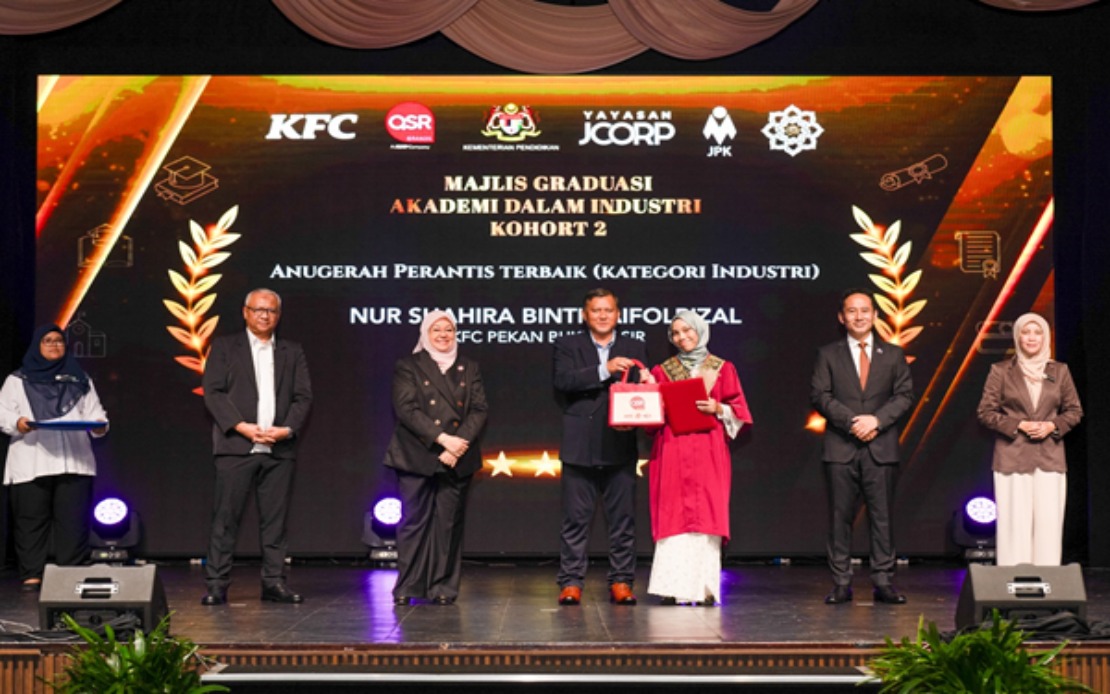
QSR Brands, operating KFC Malaysia in partnership with Yayasan JCorp, has marked another milestone in youth workforce development by graduating a second cohort of 37 vocational trainees through the Apprenticeship Development Initiative (ADI) programme. The latest intake brings the total number of industry-trained graduates produced by the fast-food chain to 60 since the programme's inception in June 2023, signalling a growing commitment to bridging the gap between classroom learning and practical employment readiness in Malaysia's hospitality sector.
The ADI programme represents a strategic convergence of three key institutional players: KFC Malaysia, the Department of Skills Development under the Ministry of Human Resources, and the Ministry of Education. What distinguishes this initiative from conventional vocational training is its embedded approach—students do not simply observe industry practices from a distance but instead work within actual KFC restaurant environments throughout Johor Bahru, acquiring certifications while simultaneously contributing to daily operations. This dual-track model has proven effective at retention and skill acquisition, as evidenced by the cohort's academic performance metrics.
The second cohort's curriculum centred on the vocational syllabus for Fast Food Preparation and Service, immersing participants in the full spectrum of quick-service restaurant operations. Beyond food preparation techniques, trainees gained exposure to customer interaction protocols, inventory management, hygiene compliance, and the operational rhythms that characterise successful food-service enterprises. This comprehensive grounding ensures that graduates enter the job market not merely as certificate holders but as individuals capable of functioning independently in demanding, fast-paced environments from day one.
Results from this cohort demonstrate the programme's pedagogical effectiveness. All 37 participants achieved a perfect pass rate in Vocational Stream Subjects (MPAK), the Malaysian Skills Certificate (SKM) at both Level 2 and Level 3, achieving an accomplishment rarely seen in vocational training cohorts. Additionally, 95 per cent of the group passed the Sijil Pelajaran Malaysia (SPM) examination, suggesting that students managed to balance academic obligations with apprenticeship demands without sacrificing either dimension. Each graduate received five separate qualifications: the Vocational SPM, dual SKM certifications, a programme completion certificate, and recognition from QSR Brands itself.
Zulkernai Fauzi, the Ministry of Education's TVET director, characterised the ADI model as an exemplary blueprint for industry-education integration that warrants nationwide expansion. His remarks reflect growing policy attention to Malaysia's skills gap, a chronic challenge undermining productivity and competitiveness. The ADI approach directly addresses this by creating pathways where young people transition from structured learning into employment without the traditional disconnect that often leaves graduates unprepared for workplace realities. Such integration mirrors successful models in Germany and Singapore, where apprenticeship systems have become engines of economic dynamism.
Yayasan JCorp's involvement underscores the broader commitment of Malaysian corporate entities to social responsibility and human capital development. Chairman Rozaini Mohd Sani emphasised that the programme creates opportunities across socioeconomic boundaries, enabling youths from diverse backgrounds to build self-confidence and acquire market-relevant skills. This democratising aspect is significant in a Malaysian context where access to quality vocational pathways has historically been uneven, with rural and lower-income cohorts facing structural disadvantages in labour market entry.
Dr Sharifah Musainah Syed Alwi, QSR Brands' chief human resources officer, reframed the discussion of graduate success beyond mere certification, positioning the achievement as evidence of genuine workplace competency. Her statement carries implicit criticism of credentialism—the tendency to treat qualifications as proxies for capability—by insisting that the cohort has mastered actual industry-recognised competencies demonstrated through supervised practice. This distinction matters considerably for employers seeking to reduce hiring uncertainty and for the national economy seeking to raise productivity standards.
The inaugural cohort, comprising 23 students who completed training in March 2025, established the proof-of-concept upon which the second intake built. The progression from 23 to 60 graduates within approximately two years suggests scaling momentum, though figures of this magnitude remain modest relative to Malaysia's annual vocational training output. Nevertheless, the quality metrics—100 per cent pass rates in key certifications—demonstrate that expansion need not compromise rigour.
The graduation ceremony incorporated recognition of exceptional achievement through awards for Best Apprentice (Industry Category), Best Apprentice (SPM Category), and Best Apprenticeship Documentation. These distinctions reinforce a merit-based culture and provide participants with competitive credentials that signal distinction in the labour market beyond baseline competency. Such recognition mechanisms are increasingly important in economies where credential inflation has diminished the signalling power of basic qualifications.
From a Malaysian labour market perspective, the ADI programme addresses critical sectoral challenges. The quick-service restaurant industry, whilst labour-intensive, has historically struggled with high turnover and inconsistent service quality, partly attributable to insufficient pre-employment preparation of workers. By systematically producing graduates with genuine operational knowledge and certification, the initiative contributes to sectoral professionalisation and productivity enhancement. Moreover, successful models in one sector create demonstration effects that encourage replication across hospitality, manufacturing, and service industries more broadly.
The collaboration structure itself merits analytical attention. By integrating government skill-development infrastructure, educational institutions, and private corporate capacity, the model distributes costs and expertise across stakeholders while aligning incentives around employment outcomes. KFC Malaysia benefits from a reliable talent pipeline; the Ministry of Education gains evidence of effective TVET delivery; and participants secure employment pathways with reduced uncertainty. This tri-partite approach, when replicated systematically across Malaysia's economy, could materially improve labour market efficiency and youth employment rates.
Looking forward, the sustainability of programmes such as ADI depends on continued corporate commitment, government policy stability, and demonstrated employment absorption of graduates. With 60 alumni now distributed across the labour market, the next phase should track long-term employment outcomes, wage trajectories, and progression within the hospitality sector. Such data would provide policymakers and potential corporate partners with concrete evidence of the model's economic returns, catalysing broader adoption and scaling across Malaysia's workforce development infrastructure.

