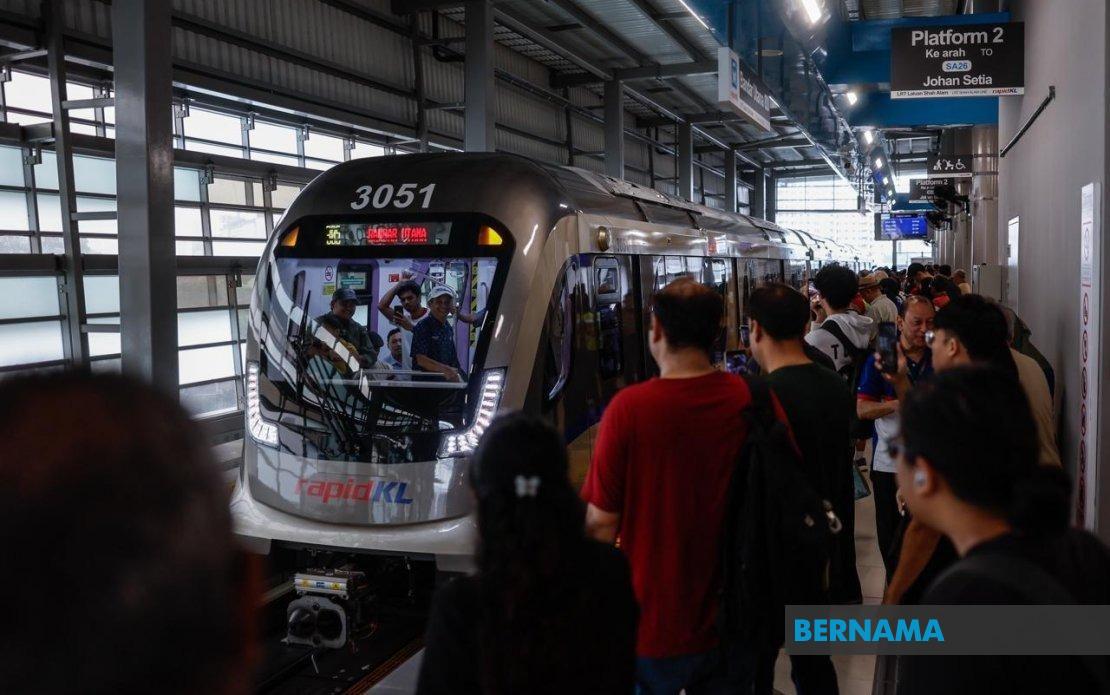
Rapid KL has announced a significant extension of its promotional free-travel period for the Light Rail Transit 3 Shah Alam Line, pushing the initiative two weeks further into mid-August and signalling confidence in the new corridor's potential to reshape commuting patterns across the Klang Valley. The extended complimentary service, now running through August 14, represents a strategic decision to capitalise on early momentum and overcome initial resistance from passengers accustomed to traditional transport routes.
The expanded grace period encompasses not only fares on the primary LRT3 Shah Alam service but also companion shuttle bus operations and Park N' Ride parking facilities at associated stations. This comprehensive subsidy approach eliminates financial barriers across the entire journey chain, addressing a common pain point for public transport users who face ancillary costs beyond core fares. By bundling these services into one cost-free offering, Rapid KL removes multiple decision-making friction points that might otherwise deter casual experimentation with the network.
The transit operator framed the extension as an opportunity for residents and regular commuters throughout the Petaling Jaya, Shah Alam and Klang corridor to develop confidence and familiarity with operational rhythms, station layouts, and service reliability. For many public transport systems globally, the transition period from novelty to routine usage determines long-term success. Rapid KL appears intent on extending this honeymoon phase sufficiently to convert exploratory riders into habit-forming passengers.
The Shah Alam Line represents a tangible expansion of Klang Valley rapid transit infrastructure, addressing capacity constraints and offering an alternative to congestion-prone road networks. The line's geometric position connecting three major urban centres makes it strategically significant for regional economic integration and workforce mobility. However, as with most new transit corridors, achieving sustainable ridership requires more than infrastructure availability; it demands conscious adoption among populations with established commuting patterns.
Prime Minister Datuk Seri Anwar Ibrahim had originally inaugurated the free-fares initiative on June 28 at the Johan Setia LRT Depot launching ceremony in Klang, prescribing a one-month promotional window from June 29 through July 31. The decision to extend reflected either better-than-anticipated initial uptake or recognition that a single month insufficient to establish behavioural change among the broader commuting population. Malaysia's public transport adoption has historically lagged road vehicle usage, suggesting that marketing interventions require sustained duration to overcome embedded preferences.
Rapid KL's statement positioned the extension as benefiting lower-income commuters and students by reducing daily transport expenditure during an economically sensitive period. Public transport subsidies carry broader policy implications beyond immediate ridership metrics, touching on urban development priorities, environmental sustainability objectives, and social equity considerations. Extended free-fares periods effectively represent temporary income support for transport-dependent populations, with spillover effects on household budgets and discretionary spending.
The operator explicitly encouraged prospective users to plan journeys in advance and comply with operational guidelines, suggesting management's desire to avoid crowding incidents or safety lapses that might undermine confidence in the system. New transit lines occasionally experience operational teething problems, and reputational vulnerability during promotional periods could jeopardise long-term adoption even after fares commence. This cautionary messaging indicates awareness that first impressions during free-service windows substantially influence subsequent willingness to pay.
The Shah Alam Line development aligns with broader Malaysian urban planning initiatives prioritising rapid transit over road expansion. Kuala Lumpur and surrounding federal territories have invested substantially in multi-modal connectivity, yet adoption rates remain lower than in comparable Southeast Asian metropolitan areas. Extended subsidies function partly as demand-creation mechanisms, conditioning populations to view rail transit as viable and comfortable before introducing price signals.
Looking beyond August 14, Rapid KL faces critical commercial questions regarding optimal fare structures, revenue sustainability, and demand stability once subsidies end. The extension period provides valuable data on ridership patterns, peak-hour pressures, and station performance across differing demographic cohorts. This operational intelligence should inform post-promotion pricing strategies and service adjustments designed to retain voluntary riders who might otherwise revert to private vehicles or competing transport modes.
The extended promotion also signals confidence from Rapid KL's parent company and government stakeholders in the line's potential as a foundational asset for Klang Valley transport architecture. Successive fare-free extensions would become progressively less tenable from budgetary perspectives, suggesting that current extension represents roughly the outer limit of promotional generosity. By August 14, the operator must transition riders toward commercial normalcy while preserving whatever behavioural shifts the extended subsidy period achieves, a delicate balancing act that will demonstrate whether infrastructure investment alone suffices to achieve meaningful modal shift in Malaysia's congested urban corridors.

