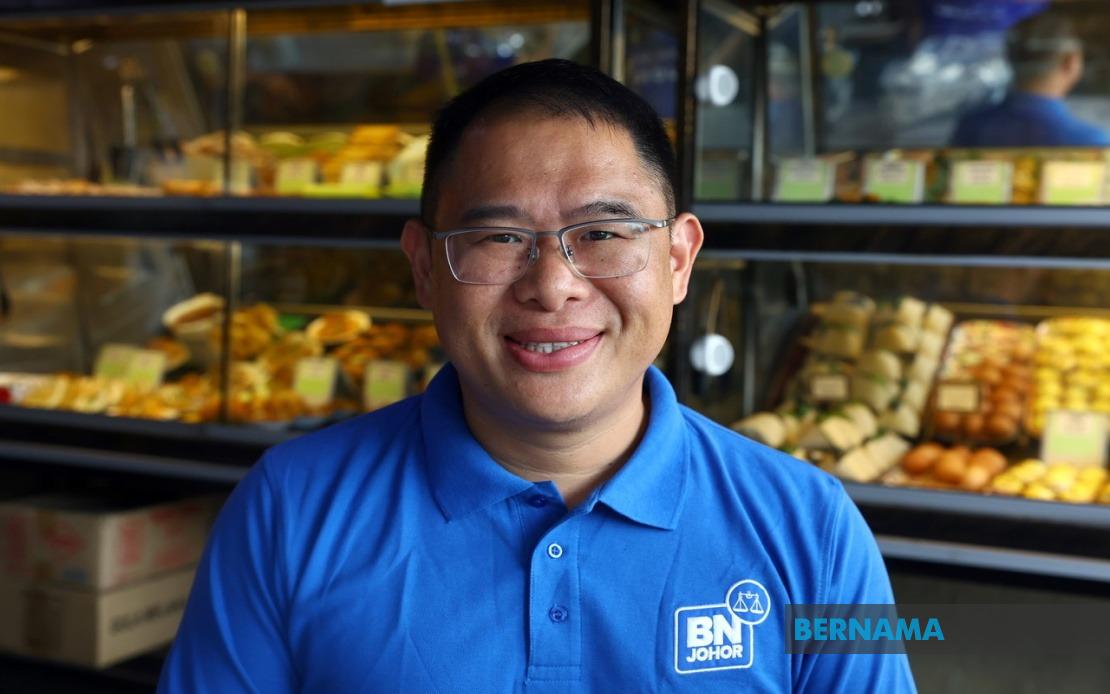
Yong Peng state assemblyman Ling Tian Soon is staking his re-election prospects on tangible infrastructure improvements that have transformed a notoriously dilapidated stretch of road into a symbol of development-driven governance. The 42-year-old legislator, affectionately known as Ah Soon to constituents, is defending his seat in the upcoming Johor state election against Pakatan Harapan candidate Yong Hui Yi in what has shaped into a direct contest. At the centre of his campaign narrative is the dramatic rehabilitation of a thoroughfare that residents had cynically labelled 'Jalan Koyok'—a colloquialism reflecting its patchwork, severely deteriorated state before renovation commenced.
Since securing the mandate in 2022, Ling has channelled approximately RM23 million in development allocations over three years to reconstruct the vital artery connecting Ayer Hitam to the Segamat border. His philosophy echoes a traditional Chinese axiom that prosperity follows good roads; in his telling, the correlation between physical infrastructure and economic dynamism is neither abstract nor delayed. The investment represents a deliberate prioritisation of foundational development over more politically expedient but ephemeral commitments, a strategic choice that appears to be yielding measurable returns in terms of regional perception and investor behaviour.
The road transformation has catalysed unexpected economic momentum in Yong Peng, a locality situated roughly 100 kilometres south of Johor Bahru's urban core yet increasingly positioned as a strategic nexus for regional commerce. Several major logistics operators and courier enterprises have recently established or expanded operational bases in the constituency, viewing its improved transportation infrastructure as a competitive advantage. More significantly, a prominent e-commerce platform is in advanced planning stages to develop its largest distribution facility in Yong Peng, a project anticipated to generate substantial employment pathways for younger residents and reverse demographic outflow that has challenged smaller-town viability across Malaysia.
Yong Peng's geographical positioning delivers inherent advantages that infrastructure improvements have now made tangible rather than theoretical. The constituency lies within an hour's journey to Port Tanjung Pelepas, one of Southeast Asia's burgeoning shipping hubs, situating it at a convergence point of logistics networks spanning the region. Ling explicitly identifies this as a transformative opportunity, arguing that manufacturing and supply-chain operators can leverage Yong Peng's central Johor location to access broader markets while maintaining operational cost efficiencies. This framing positions the constituency not as a peripheral hinterland but as an emerging epicentre of industrial activity, a narrative that investors appear increasingly willing to validate through capital commitments.
The influx of logistics and manufacturing interest suggests Yong Peng is approaching an inflection point where incremental infrastructure investment can crystallise into self-reinforcing economic expansion. Ling notes that land acquisition for industrial development has accelerated noticeably, implying that private-sector actors perceive genuine commercial viability rather than speculative opportunity. This positive feedback loop—improved roads attracting investors, investor presence justifying further infrastructure development—represents the tangible dividend that infrastructure-focused governance can deliver when executed with strategic coherence.
Beyond the flagship road project, Ling's electoral manifesto, to be unveiled at a forthcoming rally this Saturday, encompasses three substantive pillars that reflect a more comprehensive governing philosophy. Infrastructure strengthening forms the foundation, building upon the road success toward broader transportation and utility improvements. The second pillar targets enhanced social safety provisions, though Ling has articulated these primarily through facilities and amenities benefiting specific demographic cohorts rather than broad welfare expansion. Senior citizens' welfare infrastructure, support systems for young families, and incentives for newlyweds—such as housing or settlement facilities—form a targeted approach to demographic retention and lifecycle support.
The manifesto's third pillar addresses economic dynamism through tourism sector development, a strategic pivot reflecting the recognition that logistics and manufacturing alone cannot sustain comprehensive prosperity. Yong Peng possesses cultural and historical assets that targeted tourism investment could amplify, creating complementary employment pathways and entrepreneurial opportunities for residents whose skills or preferences lie outside industrial and logistics sectors. This multi-sectoral approach suggests Ling's political calculations recognise that contemporary voter expectations extend beyond narrow infrastructure provision toward holistic quality-of-life improvements.
Ling's confidence in retaining the seat rests substantially on his claimed relationship depth with constituents, cultivated through a distinctive grassroots engagement methodology that has earned him the soubriquet 'YB Kedai Kopi'—literally the 'coffee shop representative.' He has maintained a pattern of near-daily visits to informal commercial establishments where constituents gather, from casual food stalls to mamak restaurants, investing personal time in unstructured constituent interaction rather than relying principally on scheduled formal engagements. This approach has reportedly transformed the transactional relationship between representative and voter into something more reciprocal and familial in character, building durable social capital that persists beyond election cycles.
Ling's grassroots methodology extends backward temporally as well. Prior to securing the state seat in 2022, he spent sixteen years handling parliamentary affairs within the Ayer Hitam parliamentary constituency, serving under Datuk Seri Dr Wee Ka Siong, the Member of Parliament and MCA president. This extended tenure in supporting roles provided sustained opportunity to cultivate relationships across the broader region encompassing Yong Peng, establishing familiarity that predated his elevation to state assembly candidacy. He emphasises that this relationship-building has been consistent and uninterrupted, not contingent on electoral campaigns or temporal proximity to voting, a distinction he evidently believes strengthens his incumbency advantage.
The political challenge facing Ling, however, extends beyond asserting his record to navigating evolving voter preferences regarding representation and governance. His appeal appears strongest among constituents who value pragmatic service delivery and personal accessibility over ideological positioning or partisan messaging. The road upgrade exemplifies this orientation—it is non-ideological, tangible, and directly addresses a problem that residents experienced daily. Yet whether such infrastructure-centred governance suffices to overcome broader dynamics influencing Johor state politics remains contingent on whether voters in 2024 prioritise the metrics Ling emphasises or alternative considerations altogether.
Ling's assertion that he is content to place his record before constituents for their assessment reflects confidence in the tangibility of his achievements, yet it also implicitly acknowledges that election outcomes depend on voter preferences rather than representatives' self-evaluations. The RM23 million road investment, the logistics sector momentum, and the accumulated social capital from sixteen years of informal engagement form his substantive case; whether this combination proves sufficient to secure his re-election mandate will emerge through the electoral process itself. His candidacy ultimately tests whether voters in the Johor state context reward consistent infrastructure focus and grassroots accessibility, or whether competing political narratives and partisan dynamics override such performance-centred considerations.

