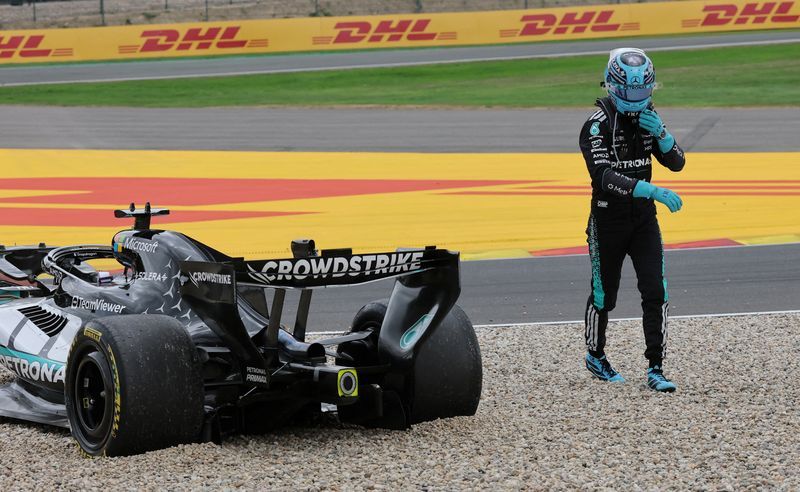
George Russell's hopes of mounting a championship challenge took another severe blow at Spa-Francorchamps on Sunday when the Mercedes driver crashed out of the Belgian Grand Prix in a first-lap incident with former teammate Lewis Hamilton. The collision, which sent Russell spinning into the gravel trap, marked yet another points-scoring opportunity lost for the British driver, who has now failed to register a score in three of the season's first nine races. Russell's measured response in the immediate aftermath—describing himself as "numb to the disappointment"—reflected the frustration of a driver watching his title aspirations slip away through a combination of mechanical failure and racing circumstance.
Russell's day unraveled almost immediately despite a promising start. Beginning from third on the grid, the 26-year-old initially executed a strong first-corner manoeuvre and positioned himself directly behind Max Verstappen's Red Bull. However, the illusion of a competitive afternoon vanished within seconds when his Mercedes suffered a critical electrical malfunction. The car's battery, which powers the hybrid energy recovery system integral to modern Formula One performance, failed to recharge through Turn One, leaving Russell desperately underpowered as the field accelerated away. This wasn't a gradual degradation but a catastrophic loss of system function—Russell found himself exiting the first corner with just 35 percent battery capacity and watched helplessly as it continued depleting rather than recovering.
The situation deteriorated as Russell pressed deeper into the circuit. With no electrical power available and the turbocharger struggling to establish normal boost levels, he arrived at Eau Rouge—one of Spa's most demanding corners—with a completely flat battery. Operating at zero percent reserve capacity on one of the track's fastest sections created genuine safety concerns, leaving Russell exposed and vulnerable. As three cars swept past him in rapid succession, the reality of his predicament became inescapable. Russell's frustration, evident in his post-race comments, centered less on the eventual collision with Hamilton and more on the cascade of mechanical failures that forced him into an untenable position in the first place. "I shouldn't have been in that position," he emphasized, recognizing that the car trouble, not racing decisions, had triggered the sequence of events.
The contact with Hamilton occurred as Russell attempted to recover ground, the two drivers making side-by-side contact that sent the Mercedes into a spin and retirement. Stewards investigated the incident and assessed Hamilton a five-second penalty, determining the seven-time champion bore primary responsibility for the collision. However, Russell's own assessment proved more nuanced. While acknowledging that Hamilton deserved the harsher judgment, Russell characterized the clash as ultimately a racing incident rather than a deliberate act. "He didn't do anything reckless," Russell said, demonstrating the pragmatism expected of a driver aware that both competitors operate under extreme pressure in split-second situations.
Russell's mechanical troubles represent a troubling pattern for Mercedes this season. The battery and turbo issues at Spa mirror problems that plagued the driver during qualifying on Saturday, when he identified serious concerns with straight-line performance. These recurring technical defects suggest systemic issues that pit engineers must urgently address if the team hopes to support Russell's title challenge. Meanwhile, his teammate and championship leader Kimi Antonelli started from pole position and now extends his advantage to 25 points following the opening nine races of the 22-round calendar. Antonelli has accumulated six victories this season, while Russell's three-race drought without points represents a concerning divergence for a driver nominally among the team's primary title contenders.
The Belgian Grand Prix result extends a frustrating trend for Russell, who entered the weekend still mathematically competitive in the championship race despite Antonelli's commanding position. However, three blanks in nine races—contrasted against Antonelli's two non-scoring rounds—has gradually eroded Russell's realistic prospects of closing the 25-point gap. The statistical gap widens with each race Russell fails to finish or score, mathematically reducing the maximum points he can accumulate over the remaining thirteen races. For a driver of Russell's caliber, such unforced absences from the results must feel increasingly unbearable, particularly when attributed to mechanical failure rather than on-track performance deficits.
Russell's emotional detachment—"when it happens so often you just get used to it"—carried undertones of resignation rather than acceptance. This represents a significant concern for Mercedes' championship ambitions. A driver who feels resignation rather than fighting spirit may struggle to extract maximum performance when opportunities do arise. The psychological toll of repeated mechanical failures can accumulate, potentially undermining the mental resilience required to maintain championship pressure during a grueling 22-race season. Mercedes faces not merely a technical challenge but also a motivational one in restoring Russell's confidence that the team can deliver competitive machinery.
Looking forward, Russell and Mercedes must urgently resolve the hybrid system unreliability that plagued the Belgian GP. The battery malfunction represents precisely the kind of unforced technical error that separates championship contenders from also-rans in Formula One's razor-thin margins. With thirteen races remaining, Russell cannot afford further mechanical retirements if he harbors any realistic title ambitions. The team's engineers in Brackley will be scrutinizing telemetry data from both Russell's car and the wider Mercedes fleet to understand how the energy recovery system catastrophically failed. Until such issues are resolved, Russell will remain vulnerable to finishing races without having genuinely competed, a scenario that must frustrate both driver and team given the competitive machinery's inherent potential.
For Malaysian and Southeast Asian motorsport enthusiasts, Russell's struggles highlight the complex interplay between driver skill and machine reliability at Formula One's highest level. While Hamilton's penalty demonstrated that stewards maintain consistent standards regardless of a driver's history, the incident's genesis—mechanical failure forcing desperation—reminds viewers that technical failures often create the circumstances for on-track collisions. As the championship battle unfolds over the remaining rounds, Russell will need both improved reliability and a psychological reset to mount any sustained challenge to Antonelli's commanding position.

