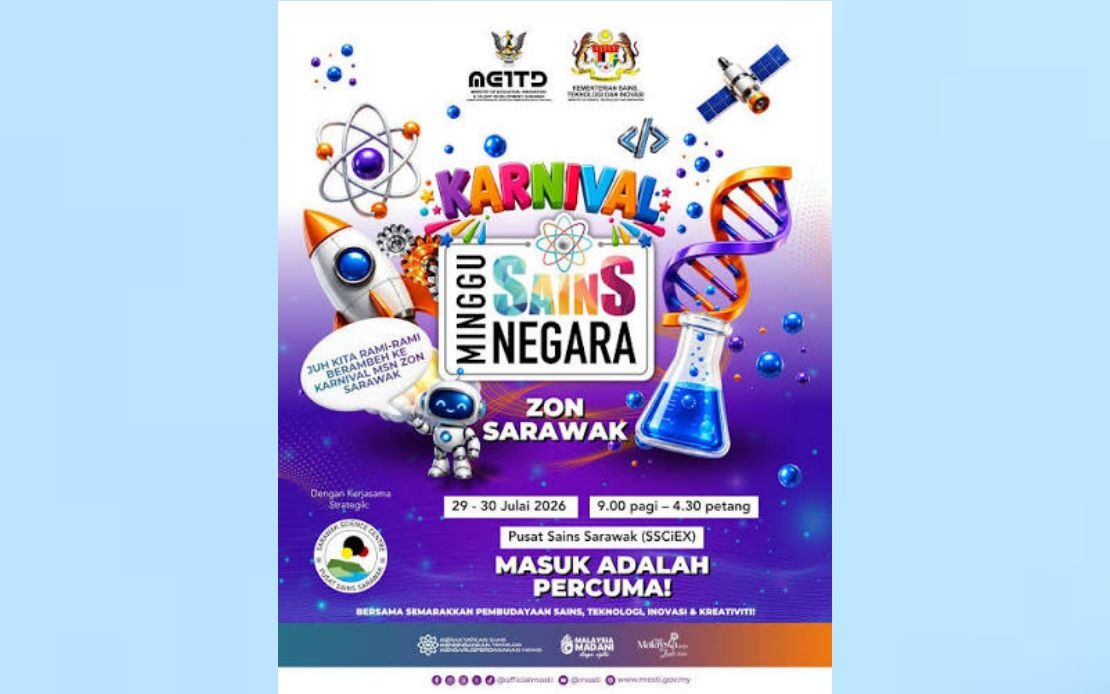
The Ministry of Science, Technology and Innovation (MOSTI) has formally opened the Sarawak Zone edition of the 2026 National Science Week (MSN) Carnival in Kuching, signalling a renewed commitment to democratising access to science and technology across Malaysia's diverse geography. Held at the Sarawak Science Centre and inaugurated by Sarawak's Minister of Education, Innovation and Talent Development Datuk Seri Roland Sagah Wee Inn, the event represents a strategic pivot towards communities historically underserved by national science initiatives.
This year's carnival carries particular significance as a watershed moment for how Malaysia approaches science engagement beyond urban centres. By deliberately targeting interior and rural districts, the initiative acknowledges a persistent gap in technology literacy that could widen economic disparities if left unaddressed. MOSTI's secretary-general Datuk Dr Nagulendran Kangayatkarasu emphasised that fostering a culture of scientific curiosity and innovation at grassroots level remains central to building a technology-competent workforce for the nation's future.
The Sarawak programme will channel resources into the STEM Catalysts Programme, an outreach mechanism designed to penetrate remote school populations in Meradong, Bintulu and Belaga districts. These areas, characterised by dispersed populations and limited infrastructure, have historically received minimal exposure to structured science and technology education beyond standard curricula. The carnival thus functions as both an immediate engagement tool and a pilot for scaling similar interventions across East Malaysia and other rural regions.
A notable dimension of this year's carnival involves introducing nuclear technology advocacy to public consciousness. This represents a deliberate effort to reshape perceptions around nuclear science, positioning it as a safe and viable technology pathway for Malaysia's energy and development future. By introducing advocacy work within the carnival framework, MOSTI aims to build informed public discourse around nuclear applications before larger policy decisions emerge—a prudent approach given historical scepticism in certain communities.
Complementing the physical carnival experience, MOSTI has operationalised the sainsrakyat.my portal, a citizen science platform that fundamentally reconceptualises how scientific research can be conducted. Rather than treating rural communities as passive recipients of knowledge, the platform invites active participation in data collection and analysis for real-world research problems. This democratisation of scientific contribution could yield valuable datasets while simultaneously instilling a sense of ownership over the scientific enterprise among participants.
The implications for Malaysian education and workforce development extend beyond the immediate carnival attendees. By establishing visible, tangible connections between schooling and science careers in rural settings, the initiative addresses a critical pipeline challenge. Many talented students in interior areas lack exposure to science and technology as legitimate career pathways, instead perceiving such opportunities as exclusively available to urbanites. This carnival helps normalise STEM aspirations across demographic groups.
From a regional perspective, Sarawak's position as a test bed for these initiatives holds significance for neighbouring Southeast Asian nations facing similar challenges. The model of combining physical engagement events with digital participation platforms could inform how other countries approach science literacy in underserved territories. Malaysia's experience may provide instructive lessons for regional peers grappling with geographic disparities in educational access.
The timing of this launch also intersects with broader national conversations about economic diversification. As Malaysia seeks to move up the value-added manufacturing and innovation chain, cultivating scientific thinking across all demographic segments becomes economically imperative. Rural and interior communities represent untapped human capital, and early engagement through initiatives like the MSN carnival can yield compounding returns as these cohorts mature into the workforce.
The two-day event structure suggests an intensive engagement model rather than a superficial awareness campaign. This sustained contact allows for deeper exploration of scientific concepts and hands-on experimentation opportunities, particularly valuable for students with minimal prior exposure to laboratory-style learning environments. The carnival format also enables dialogue between scientists, educators, and community members, potentially identifying local innovation challenges that could drive applied research priorities.
Looking forward, the success of the Sarawak Zone carnival will likely influence resource allocation decisions for subsequent editions and related programmes. If preliminary assessments indicate robust student interest, elevated science aspirations, or increased enrolment in STEM subjects, the model could be rapidly scaled to Peninsular Malaysia's rural regions. Conversely, implementation challenges—whether logistical, financial, or pedagogical—will surface important design considerations for replication.
The carnival also signals MOSTI's recognition that science culture cannot be imposed top-down; it must be co-created with communities through sustained engagement. By positioning rural Sarawak as a priority zone and investing institutional resources accordingly, the ministry sends a powerful signal about national commitment to equity in opportunity access. Whether this translates into measurable long-term outcomes in student aspirations and career pathways will become apparent only through rigorous follow-up assessment and continued programme iteration.

