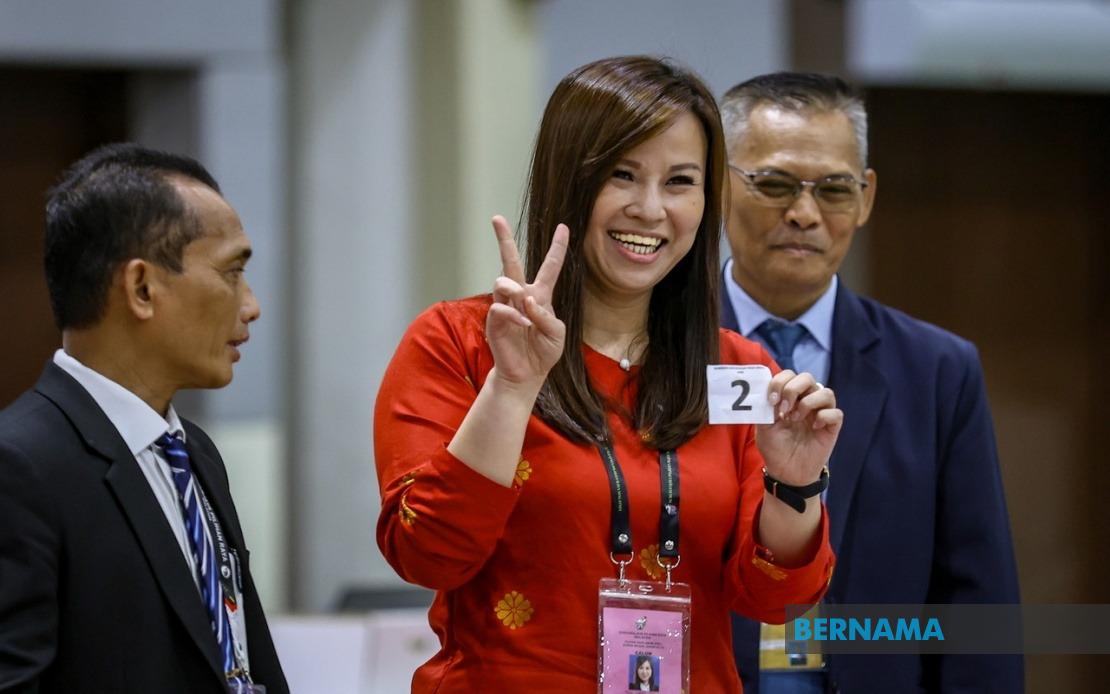
Sharon Teo, the Pakatan Harapan contender for the Permas state seat in Johor's upcoming elections, has positioned her campaign squarely around community infrastructure and public welfare programmes. Speaking after the nomination process at Dewan Muafakat in Johor Bahru on June 27, the Johor Amanah Women's Youth chief emphasised that these two pillars represent what constituents have consistently flagged during her grassroots engagement across the electoral division.
Road conditions stand foremost in Teo's policy priorities, a choice rooted in her understanding that deteriorating infrastructure directly affects public safety and quality of life. Her repeated interactions with residents have convinced her that this remains a pressing grievance that successive administrations have failed to adequately address. This focus reflects a pragmatic approach to campaigning—identifying tangible, visible issues that resonate with everyday concerns rather than abstract political messaging.
Teo's political background includes prior work as an aide in the Pulai parliamentary constituency under the late Amanah deputy president Salahuddin Ayub, which has provided her with insights into how government machinery operates and where systemic gaps emerge. She indicated that a comprehensive manifesto detailing her specific vision and strategic initiatives for Permas residents will be released in the coming days, suggesting her campaign apparatus is building toward a fuller policy presentation.
Defending the Permas seat is incumbent Baharudin Mohamed Taib of Barisan Nasional, who successfully captured the constituency in the 2022 Johor state election. Acknowledging the competitive dynamics he faces, Baharudin has adopted a circumspect tone, recognising that each rival candidate brings distinct advantages to the contest. His statement that he must work intensively to secure another BN victory reflects the genuine uncertainty surrounding incumbent defence in this electoral cycle.
Barahudin's campaign strategy diverges from Teo's approach in an instructive way. Rather than unveiling a personal manifesto, he has indicated his campaign will be anchored to the broader Barisan Nasional platform and party guidelines. This choice suggests a reliance on institutional brand recognition and party machinery rather than bespoke local engagement, potentially leaving room for opposition candidates to define the narrative around constituency-specific issues.
The Permas contest has evolved into a four-cornered fight, adding further complexity to incumbent retention calculations. Beyond Teo and Baharudin, Perikatan Nasional has fielded T. Vela, while Parti Bersama Malaysia is represented by Dr Zamil Najwah. This fragmentation of the opposition vote theoretically aids the BN incumbent, though it also signals growing electoral volatility in the state. The presence of two opposition-aligned candidates alongside the independent Bersama candidate creates multiple pathways through which BN's vote share could be challenged.
Permas sits within the Pasir Gudang parliamentary constituency and represents a significantly sized electorate for the state tier. With 113,963 eligible voters, the division is substantial enough that voter mobilisation and turnout dynamics will prove decisive. A divided opposition struggle to coordinate messaging could inadvertently benefit Baharudin, yet Teo's focus on granular, local issues like road maintenance may prove more electorally potent than BN's traditional machinery-dependent approach.
The timing of Johor's 16th state election on July 11, with early voting scheduled for July 7, falls within a period of heightened national political attention. The state election comes amid ongoing competitive pressures within Malaysia's broader political landscape, where Pakatan Harapan has sought to rebuild credibility after its 2022 federal election setback. A strong performance in Johor would signal renewed momentum in the peninsula's most developed southern state.
For Malaysian voters monitoring state-level politics, the Permas contest exemplifies a shift in how electoral campaigns are being structured. Rather than relying solely on party machinery and incumbent advantage, candidates increasingly must articulate specific, locally-rooted policy responses. Teo's infrastructure-and-welfare framing competes directly against the institutional heft of Baharudin's BN backing, suggesting that voter preferences may increasingly turn on perceived competence in addressing tangible quality-of-life concerns.
The road infrastructure issue, seemingly mundane, carries broader implications for how Johor constituencies perceive state-level governance. If voters perceive systemic neglect of basic maintenance across multiple constituencies, this could create an anti-incumbent wave that transcends individual candidate appeal. Conversely, should Baharudin successfully reframe the narrative around BN's broader development record, he may withstand the challenge. The coming weeks will reveal whether local-issue campaigns can overcome the structural advantages that incumbency and party machinery traditionally confer in Malaysian state elections.

