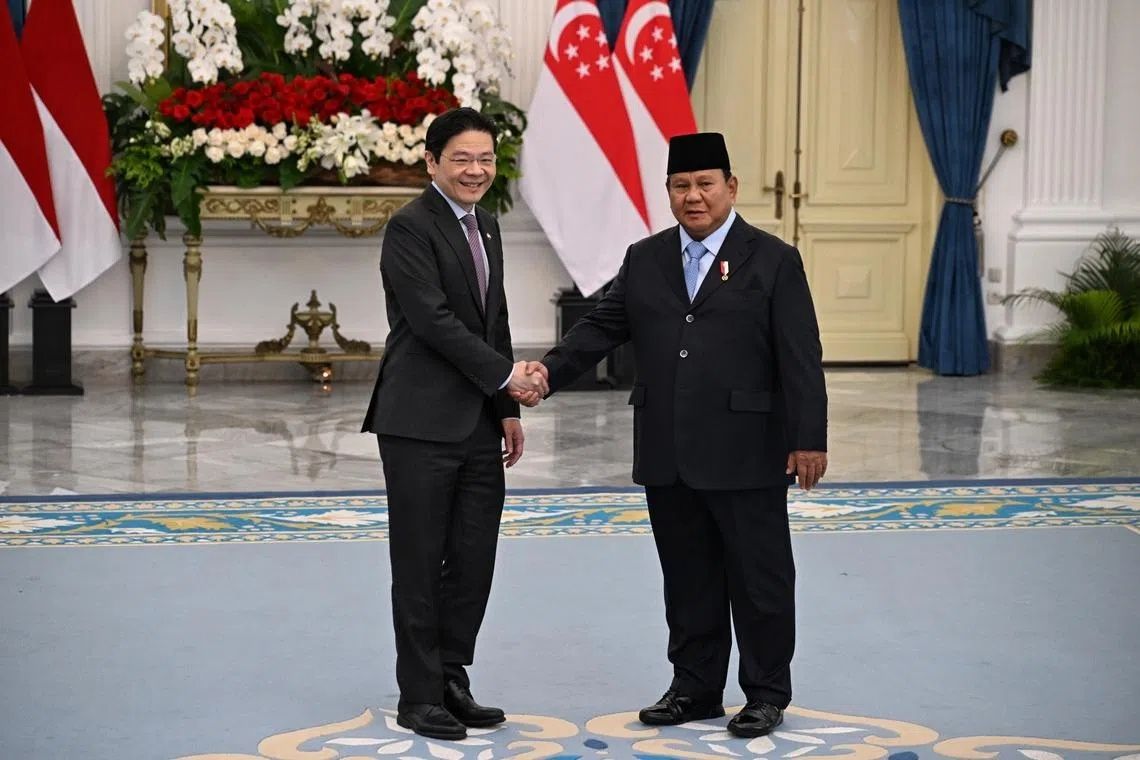
Singapore and Indonesia have jointly committed to preserving the Strait of Malacca as an open, secure and accessible waterway for all nations, elevating maritime security to a central pillar of their bilateral relationship as both countries grapple with mounting geopolitical instability. The undertaking came during talks between Prime Minister Lawrence Wong and President Prabowo Subianto at their annual Leaders' Retreat on July 6, signalling that both Southeast Asian powers view regional stability and unimpeded maritime commerce as inseparable from their own prosperity and influence.
The Strait of Malacca represents one of the world's most critical shipping arteries, linking the Indian Ocean to the South China Sea and funnelling a substantial portion of global trade and energy flows through its narrow waters. For Malaysia, Singapore and Indonesia—the three nations sharing responsibility for the waterway—any disruption carries cascading consequences. Yet the commitment announced at the retreat goes beyond platitudes. Both leaders framed their pledge within a broader strategic alignment, recognising that their geographic position astride this vital passage places them at the forefront of international maritime governance and gives them outsized influence over how global commerce flows. President Prabowo emphasised that as countries directly bordering the strait, Singapore and Indonesia share an inherent interest in maintaining a passage that remains "free for all parties" while simultaneously safeguarding it from security threats, pollution and maritime crime.
The backdrop to this emphasis on maritime security has shifted noticeably in recent months. PM Wong explicitly referenced disruptions to Middle Eastern shipping routes caused by geopolitical tensions, noting how instability in the Strait of Hormuz has already begun diverting traffic and disrupting global energy supplies. This real-world example underscores why Singapore and Indonesia's position on maintaining freedom of navigation in their own waters carries heightened urgency. The two leaders articulated a vision of their countries as bulwarks of regional stability, capable of guaranteeing safe passage and predictable maritime governance in a period when such assurances are increasingly valuable. Their repeated emphasis on working with Malaysia and Thailand—honouring the three-nation framework established under the United Nations Convention on the Law of the Sea—demonstrates an attempt to build consensus among all littoral states rather than issuing unilateral declarations.
Yet maritime security, while commanding headlines, represents only one dimension of a relationship that both capitals are deliberately broadening and deepening. The retreat focused extensively on expanding economic ties into emerging sectors expected to reshape regional development over the coming decade. Cross-border electricity trade emerged as the most prominent new frontier, with both leaders identifying energy cooperation as foundational to future ASEAN integration and climate transition goals. Indonesia's sovereign investment fund Danantara will spearhead implementation efforts, working alongside Singapore firms Keppel Electric, Sembcorp Industries and Singapore Energy Interconnections to negotiate the mechanics of exporting Indonesian power across the strait. PM Wong framed this initiative as a critical building block for a region-wide ASEAN Power Grid, positioning Singapore and Indonesia as pioneers in establishing the infrastructure and institutional frameworks that could eventually bind the region's energy systems together.
This electricity initiative carries particular resonance for Malaysia and other ASEAN members, as successful implementation would demonstrate that cross-border energy trade is operationally feasible and commercially viable at scale. A functioning Singapore-Indonesia electricity corridor could provide a template for similar projects across Southeast Asia, potentially offering smaller or less energy-rich nations access to reliable power supplies and enabling more efficient resource allocation across the region. For Singapore, the project addresses long-standing constraints on its energy independence and geographic constraints; for Indonesia, it represents an opportunity to monetise its renewable energy potential and expand industrial capacity. The two countries have deliberately pitched the arrangement as mutually beneficial rather than as a transfer of wealth or dependence, conscious that energy cooperation succeeds only when both parties see tangible advantages.
Beyond energy, Singapore and Indonesia identified digital infrastructure, supply chain resilience and cybersecurity as interconnected priorities deserving elevated attention. The emphasis on these sectors reflects a deliberate pivot away from traditional manufacturing and investment frameworks toward the technologies and systems that increasingly determine competitive advantage in the regional and global economy. As supply chains become more complex and geopolitically fragile, both countries recognise that their ability to offer secure, resilient connectivity becomes a strategic asset. President Prabowo highlighted that discussions on digital governance and cybersecurity had yielded "fairly concrete outcomes," suggesting that both sides are moving beyond rhetorical commitment toward implementable cooperation frameworks. For Malaysian observers, this signals that Singapore and Indonesia intend to position themselves as anchors of digital governance and infrastructure security in Southeast Asia, potentially influencing how regional standards and protocols develop.
The retreat also served as an implicit referendum on Indonesia's economic trajectory and regional standing. PM Wong repeatedly expressed confidence in Indonesia's future and signalled Singapore's intention to remain engaged across multiple sectors and timeframes. He pointed to evolving investment patterns, highlighting developments in the Batam, Bintan and Karimun region as well as the Kendal Industrial Park in central Java, which is approaching full capacity and planning a 1,000-hectare expansion. These examples illustrate how Singapore's engagement with Indonesia extends beyond financial flows to encompass the creation of downstream industries, employment and integrated supply networks. For Indonesia, this sustained partnership signals confidence from a sophisticated investor that sees profitable opportunities ahead; for Singapore, it represents a long-term bet on Indonesia's continued growth and rising consumer purchasing power.
The timing of this retreat also carries symbolic weight, as both nations prepare to commemorate 60 years of diplomatic relations in 2027. Rather than treating the approaching milestone as a retrospective occasion, both leaders have deliberately used it as motivation to forge new commitments and deepen integration across emerging domains. This forward-looking approach reflects confidence that the bilateral relationship remains dynamic and mutually beneficial rather than settled into routine or complacency. By explicitly linking economic cooperation to maritime security and positioning both within a broader vision of regional stability, Singapore and Indonesia are articulating a coherent strategic narrative: that their partnership serves not only their own interests but contributes to the stability and prosperity of Southeast Asia more broadly.
For Malaysia, which shares both maritime boundaries and energy interests with both Singapore and Indonesia, these developments carry direct implications. Malaysia's own role in Strait of Malacca governance depends partly on demonstrated alignment with Singapore and Indonesia on preserving open passage and preventing disruption. The electricity cooperation framework emerging between Singapore and Indonesia may eventually incorporate Malaysia, particularly if cross-strait projects prove commercially successful and create precedent for regional energy integration. Similarly, Malaysia's digital infrastructure and supply chain strategies may increasingly need to align with standards and protocols that Singapore and Indonesia help establish through their expanding cooperation.
The Leaders' Retreat ultimately revealed two Southeast Asian powers operating from positions of confidence, deliberately constructing a partnership architecture designed to address both immediate security concerns and longer-term economic transformation. By elevating maritime security alongside emerging economic cooperation, Singapore and Indonesia are signalling that they understand regional stability as multifaceted and interconnected. Their commitment to keeping the Strait of Malacca open and secure provides essential reassurance to global commerce; their simultaneous expansion into renewable energy, digital infrastructure and supply chain resilience demonstrates that their vision extends beyond maintaining the status quo toward actively shaping the region's economic future. Both dimensions of their partnership will reverberate throughout Southeast Asia in the years ahead.

