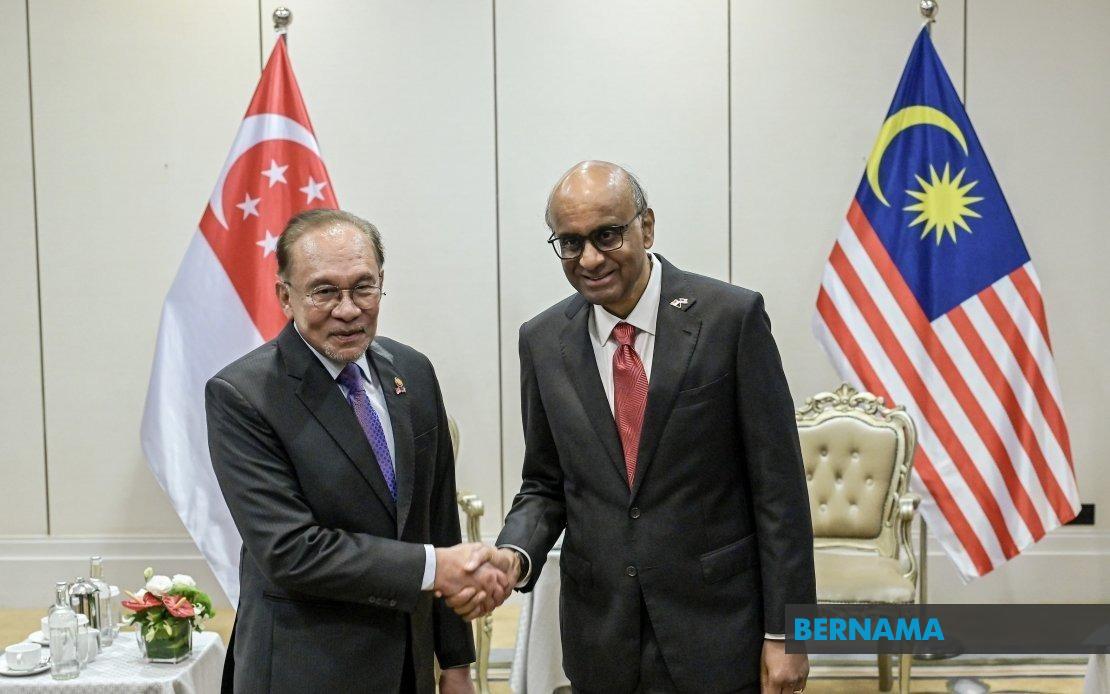
Singapore and Malaysia have committed themselves to broadening their collaborative framework across multiple sectors considered vital to both nations' development and stability, particularly in food security and energy resilience. This undertaking emerged from discussions between Prime Minister Datuk Seri Anwar Ibrahim and Singapore's President Tharman Shanmugaratnam during an official courtesy call on Monday, underscoring the continuity of bilateral engagement at the highest levels despite periodic tensions between the two neighbours.
President Tharman Shanmugaratnam is currently undertaking his maiden state visit to Malaysia, which runs from July 12 to 15, representing a significant diplomatic moment for relations between the two economically interdependent nations. The visit commenced with full ceremonial honours, including a formal reception at Istana Negara where President Tharman and his wife Jane Ittogi Shanmugaratnam were welcomed by His Majesty Sultan Ibrahim, King of Malaysia, and Her Majesty Raja Zarith Sofiah, Queen of Malaysia. Such symbolic gestures carry weight in Southeast Asian diplomacy, signalling both countries' commitment to maintaining cordial high-level channels despite occasional disagreements over maritime boundaries and other contentious issues.
Beyond the ceremonial aspects, the substantive discussions between the two leaders addressed pressing regional concerns that resonate throughout Southeast Asia. Both leaders reiterated the fundamental importance of upholding international law, particularly emphasising strict adherence to the United Nations Convention on the Law of the Sea, which governs maritime conduct across the region's contested waters. The emphasis on safeguarding freedom of navigation reflects shared anxieties about attempts to restrict legitimate passage through strategically critical sea lanes that service trillions of dollars in annual trade flowing through Southeast Asian waters.
The leaders also devoted considerable attention to geopolitical developments unfolding beyond the region, particularly the escalating situation in West Asia. For Malaysia and Singapore, stability in distant regions carries implications for energy supplies, investment flows, and regional security architecture. Both nations depend heavily on energy imports and have significant trade interests affected by turbulence in Middle Eastern markets, making regional perspectives on these distant conflicts increasingly relevant to their strategic calculations.
The expansion of bilateral cooperation extends into practical sectoral partnerships that directly affect citizens' welfare. Technical and vocational education emerged as a collaboration area, recognising that both nations require skilled workforces to maintain competitiveness in evolving labour markets. Such educational exchanges and partnerships can facilitate knowledge transfer and create employment opportunities across both sides of the causeway. Climate adaptation and flood mitigation also featured prominently, reflecting heightened recognition that climate-related challenges respect no borders and require coordinated regional responses.
The growth of start-ups and innovation ecosystems formed another dimension of the renewed partnership focus. Singapore has established itself as Southeast Asia's leading innovation hub, while Malaysia possesses complementary strengths in manufacturing, resources, and emerging technological capabilities. Deeper cooperation in this realm could unlock synergies that benefit entrepreneurs and investors throughout the region, positioning both nations more competitively against larger global powers.
During his visit, President Tharman extended his engagement beyond the federal capital, meeting with the Sultan of Selangor, Sultan Sharafuddin Idris Shah, and Selangor Menteri Besar Datuk Seri Amirudin Shari on Tuesday. These interactions at the state level demonstrate Singapore's interest in deepening ties across Malaysia's entire administrative structure rather than limiting engagement to federal channels. The Selangor meetings specifically explored potential collaboration in technical education, climate resilience, and entrepreneurship development, indicating that bilateral cooperation frameworks are expanding to encompass sub-national actors.
The presidential visit underscores a broader strategic calculation by both governments to strengthen institutional mechanisms for managing differences while expanding cooperative spaces. Singapore and Malaysia share extensive people-to-people connections, integrated supply chains, and overlapping security interests, yet disagreements over issues including water agreements, maritime boundaries, and immigration occasionally strain relations. By continuously reaffirming commitment to mutual development and regional stability, both nations seek to compartmentalise specific disputes from the broader relationship.
For Malaysian readers, the renewed emphasis on food security cooperation carries particular resonance. Malaysia remains substantially dependent on imported grains and other foodstuffs, with supply chain vulnerabilities exposed during recent global disruptions. Deeper coordination with Singapore on food production, storage, and logistics could enhance both nations' food resilience while creating business opportunities for Malaysian agricultural enterprises and logistics providers. Energy cooperation similarly addresses Malaysia's dual role as both producer and consumer of energy resources, with potential benefits flowing to consumers through improved supply stability and efficiency.
The partnership's focus on climate adaptation reflects growing regional consensus that environmental challenges will increasingly shape economic and security trajectories. Both nations face vulnerability to rising sea levels, changing precipitation patterns, and intensified weather events. Collaborative research, technology transfer, and infrastructure projects in flood mitigation and climate-resilient agriculture could benefit populations across the region while positioning both countries as climate adaptation leaders in Southeast Asia.
These commitments also reflect awareness that regional stability depends on major players managing relations constructively. The European Union, China, and other external powers increasingly engage in regional affairs, and Southeast Asian nations benefit when they present unified positions on core principles like international law and freedom of navigation. Singapore and Malaysia's reaffirmation of these principles during heightened global tensions carries symbolic importance beyond their bilateral relationship.
Looking forward, the success of these pledges depends on translating diplomatic statements into concrete institutional arrangements and resource allocation. Both governments must establish mechanisms for regular monitoring, cross-sectoral collaboration forums, and sufficient budget allocation to ensure initiatives move beyond rhetorical commitment. The visits to Selangor suggest awareness that sustained cooperation requires engagement at multiple governance levels, a recognition that should strengthen implementation prospects.

