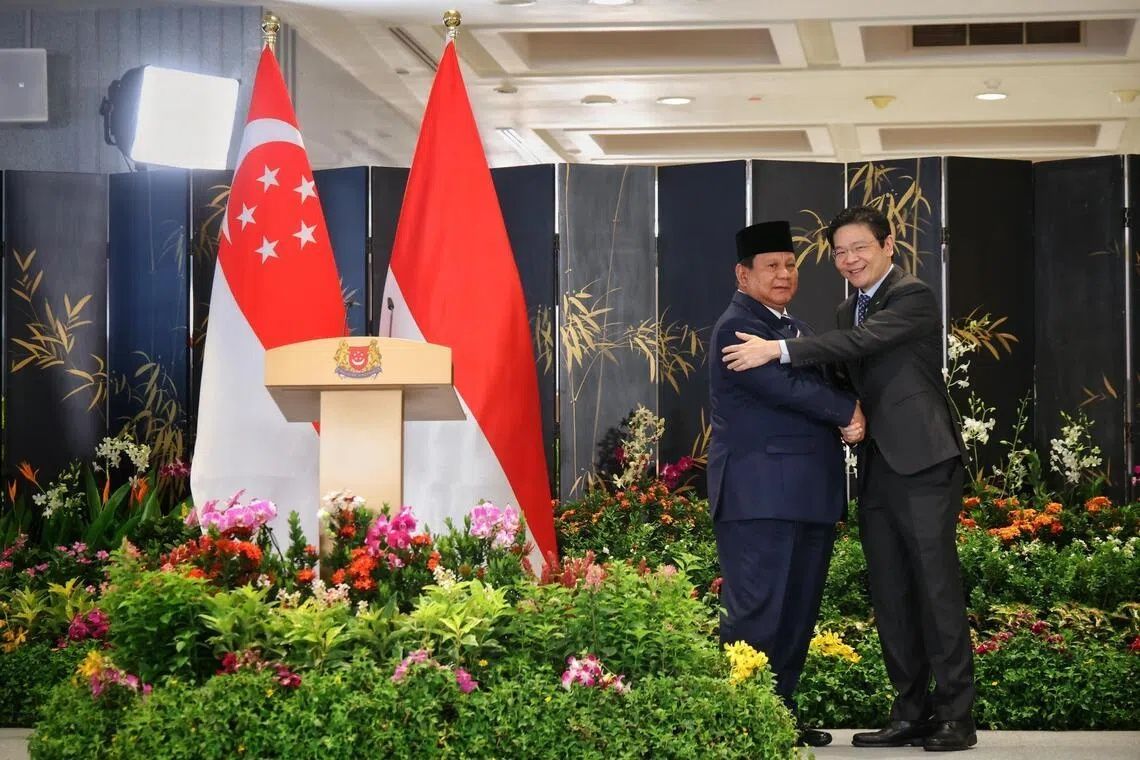
Prime Minister Lawrence Wong will journey to Jakarta on Monday, July 6, for what is set to be a landmark diplomatic engagement with Indonesian President Prabowo Subianto. The Singapore-Indonesia Leaders' Retreat, hosted by President Prabowo at an undisclosed venue, represents one of the most significant bilateral forums between the two neighbouring nations. This gathering will serve as an opportunity for the two leaders to reaffirm their nations' commitment to sustained cooperation across multiple domains, from traditional commerce and security arrangements to emerging technology and green energy sectors.
The annual retreat framework has become the cornerstone of Singapore-Indonesia relations, functioning as the highest-level bilateral platform through which the two countries coordinate policy and exchange strategic perspectives. The previous gathering took place in Singapore in June 2025, and before that, the two nations convened in April 2024 at the Bogor Presidential Palace when then-Prime Minister Lee Hsien Loong met with then-President Joko Widodo. The regularity of these summits underscores the institutional maturity of the relationship and the priority both governments place on sustained dialogue at the most senior levels.
What makes this retreat particularly significant is its timing and composition. Prime Minister Wong will bring a substantial delegation including Deputy Prime Minister and Minister for Trade and Industry Gan Kim Yong, Coordinating Minister for Public Services and Minister for Defence Chan Chun Sing, Foreign Minister Vivian Balakrishnan, and several other senior cabinet figures. This broad ministerial representation signals that the discussions will traverse a comprehensive range of policy areas rather than focusing narrowly on any single issue.
The agenda for Monday's discussions is expected to concentrate on strengthening bilateral cooperation in areas of mutual strategic and economic interest. The leaders will receive comprehensive updates on various bilateral projects that have progressed since their last meeting, allowing them to assess the implementation of previously agreed initiatives and identify any obstacles requiring high-level intervention. Such project reviews are crucial for ensuring that rhetorical commitments translate into concrete outcomes that benefit both populations.
Beyond bilateral matters, Prime Minister Wong and President Prabowo will exchange perspectives on broader regional and global developments, a practice that reflects the two countries' shared interests in maintaining regional stability and addressing transnational challenges. For Malaysian observers, this discussion format is noteworthy because developments in Singapore-Indonesia relations directly influence the broader Southeast Asian geopolitical landscape. Both nations' positions on regional security, economic integration, and responses to external powers can shift the calculus for other ASEAN members, including Malaysia.
The retreat takes place as Singapore and Indonesia have been deliberately expanding their cooperation framework beyond longstanding pillars such as trade, investment, and defence arrangements. The two countries are now actively collaborating in emerging sectors including the green economy, cross-border electricity trade, carbon capture and storage technology, artificial intelligence development, and digital connectivity infrastructure. This diversification reflects both nations' recognition that 21st-century bilateral relationships must encompass the challenges and opportunities presented by climate change, technological disruption, and energy transition.
The economic relationship between the two nations remains robust, with Singapore maintaining its position as Indonesia's top source of foreign direct investment. In 2025 alone, Singaporean investors committed US$17.4 billion to Indonesian projects, a figure that underscores the depth of commercial integration between the two economies. This substantial investment flow creates mutual incentives for political stability and dispute resolution, fundamentally anchoring the bilateral relationship in economic self-interest beyond diplomatic niceties.
The cross-border electricity trade dimension carries particular relevance for Southeast Asia's broader energy future. As the region grapples with decarbonisation pressures and seeks to optimize renewable energy generation across borders, the Singapore-Indonesia framework for electricity commerce could serve as a template for other bilateral energy arrangements within ASEAN. Similarly, their collaboration on carbon capture and storage technologies positions both nations as potential leaders in climate-related industrial innovation across the region.
During Prime Minister Wong's absence from Singapore, Coordinating Minister for National Security and Minister for Home Affairs K. Shanmugam will assume the role of acting prime minister, ensuring continuity in Singapore's governance. This succession arrangement reflects the institutional arrangements Singapore has developed to maintain administrative continuity during periods when senior leaders are engaged in overseas diplomatic missions.
For Malaysia and other ASEAN neighbours, the Singapore-Indonesia Leaders' Retreat carries implications extending well beyond bilateral Singapore-Indonesian affairs. The outcomes of discussions on regional matters, responses to global developments, and decisions regarding cross-border cooperation frameworks can influence the broader ASEAN policy environment. Furthermore, the model of regular high-level bilateral summits that Singapore and Indonesia have institutionalized serves as a reference point for how other ASEAN members might structure their own strategic partnerships.
The retreat also occurs within a context of evolving regional geopolitics, where Southeast Asian nations are increasingly balancing relationships with major powers while seeking to strengthen intra-regional cooperation. The Singapore-Indonesia dialogue provides an opportunity for two pivotal Southeast Asian players to align their approaches to regional challenges and opportunities, potentially setting expectations for broader ASEAN coordination on issues ranging from maritime security to economic integration.
As Singapore and Indonesia continue to deepen cooperation across traditional and emerging sectors, the precedent they establish in areas such as green economy collaboration and digital connectivity may influence how other Southeast Asian nations approach similar challenges. The detailed discussions expected during Monday's retreat could yield outcomes that ripple across the region, making this gathering of significance not merely to the two countries involved but to the broader Southeast Asian order.

