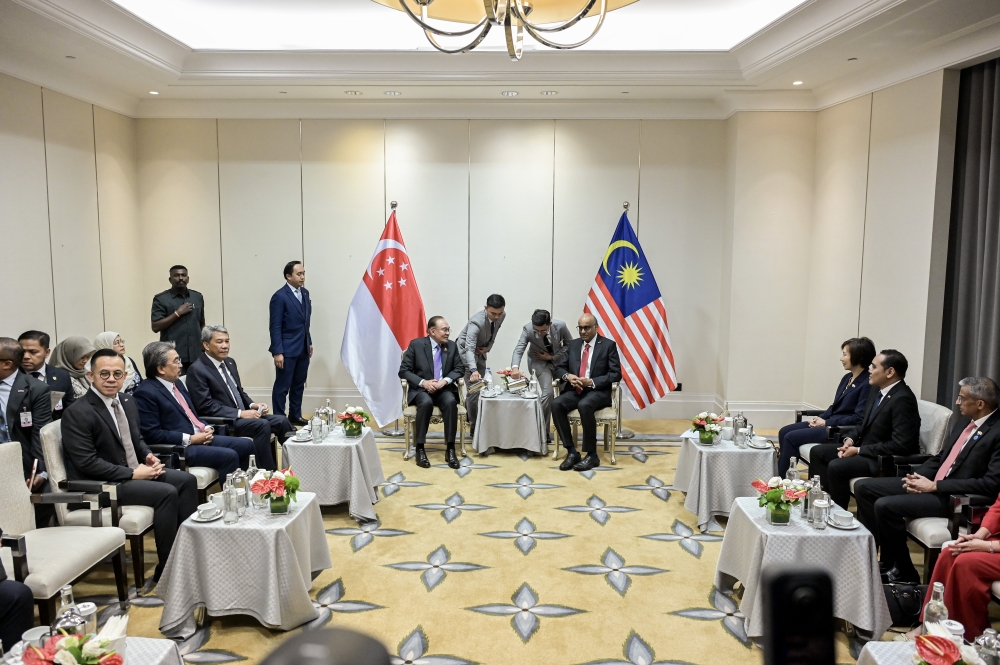
President Halimah Yacob of Singapore concluded a focused 40-minute meeting with Malaysia's Prime Minister Datuk Seri Anwar Ibrahim in Kuala Lumpur on Monday, underscoring the strategic importance both nations place on maintaining strong diplomatic channels. The courtesy call, held at the highest levels of government, reflects the ongoing commitment between Kuala Lumpur and Singapore to deepen their partnership despite periodic tensions that have characterised their bilateral relationship in recent years.
The engagement between the two leaders served as a platform for discussing matters of mutual concern affecting the broader Southeast Asian region. As two of the region's most developed economies and key players within ASEAN, Malaysia and Singapore wield considerable influence over regional stability, trade flows, and security arrangements. The meeting's timing during an official state visit signals the careful orchestration of diplomatic engagement that both governments employ to manage their complex relationship.
PM Anwar's reception of President Halimah underscores Malaysia's commitment to maintaining constructive relations with its closest neighbour, despite historical grievances and ongoing disputes over maritime boundaries and water agreements that periodically flare up in public discourse. The prime minister's willingness to engage at such a senior level demonstrates a pragmatic approach to managing bilateral tensions while focusing on areas of mutual benefit. Singapore, as Malaysia's primary trading partner and a crucial node in regional commerce, remains economically vital to Malaysian interests.
Bilateral trade between the two nations continues to represent one of the most robust economic relationships in Southeast Asia, with cross-border investments, financial services, and manufacturing sectors creating interdependencies that neither country can afford to ignore. The meeting likely touched on trade facilitation, investment protection, and the removal of non-tariff barriers that occasionally impede commerce between them. For Malaysian businesses, Singapore remains an essential market and a gateway to broader Asian and global networks.
Security cooperation has similarly become increasingly important as both nations navigate transnational challenges including cybersecurity threats, maritime piracy, human trafficking, and the rising geopolitical competition between major powers in the region. Joint exercises and intelligence sharing, though not always publicly celebrated, form a crucial backbone of regional stability. The meeting provided an opportunity to reaffirm commitment to these collaborative frameworks.
Singapore's state visit to Malaysia carries particular significance given the sophisticated diplomatic choreography required to manage the relationship. State visits represent the pinnacle of diplomatic engagement and typically occur at multi-year intervals, making them significant barometers of bilateral health. The fact that such a visit was facilitated reflects both nations' determination to prevent diplomatic drift despite periodic public spats that capture media attention.
For Malaysian readers, understanding the importance of this engagement provides context for why senior leaders invest time in these interactions even when domestic political pressures might suggest otherwise. Singapore's small but mighty economy and its strategic location at the convergence of major shipping lanes make it strategically indispensable. Moreover, Singaporean capital has fuelled Malaysian development across multiple sectors, from banking and finance to real estate and technology.
Regional observers note that such high-level meetings also serve to signal stability to investors and trading partners watching the ASEAN region. Market confidence in cross-border transactions depends partly on the perception of stable interstate relations. Positive diplomatic signals emanating from Kuala Lumpur and Singapore can have subtle but meaningful effects on business confidence and capital flows throughout Southeast Asia.
The meeting also occurs within the broader context of Malaysia's evolving regional diplomacy under PM Anwar's administration. The prime minister has sought to position Malaysia as a stabilising force within ASEAN while navigating complex relationships with regional and extra-regional powers. Strong engagement with Singapore aligns with this broader strategic framework, demonstrating that Malaysia remains committed to managing its most important bilateral relationship professionally.
Looking forward, the substantive discussions held during this meeting will likely produce follow-up mechanisms through established bilateral committees focused on trade, security, and other functional areas. These lower-level but crucial channels of engagement often prove more productive than headline-grabbing state visits, as they allow technical experts to resolve specific issues and prepare the groundwork for political decisions.
For Malaysia's broader Southeast Asian engagement, maintaining robust ties with Singapore sets a constructive tone for regional relationships. ASEAN's effectiveness depends significantly on whether its most developed and most influential members can work collaboratively on regional challenges. The Kuala Lumpur meeting, therefore, carries implications that extend well beyond the bilateral sphere and into Malaysia's role within the wider regional architecture that shapes Southeast Asian political and economic life.

